
EPR Registration Under PPWR: What Producers Need to Do, Country by Country
If you sell packaged products anywhere in the EU, PPWR changed the rules on how that packaging is designed and documented. But it left one thing untouched: EPR registration. You still have to register, report, and pay fees separately in every single country you sell into, and the requirements aren’t the same twice. This guide walks through who counts as a producer, what the Authorised Representative rule means for non-EU sellers, and what registration actually looks like in eight of the highest-volume EU markets.
Who counts as a producer under PPWR
Under PPWR, the producer is whoever first puts the packaging on the market in a given country. Usually that’s the brand owner. Sometimes it’s the manufacturer. If you sell online, it’s often just you, the seller, not your supplier and not your fulfilment partner.
It doesn’t matter where your business is based. If you’re a US brand shipping a parcel straight to a customer in Germany, Germany treats you as the producer. Your company’s home country doesn’t come into it.
There’s no exemption for small businesses. Some schemes cut you some slack on the admin side if you’re small, but that’s not guaranteed everywhere, so check the country, not the assumption.
Why EPR registration is still country by country under PPWR
PPWR is a regulation, so the design rules, substance limits, and Declaration of Conformity requirements are the same in all 27 member states. EPR registration wasn’t folded into that. Each country still runs its own producer registry, sets its own fees, and often has its own approved Producer Responsibility Organisations (PROs) working alongside the government registry. Sell into multiple countries, and you’re looking at multiple registrations, not one EU account.
PPWR Authorised Representative requirements for non-EU sellers

If you’re a non-EU producer selling directly to EU customers, you’ll generally need an EU-based Authorised Representative to handle EPR in any country where you don’t have your own entity. That requirement starts on PPWR’s application date, 12 August 2026, no matter how the debate below turns out.
And there is a debate still running, worth a quick check closer to your publish date. The European Commission had proposed pausing the AR requirement for EU-based producers until 2035. As of mid-July 2026, the Council of the EU decided not to go ahead with that broad pause. A large majority of member states opposed it. Separately, the European Parliament’s environment committee has drafted a narrower version that would limit any pause to micro and small enterprises only (under 50 employees, turnover under €10 million), ending either when the EU’s Circular Economy Act comes in or on 1 January 2035, whichever happens first. Neither version is law yet. Both are draft committee positions, with votes expected around October 2026.
The part that matters right now: if you’re a non-EU seller, this debate doesn’t change anything for you. Your AR obligation goes ahead on schedule regardless of what happens with the EU-producer carve-out.
What EPR registration involves: reporting, fees, and documentation
Once you know where to register, the process looks fairly similar across most schemes:
- Register with the national producer registry
- Report your packaging data per SKU: materials, weights, formats
- Pay EPR fees, which scale with how recyclable your packaging is. Mixed materials, dark or black plastics, and non-recyclable laminates cost more
- Keep your technical documentation on hand, since authorities can ask for it alongside your Declaration of Conformity
That last point connects back to the same technical file you’re already building for PPWR’s design and substance rules. It’s not a separate paperwork trail, it’s the same one. (If you haven’t mapped that documentation yet, our Declaration of Conformity guide and GPSR Labelling Requirements guide cover the overlapping pieces.)
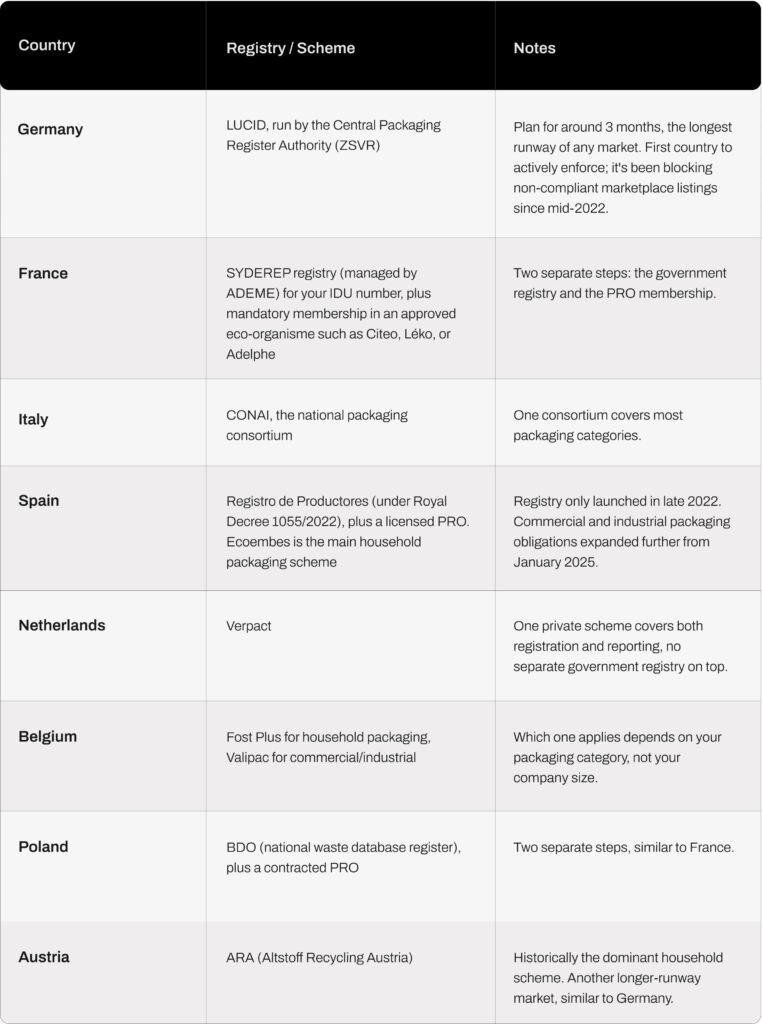
EPR registration requirements by country: Germany, France, Italy, Spain, and more
Timelines and structures vary. Here’s where eight of the higher-volume markets currently stand:
How marketplace fulfilment affects who’s the producer
Several marketplaces now ask sellers to show a valid registration number before a listing goes live, and that checking is getting stricter as PPWR rolls out. But “who’s the producer” doesn’t stay fixed once a marketplace gets involved.
If you ship direct to EU customers yourself, you’re generally the producer in that country. If you use a marketplace’s own EU-based fulfilment or warehousing programme, that can shift, since the entity that first makes the packaging available locally might end up being whoever holds the stock, not the seller of record. Schemes handle this differently, so it’s worth checking directly with each country’s registry rather than assuming one platform’s answer applies everywhere else.
Penalties for not registering: delisting and enforcement risk
The immediate risk is losing the right to place packaging on that market from 12 August 2026. Marketplace delisting is a real possibility too. Germany has already done this in practice, blocking listings without a valid LUCID number back in 2022 rather than just fining sellers after the fact.
Penalties beyond delisting vary a lot by country, and the fine figures circulating online aren’t consistent. Rather than quote a number that might not hold up, here’s the safer version: enforcement is real, it’s already happened in at least one major market, and it’s not a risk worth testing.
A few common questions
Is there a single EU-wide EPR registration? No. PPWR harmonised the design and documentation rules, not registration. You still register separately in each country where you place packaging on the market.
Does EPR registration apply to small or micro-enterprise sellers? Generally yes, there’s no blanket exemption, though several schemes offer lighter admin requirements or fee thresholds for smaller volumes. This varies enough by country that it’s worth checking directly rather than assuming your size puts you outside scope.
What if I only sell through a marketplace’s EU fulfilment programme? You may still have obligations. Who counts as the producer can shift depending on the programme, so don’t assume that using a marketplace’s warehousing removes your responsibility. Confirm it for each country and each platform you use.
Your EPR registration checklist
- List every member state you currently ship to
- Check whether you’re already registered in each one, or need to be
- Confirm who’s acting as “producer” for each market: you, your fulfilment provider, a marketplace programme, or your Authorised Representative
- Start building SKU-level packaging data (materials, weights, formats) so reporting isn’t a scramble later
That last point is where most producers get stuck, not because the reporting is hard, but because nobody’s pulled the packaging data together in one place yet. Euverify’s PPWR wizard turns your materials, weights, and formats into that SKU-level record once, then reuses it for your Declaration of Conformity and technical file, so you’re not rebuilding it every time a new country’s registry asks for it.
If you’re a non-EU seller, the Authorised Representative requirement is also one Euverify covers directly: appoint Euverify under Article 17 and it holds your documentation, responds to authorities within the statutory 10 days, and handles renewals, so registering in each new country doesn’t mean setting up a new AR each time too.