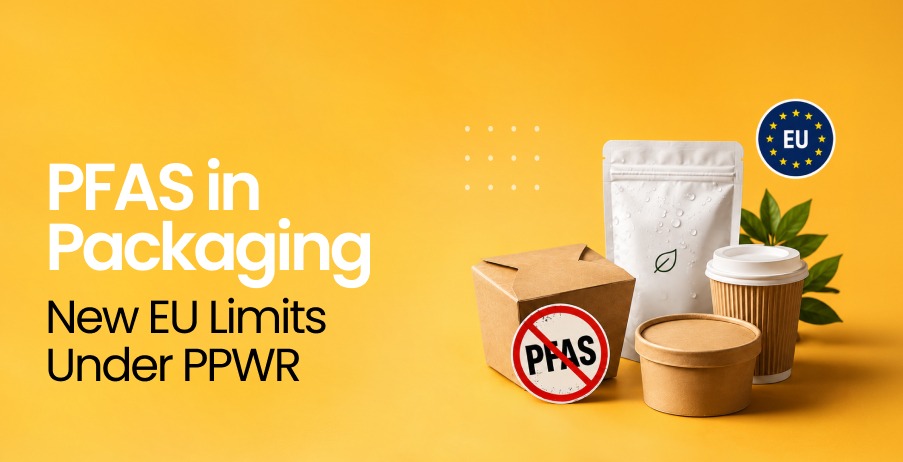

PFAS in Packaging: What’s Restricted Under PPWR
PFAS in packaging has moved from a niche chemical safety issue to a live compliance question for anyone selling food-contact packaging into the EU. From 12 August 2026, the PPWR sets hard limits on PFAS in food-contact packaging, and packaging that falls on the wrong side of that limit simply can’t be placed on the EU market.
This isn’t a fringe concern. PFAS in packaging shows up in ordinary, everyday formats, grease-resistant wrappers, takeaway containers, popcorn bags, and coated cartons, often without anyone downstream realising it’s there. If your packaging touches food and hasn’t been checked against the new limits yet, here’s what you need to know.
What Is Food-Contact Packaging Under PPWR?
The rule applies specifically to packaging intended to touch food, or packaging already in contact with food for that purpose. Think wrappers, liners, cartons, and any coating that sits between the packaging material and the product inside.
This is narrower than most of the PPWR’s other substance rules. It’s a food-contact test, not a blanket rule covering every type of packaging on the market.
In practice, PFAS in packaging shows up most often in grease-resistant and water-resistant coatings: fast-food wrappers, microwave popcorn bags, take-out paperboard containers, pizza boxes, candy wrappers, and pet food bags are the categories most commonly affected. If your packaging is designed to resist oil, grease, or moisture, it’s worth checking specifically.
PFAS in Packaging: The PPWR Thresholds Explained

Article 5(5) of the PPWR sets three specific limits:
• 25 µg/kg for any single PFAS substance
• 250 µg/kg for the combined total of targeted PFAS substances
• 50 mg/kg for total PFAS, including polymeric PFAS
These numbers matter more than the general idea of a “PFAS restriction.” If a supplier says their packaging is PFAS-free, ask which test method and threshold that claim is based on. The regulation is specific, so the evidence needs to be too.
To put it in context: a snack wrapper with a thin grease-resistant coating could exceed the 25 µg/kg single-substance limit even if the coating looks and performs exactly like ones used for years. It’s the measured concentration that counts, not how familiar or established the material seems.
Does Unintentional PFAS in Packaging Still Count?
One detail catches a lot of businesses off guard. The limit applies whether or not PFAS was deliberately added to the packaging.
That matters most for recycled materials and multi-layer packaging. PFAS can carry over from source materials without anyone in the current supply chain having added it on purpose. Intent doesn’t move the threshold.
PFAS vs. Heavy Metals: What’s Different Under PPWR
PPWR keeps a limit that isn’t new: a combined cap of 100 mg/kg for lead, cadmium, mercury, and hexavalent chromium in packaging or packaging components. That figure carries over from the old Packaging Directive, so most established suppliers already test for it.
PFAS is the newer, harder part. Testing methodology at EU level is still catching up, which is exactly why documentation matters more here than it does for the heavy metals limit.
How to Test for PFAS in Packaging Under PPWR
There’s no single EU-mandated PFAS test method yet. A harmonised protocol is still in development, but recent European Commission guidance has outlined a tiered approach that most labs are already following:
1. Total fluorine (TF) screening first. If the result comes back below 50 mg/kg, the packaging is generally treated as compliant, and no further testing is required.
2. If TF exceeds 50 mg/kg, the next step separates organic fluorine (TOF) from inorganic fluorine (TIF). Packaging with TOF below 50 mg/kg is still considered compliant.
3. Only if TOF exceeds 50 mg/kg does targeted analysis for specific PFAS substances, such as PFOA, PFOS, and PFHxS, become necessary, checked against the 25 µg/kg and 250 µg/kg thresholds.
Labs commonly reference CEN/TS 15968 for targeted PFAS analysis, though standard references vary between providers and a fully harmonised PPWR-specific method isn’t in place yet. That gap matters in practice: identical samples can produce different results across different labs.
Two things worth insisting on from any supplier or testing partner:
• A Certificate of Analysis, not a verbal or written assurance alone
• A stated limit of quantification (LOQ) below the 25 µg/kg threshold, since a test that can’t detect down to that level doesn’t actually confirm compliance
Both the certificate and the underlying data should sit inside your technical documentation and Declaration of Conformity, ready to produce if a market surveillance authority asks. Waiting for a finalised test protocol before starting this work isn’t a safe strategy. The deadline doesn’t move just because the methodology is still developing.
Retention matters too. Technical files need to be kept for at least 5 years for single-use packaging and 10 years for reusable packaging, so this isn’t paperwork you file once and forget.
Is PFAS in Packaging Regulated Outside the EU?

The EU isn’t acting alone. In the US, the FDA announced in February 2024 that grease-proofing substances containing PFAS were no longer being sold for food-contact packaging, following voluntary phase-outs by manufacturers. Separately, more than a dozen US states, including California, Washington, and New York, have already passed their own laws restricting PFAS in food packaging.
The PPWR’s PFAS limit also sits alongside a much broader move within the EU itself. The European Chemicals Agency has proposed an EU-wide restriction on PFAS under REACH that would reach far beyond packaging. The PPWR’s food-contact limit lines up with that direction of travel, but takes effect well before the wider REACH restriction is likely to.
In practice, PFAS in packaging is one of the first places these restrictions are landing, not the only place. Businesses that treat this as a one-off packaging fix may find themselves revisiting the same question again as broader restrictions, in the EU and elsewhere, continue to move forward.
What Happens If You Miss the PPWR PFAS Deadline?
PPWR leaves the exact penalties to individual EU member states, but Article 68 requires each one to set fines and enforcement measures that are effective, proportionate, and dissuasive.
In practice, that has meant administrative fines, market surveillance action, and in some cases removal of non-compliant products from sale, including delisting from online marketplaces. The packaging itself is what gets assessed, not the brand’s intentions behind it, so having documentation ready before enforcement starts is the only real protection.
PFAS in Packaging Compliance: What to Do Now
• Map which SKUs use food-contact packaging
• Request PFAS declarations or test reports from material suppliers, and insist on a Certificate of Analysis rather than a verbal assurance
• Flag anything with a grease-resistant coating, moisture barrier, or laminate layer for closer checking
• File the results into your technical documentation before 12 August 2026
None of this requires a full packaging redesign. It requires knowing what’s in your supply chain, and having the paperwork to prove it.
PFAS in Packaging: Key Takeaways
PFAS in packaging isn’t a single compliance task to tick off and forget. It sits inside a wider shift, EU rules landing alongside US federal and state action, and a broader REACH restriction still working its way through the EU legislative process. The August 2026 deadline is the first checkpoint, not the only one.
For most businesses, the real work isn’t technical. It’s evidentiary. Knowing your supply chain, getting the right test data from the right suppliers, and having it filed somewhere a market surveillance authority can actually find it.
Euverify generates your Declaration of Conformity, technical documentation, and readiness report for PPWR, included with your plan, no expertise needed. Learn more: https://euverify.com/ppwr/