
Declaration of Conformity vs Certificate of Conformity: What Is the Difference and Which Do You Need?
If you sell products in the EU, you’ve probably run into both terms. A supplier sends you a Certificate of Conformity. A marketplace asks for your Declaration of Conformity. A customs agent says your paperwork is incomplete. And at some point you start wondering if these are just two names for the same thing, two totally separate documents, or if one makes the other unnecessary.
They’re not the same thing. They come from different parties, do different jobs, and in a lot of cases you need both. Mixing them up is one of the most common paperwork mistakes we see with EU market surveillance checks, and it’s also one of the easiest to avoid once you understand what each one actually is.
This post covers what each document is, when you need it, how they fit together, and what happens if you get it wrong.
What Is the EU Declaration of Conformity?
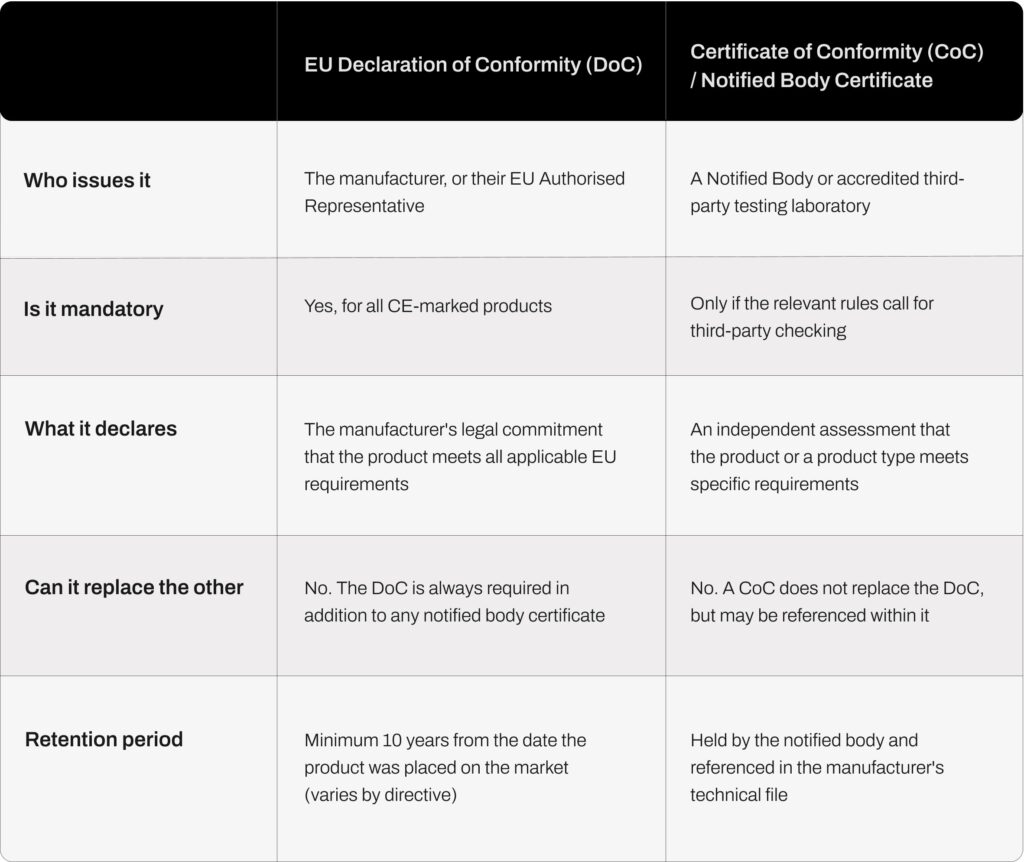
The EU Declaration of Conformity, or DoC, is a document the manufacturer writes and signs themselves, under their own responsibility. It’s the manufacturer saying, in writing, that their product meets every EU rule that applies to it.
Every CE-marked product needs a DoC. No exceptions. It doesn’t matter what the product is or whether anyone else was involved in testing it — if it has a CE mark, a DoC has to exist before that mark goes on the product.
A few things the DoC is not: it’s not written by a test lab, it’s not written by a Notified Body, and it’s not a quality certificate. It’s the manufacturer vouching for their own product, based on the evidence sitting in their technical file. If that product later turns out not to comply, the manufacturer is on the hook — the DoC is their legal commitment.
If the manufacturer is based outside the EU, their EU Authorised Representative can draw up and hold the DoC on their behalf, but only if the representative’s mandate specifically allows for this. The manufacturer is still ultimately responsible either way.
The DoC needs to be kept for at least 10 years after the product was placed on the market, and it has to be handed over if a market surveillance authority asks for it. Some product rules require it be kept even longer.
What Is a Certificate of Conformity?
A Certificate of Conformity, sometimes called a CoC or a Notified Body certificate, is issued by someone independent — a Notified Body designated by an EU country, or an accredited test lab. It says a product (or a type of product) was checked against certain requirements and passed.
Unlike the DoC, not every product needs one of these. It only comes into the picture when the rules for that particular product say a third party has to check it. Whether that’s needed depends on how risky the product is and which conformity assessment route applies to it.
Under the EU’s framework, there are several assessment routes, usually labelled Module A through Module H. Module A is for lower-risk products and lets the manufacturer self-check without bringing in anyone else. The higher modules — things like Module B (EU-type examination), Module G (unit verification), or Module H (full quality assurance) — require a Notified Body, and that’s when a certificate gets issued.
That certificate then gets referenced in the manufacturer’s technical file and named on the DoC. It doesn’t take the place of the DoC. You still need both.
Declaration of Conformity vs Certificate of Conformity: Key Differences
The table below sets out the main distinctions between the two documents.
When Do You Need Both Documents?
For lower-risk products assessed under Module A, the manufacturer self-declares using internal testing and technical documentation. No Notified Body is involved, and no certificate is issued. The DoC is drawn up by the manufacturer and that is sufficient.
For higher-risk products where a Notified Body is required, the process works in sequence:
• The manufacturer submits the product or product type to a Notified Body for assessment
• The Notified Body carries out the required testing or quality system evaluation and issues a certificate if the product passes
• The manufacturer references that certificate in their technical file and draws up the DoC, listing the Notified Body’s name, identification number, and certificate reference
• The CE mark is affixed with the Notified Body’s four-digit ID number alongside it
In this scenario, you need both. The Notified Body certificate is the evidence of third-party assessment. The DoC is the manufacturer’s legal declaration based on that evidence. One does not substitute for the other, and neither alone is sufficient.
Which EU Directives Require a Notified Body and Which Allow Self-Declaration?
It depends on the specific rule and how risky your product is under it. Some rules let every product in scope self-declare. Others only need a Notified Body for the riskier categories. And a few require third-party checks across the board.
Products where self-declaration is usually enough:
Low-voltage electrical equipment under the Low Voltage Directive, for most products. Products covered by the Electromagnetic Compatibility Directive.
Products where a Notified Body is usually needed:
Medical devices under the MDR, for Class IIa, IIb and III devices. Personal protective equipment under the PPE Regulation, for Category II and III gear. Higher-risk pressure equipment under the Pressure Equipment Directive. Radio equipment under the RED, in cases where the manufacturer hasn’t applied the relevant harmonised standards.
Machinery is a bit different. Even for the higher-risk machinery listed in Annex IV of the Machinery Directive, a manufacturer can still self-certify if they’ve fully applied the relevant harmonised standards. A Notified Body only comes into play if those standards weren’t applied, or don’t cover everything the machine needs.
It’s also common for one product to fall under more than one set of rules at once, needing a Notified Body under one and self-declaring under another. When that happens, everything gets rolled into a single DoC that lists all the applicable legislation.
What Happens If You Confuse the Two Documents?

The consequences depend on the mistake.
Handing over a Certificate of Conformity when someone asked for a DoC is the most common slip-up. A test report isn’t a Declaration of Conformity, and authorities, customs, or marketplaces won’t accept one in place of the other. The DoC has to exist as its own signed document.
Writing a DoC without getting the required Notified Body certificate first is a bigger problem. If the rules say your product needs third-party checking and you skipped it, your DoC doesn’t have a real legal basis. The product shouldn’t be carrying a CE mark, and if it is, that’s non-compliance — which can lead to the product being pulled from the market.
Using a certificate from a lab that isn’t actually a designated Notified Body for that specific rule is another issue that trips people up. Plenty of labs issue their own certificates that carry no weight for CE marking. If the rule requires a Notified Body, check that the lab is actually listed as one for that exact product category — the NANDO database is where you’d confirm this.
Getting the signature wrong matters too. Whoever signs the DoC needs the authority to legally commit the manufacturer. A signature from someone without that authority, or from a representative whose mandate doesn’t cover it, can make the whole document invalid.
A Note on the UK: UKCA Marking and UK Declaration of Conformity
Since Brexit, Great Britain has its own system running alongside the EU one, using UKCA marking instead of CE. A UK Declaration of Conformity is needed for products carrying the UKCA mark, and UK Approved Bodies do the same job as EU Notified Bodies where third-party checking is required.
That said, the UK government has repeatedly pushed back the deadline for switching over, and CE marking is still widely accepted for most products sold in Great Britain for the time being. It’s worth checking the current UK government guidance for your specific product, since this has changed more than once and could change again.
Northern Ireland works differently again. It generally continues to accept CE marking for most products under the arrangements agreed for the region, so it’s worth confirming which marking applies if you’re selling there specifically.
Common Mistakes to Avoid
• Submitting a test report or lab certificate when a DoC is requested — these are not interchangeable
• Self-declaring under Module A for a product that falls into a risk category requiring Notified Body involvement under the applicable directive
• Using a certificate from an accredited laboratory rather than a designated Notified Body for directives that specifically require the latter
• Failing to list all applicable directives on a single consolidated DoC where a product is subject to multiple regulations
• Not updating the DoC when the product design changes, applicable standards are revised, or contact details for the manufacturer or AR change
• Omitting the Notified Body’s four-digit identification number from the CE marking where their involvement was required
• Holding a DoC signed by someone without authority to bind the manufacturer
How Euverify Can Help
For non-EU manufacturers, the EU Declaration of Conformity can be drawn up and held by an EU Authorised Representative acting under a valid mandate. Euverify provides EU Authorised Representative services for non-EU brands, including support with Declaration of Conformity documentation.
If you are unsure whether your product requires a Notified Body, which directives apply, or whether your existing documentation is sufficient for EU market surveillance, get in touch with the Euverify team.