GPSR Labelling Requirements: Complete Guide to EU Product Safety Labels
If you sell consumer products in the European Union, there is a good chance you have heard about the General Product Safety Regulation — Regulation (EU) 2023/988, commonly known as the GPSR. It has been fully applicable since 13 December 2024, replacing the old General Product Safety Directive (2001/95/EC).
One of the biggest areas of confusion? Labelling.
The GPSR introduces strict labelling requirements that apply to manufacturers, importers, and anyone placing products on the EU market. Get it wrong, and your products could be pulled from sale, your marketplace listings suspended, or worse — you could face enforcement action from market surveillance authorities.
This guide breaks down everything you need to know about GPSR labelling requirements: what information is required, where it must appear, how digital labels work, and exactly how to get compliant.
Key Takeaways:
- The GPSR (Regulation (EU) 2023/988) has been fully applicable since 13 December 2024. All consumer products sold in the EU must comply.
- Every product must display: the manufacturer’s name, postal address, and electronic address; a product identifier (type, batch, or serial number); and the name and contact details of an EU-based responsible person.
- Label placement follows a hierarchy: on the product itself first; if not possible, on the packaging; if that is not possible, in an accompanying document.
- Digital labels (QR codes, URLs) can supplement physical labels under Article 21 — but they cannot replace the mandatory physical information.
- Importers must also add their own name and contact details on the product or packaging, in addition to the manufacturer’s information.
- Non-compliance can result in product removals, marketplace suspensions, and enforcement actions by EU market surveillance authorities.
Who Needs to Comply with GPSR Labelling Requirements?
The short answer: almost every business that places or makes available consumer products on the EU market.
Under the GPSR, labelling obligations fall on specific economic operators depending on their role in the supply chain. Here is how it breaks down:
Manufacturers (Article 9): You bear the primary responsibility. You must ensure your product carries all required identification and traceability information before placing it on the market.
Importers (Article 11): If you import products from outside the EU, you must verify the manufacturer has met their labelling obligations. You must also add your own name and contact details to the product or its packaging.
Distributors (Article 12): Before making a product available, you must verify that the manufacturer (and importer, where applicable) have met the labelling requirements under Articles 9(5), (6), and (7).
Authorised Representatives (Article 10): If a non-EU manufacturer appoints you to act on their behalf, you carry out the tasks specified in the written mandate, including cooperating with market surveillance authorities on labelling compliance.
Any person who places a product under their own name or trademark (Article 13): If you white-label, private-label, or rebrand a product and place it on the EU market under your name, you are deemed the manufacturer and all manufacturer labelling obligations apply to you.
The GPSR also applies to products sold on online marketplaces — meaning Amazon, Etsy, and Shopify sellers exporting to EU customers are all in scope.
What Information Must Appear on GPSR-Compliant Labels?
The GPSR specifies three distinct categories of mandatory label information. Let us walk through each one.
1. Product Identification (Article 9(5))
Every product must bear a type, batch, or serial number — or another element that enables identification. The regulation states this identifier must be “easily visible and legible for consumers.”
What this looks like in practice:
- A model number printed on the product body (e.g., “Model: XR-500”)
- A batch code on the packaging (e.g., “Batch: 2024-0812”)
- A serial number on a label affixed to the product (e.g., “S/N: EU2024001543”)
- A barcode or EAN/UPC number that links to a traceable product record
If the size or nature of the product does not allow this information to be placed directly on the product, it may be provided on the packaging or in an accompanying document.
2. Manufacturer Information (Article 9(6))
The manufacturer must indicate the following on the product:
How to provide this information:
- Their name (or registered trade name or registered trademark)
- Their postal address
- Their electronic address (email)- This can be used for Customer Care for the customers. So it can be an email address/a specific page of the customer care information on their website.
- If different from the above, the postal or electronic address of their single contact point
This is not optional. The regulation requires a full postal address — not just a country name, and not just a website URL. An email address is also explicitly required under the GPSR, which is a change from the older directive.
Where does this go? On the product itself. If that is not possible due to size or nature of the product, then on the packaging. If that is also not possible, then in a document accompanying the product.
3. EU Responsible Person Information (Article 16(3))
This is one of the most significant requirements introduced by the GPSR. Every product placed on the EU market must have an economic operator established in the EU who is responsible for it.
The responsible person’s details must include:
- Their name (or registered trade name or registered trademark)
- Their contact details, including postal address and electronic address
This information must be indicated on the product, its packaging, the parcel, or an accompanying document.
Who qualifies as the responsible person? Under Article 16(1), it can be:
- An EU-based manufacturer
- An EU-based importer
- An authorised representative established in the EU
- A fulfilment service provider established in the EU (as a last resort)
If your business is based outside the EU, you need to appoint an EU Authorised Representative who will serve as your responsible person. Their name and contact details will appear on your product labels.
This is where a service like Euverify can help. As an EU and UK Authorised Representative service, Euverify provides you with official EU (Ireland) and UK (England) addresses within 24 hours — ready to use on your product labels, packaging, and marketplace listings.
GPSR Label Placement: Product vs. Packaging vs. Accompanying Document
One of the most common questions about GPSR labelling is: where exactly does the information need to go?
The regulation establishes a clear hierarchy:
Priority 1: On the Product Itself
The default requirement is that all mandatory information — product identifier, manufacturer details, and responsible person details — should be placed directly on the product. This is the gold standard.
Priority 2: On the Packaging
If the size or nature of the product makes it impossible to place the required information on the product itself (for example, a very small item like a piece of jewellery, or a product without a flat surface), the information may instead appear on the packaging.
Priority 3: In an Accompanying Document
If neither the product nor the packaging can carry the required information, it may be provided in a document accompanying the product — such as a user manual, instruction sheet, or product insert.
Special Rule for the EU Responsible Person
Article 16(3) provides slightly broader flexibility for responsible person information. It may appear on:
- The product itself
- The packaging
- The parcel (the shipping box or outer packaging)
- An accompanying document
This “parcel” option is notable because it means e-commerce sellers can, in certain cases, include the responsible person’s details on the shipping label or outer packaging rather than on the product or retail packaging.
Practical Example: A Scented Candle Sold on Amazon EU

Here is how labelling might work in practice for a private-label scented candle:
On the product (bottom of candle jar): Manufacturer name, postal address, email address, plus a batch code (e.g., “Batch: SC-2024-1205”).
On the retail packaging (outer box): Manufacturer details repeated, plus the EU Responsible Person’s name, address, and email (e.g., “EU Responsible Person: Euverify Limited, Unit 3D North Point House, North Point Business Park, New Mallow Road, Cork, Ireland, compliance@euverify.com”).
Inside the box (product insert): Safety information, usage instructions, and warnings in the language(s) of the target market.
Learn more here: GPSR Labels: What Must Appear on Packaging or Product
What Does a GPSR-Compliant Label Look Like?
Below is a visual description of what a compliant product label should contain:
GPSR-Compliant Label Example:

The label must be:
- Legible: Printed in a font size that consumers can easily read
- Visible: Not hidden under flaps, seals, or secondary layers
- Durable: Must remain intact and readable throughout the product’s expected lifespan
- In the correct language: Safety information must be in a language determined by the Member State where the product is made available
GPSR Digital Product Labels: What Article 21 Allows (and What It Does Not)
Article 21 of the GPSR opens the door to digital labelling — but with important limitations.
What Article 21 Says
Economic operators may “additionally” make required information available in digital format by means of electronic technical solutions clearly visible on the product or its packaging. This could include:
- QR codes linking to a product information page
- NFC tags embedded in the product
- URLs printed on the packaging
- Data matrix codes linking to digital product passports

The Critical Word: “Additionally”
Article 21 explicitly states that this is in addition to, and not instead of, the physical labelling requirements under Articles 9(5), 9(6), 9(7), 11(3), and 16(3).
This means you cannot replace physical label information with a QR code. The mandatory manufacturer name, address, email, product identifier, and responsible person details must still appear physically on the product, its packaging, or an accompanying document.
What Digital Labels Are Good For
Digital labels are ideal for supplementary information, such as:
- Detailed safety instructions and usage guides
- Multi-language support (a QR code can link to a page with instructions in 24 EU languages)
- Technical documentation and test reports
- Product recall notifications and safety updates
- Traceability data and supply chain information
Best Practices for Digital Labels
If you use QR codes or other digital solutions:
- Ensure the digital resource is available in the language(s) of the target market
- Make digital content accessible for persons with disabilities (as required by Article 21)
- Keep the linked digital content updated and maintained for the product’s lifespan
- Do not use digital labels as a shortcut to avoid physical labelling — enforcement authorities will check
Special Labelling Scenarios Under the GPSR
Products Covered by EU Harmonisation Legislation
If your product already falls under specific EU harmonised legislation (such as the Toy Safety Directive, Low Voltage Directive, or Radio Equipment Directive), those rules take priority for labelling. However, the GPSR’s responsible person requirement under Article 16 may still apply if the harmonised legislation does not have an equivalent provision.
Second-Hand and Reconditioned Products
The GPSR applies to second-hand products that re-enter the supply chain through commercial activity (Article 3, Recital 16). However, products explicitly presented as needing repair, or sold as historical collectibles, are exempt.
Products Sold via Online Marketplaces
Article 22 places specific obligations on online marketplace providers. For sellers, the practical impact is that marketplaces like Amazon, eBay, and Etsy are increasingly requiring GPSR-compliant product information — including responsible person details — in product listings. If your listing lacks this information, it may be suspended.
Products Too Small for Full Labels
For very small products (such as earrings, small electronic components, or cosmetic samples), the regulation permits placing information on the packaging or accompanying document. The key principle is that the information must be available to the consumer — even if it cannot all fit on the product itself.
Step-by-Step: How to Make Your Product Labels GPSR-Compliant
Here is a practical action plan:
Step 1 — Audit Your Current Labels: Review every product in your catalogue. Check whether each label currently includes: manufacturer name, postal address, email address, product identifier, and EU responsible person details.
Step 2 — Appoint an EU Responsible Person (if needed): If your business is not established in the EU, you must appoint one. Euverify provides EU Authorised Representative services with an official Irish address, available within 24 hours. You can also appoint a UK Authorised Representative through Euverify if you sell into both markets.
Step 3 — Update Your Label Artwork: Work with your packaging designer to add or update the required information. Follow the placement hierarchy: product first, then packaging, then accompanying document.
Step 4 — Update Online Listings: Add your EU responsible person details to all marketplace listings (Amazon, Etsy, eBay, Shopify storefronts). Include the responsible person’s name, address, and email in the product description or designated compliance fields.
Step 5 — Prepare Your Technical Documentation: Under Article 9(2), manufacturers must prepare technical documentation, including an internal risk analysis. Keep this on file for 10 years — market surveillance authorities can request it at any time. Euverify’s platform includes secure document storage for the full regulatory retention period of 10 to 15 years.
Step 6 — Verify and Test: Before shipping updated products, verify all labels are legible, durable, and in the correct language for each target market. If you use QR codes, test them to confirm they resolve to the correct product page.
Common Mistakes to Avoid with GPSR Labels
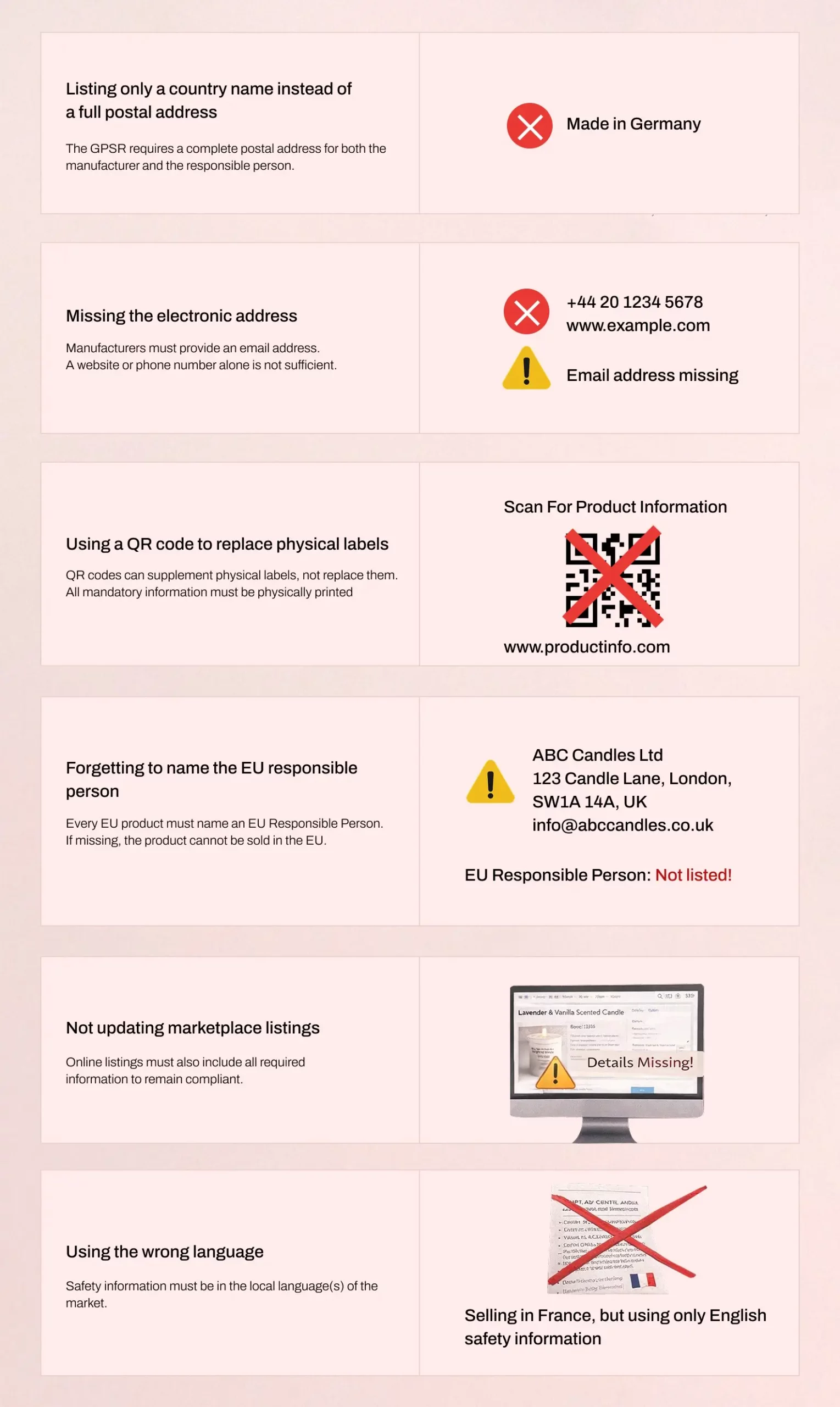
Here are the most frequent labelling errors businesses make:
Listing only a country name instead of a full postal address. The GPSR requires a complete postal address for both the manufacturer and the responsible person. “Made in Germany” alone is not enough.
Missing the electronic address. Unlike older legislation, the GPSR explicitly requires an email address for the manufacturer. A phone number or website alone does not satisfy this requirement.
Using a QR code to replace physical labels. As explained above, digital labels under Article 21 are supplementary only. The mandatory information must still appear in physical form.
Forgetting to name the EU responsible person. This is a new requirement many businesses overlook. If there is no EU-based responsible person identified on the product or packaging, the product cannot legally be placed on the EU market.
Not updating marketplace listings. Even if your physical label is perfect, an incomplete online listing can trigger marketplace enforcement or regulatory action.
Using the wrong language. Safety information and instructions must be in the language(s) determined by the Member State where the product is sold. Selling in France? The information must be in French.
Beyond GPSR: Other Compliance Obligations You Should Know About
If you are already dealing with GPSR labelling, it is worth noting that you may have additional compliance obligations depending on your product type and business structure:
CE/UKCA Marking: Products like electronics, toys, and machinery may require CE marking for the EU and UKCA marking for the UK, along with a Declaration of Conformity. Euverify provides full CE/UKCA compliance services including declarations and authorised representative support.
Cosmetics Compliance: If you sell cosmetics in the EU, you need a Responsible Person, a Product Information File (PIF), and CPNP notification. Euverify offers dedicated cosmetics compliance support.
Medical Devices: EU and UK Authorised Representative services for medical device manufacturers, including EUDAMED readiness and MDR documentation support, are also available through Euverify.
GDPR Article 27 Representation: If your business is based outside the EU or UK and processes personal data of EU/UK individuals (which includes collecting customer data through e-commerce), you may need to appoint a GDPR Article 27 Representative. Euverify provides this service with legal presence in both Ireland and England, covering both EU GDPR and UK GDPR — complete with a DSAR management portal and compliance badges for your website.
Get GPSR-Compliant Labels — Without the Complexity GPSR labelling can feel overwhelming, especially if you are managing multiple products across several EU markets. But it does not have to be. Euverify simplifies the entire process. As a dedicated compliance platform for EU and UK regulatory requirements, Euverify helps you:Visit www.euverify.com to get started — plans start from GBP 490/year, and there is a 14-day free trial to explore the platform. |
Frequently Asked Questions
Under Regulation (EU) 2023/988, every consumer product placed on the EU market must display: the manufacturer’s name, postal address, and email address; a product type, batch, or serial number for identification; and the name and contact details of an EU-based responsible person. This information must appear on the product itself, or if not possible, on the packaging or an accompanying document.
The default requirement is on the product itself. If that is not possible due to the product’s size or nature, the information can go on the packaging. As a last resort, it can appear in an accompanying document. For the EU responsible person, the information can also appear on the parcel or outer shipping packaging.
No. Article 21 of the GPSR allows digital labels (like QR codes) only as a supplement to physical labels. The mandatory manufacturer and responsible person information must still appear in physical form on the product, packaging, or accompanying document.
Non-compliant products can be removed from the EU market by market surveillance authorities. Online marketplace listings may be suspended. In serious cases, economic operators can face enforcement actions and penalties under national implementation of the regulation.
Yes. If you sell to EU consumers through any channel — including Amazon, Etsy, eBay, or your own Shopify store — your products must meet GPSR labelling requirements. Most major marketplaces are now actively enforcing this.
Article 16 of the GPSR requires that every product placed on the EU market has an economic operator established in the EU who is responsible for it. This can be the manufacturer (if EU-based), the importer, an authorised representative, or a fulfilment service provider. Their name and contact details must appear on the product, packaging, parcel, or accompanying document.
The labelling obligations in Articles 9 to 13 of the GPSR generally do not apply to products covered by EU harmonisation legislation (CE marking directives). However, the responsible person requirement in Article 16 and the marketplace obligations in Article 22 may still apply. Check whether your specific harmonised legislation has equivalent provisions.
The GPSR was published on 23 May 2023 and became fully applicable on 13 December 2024. All products placed on the EU market from that date must comply.