
EU Microplastics Regulation: Compliance Deadlines, ECHA Reporting Obligations, and What Your Business Needs to Do
The EU restriction on intentionally added microplastics has been building for years. In 2026, it moved from regulation on paper to active enforcement. The first mandatory reporting window under ECHA closed on 31 May 2026, and sector-specific compliance deadlines are now running.
For manufacturers, importers, and brands selling into the EU market, the question is no longer whether this regulation applies but where your products sit in the timeline and what you are required to do. This guide sets out the definition, the reporting obligations that are already live, the sector deadlines, what the labelling requirements mean in practice, and what non-compliance risks look like.
What Counts as a Microplastic Under REACH Regulation (EU) 2023/2055?
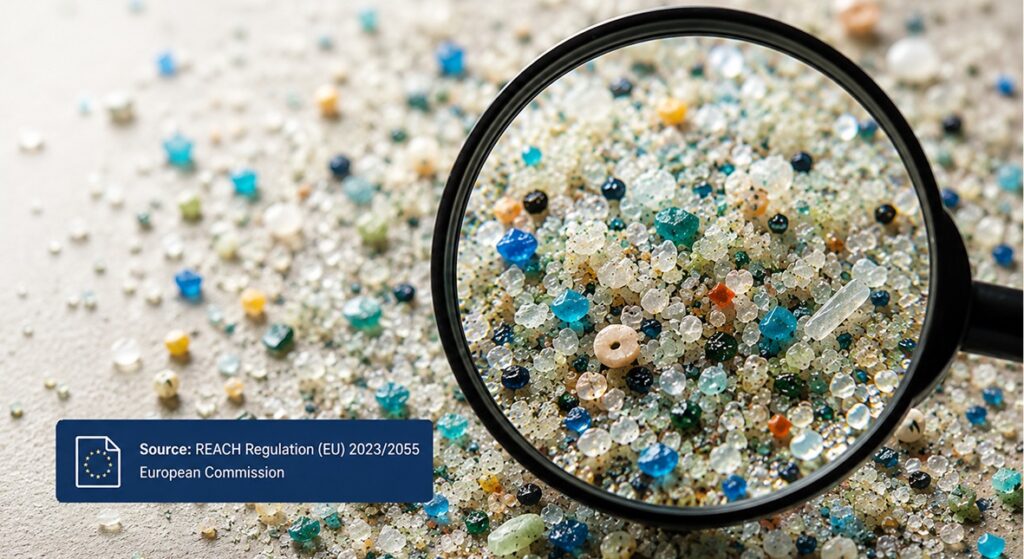
The restriction targets synthetic polymer microparticles that are intentionally added to substances or mixtures. To fall within scope, particles must be equal to or less than 5mm in any dimension and must not break down or dissolve naturally in the environment within a defined timeframe.
A few common points of confusion are worth addressing directly.
Natural polymers are excluded. Substances derived from natural sources, such as cellulose or starch, do not meet the definition even if they are in particle form. The restriction is specifically aimed at synthetic materials.
Biodegradable polymers may also be excluded, provided they meet the biodegradation criteria set out in the regulation. However, meeting that threshold requires supporting data, not just a general claim of biodegradability. The regulation sets out detailed test methods and pass criteria in Appendix 15. Businesses relying on a biodegradability exemption should ensure the technical basis for that position is documented against those specific criteria.
Certain use-based exclusions also take microparticles outside scope. Three categories are relevant under the regulation. First, microparticles permanently incorporated into a solid matrix during end use — for example, a polymer embedded in a rigid component that does not shed particles during normal use. Second, microparticles whose physical properties are permanently modified during end use such that they no longer exist as discrete particles — film-forming polymers in nail polishes or paints fall here, as they form a continuous film rather than remaining as particles. Third, microparticles contained by technical means that prevent environmental release during use, such as those inside chromatography columns or filter cartridges. In all three cases, the exclusion is conditional on the end use meeting those criteria; the same polymer used as a functional ingredient in a rinse-off or leave-on product would not benefit from these exclusions.
Fibre-like particles are also in scope. The definition extends to fibre-like synthetic polymer particles with a length of up to 15mm, provided their length-to-diameter ratio is greater than 3. This matters for businesses using synthetic fibres in adhesives, concrete reinforcement, or textile applications.
For cosmetics brands in particular, the substances most commonly in scope include polyethylene and polypropylene microbeads used as exfoliants, nylon particles in powders and foundations, and acrylate copolymers used as film formers or texture agents. If your formulations contain synthetic polymers in particle form and those particles could be released during use, a review against the restriction definition is needed.
ECHA Reporting for Industrial Users of Synthetic Polymer Microparticles: What the Deadlines Require
The regulation introduces annual ECHA reporting obligations for manufacturers and industrial downstream users of synthetic polymer microparticles. The deadlines are staggered depending on what type of material you use.
From 2026 (deadline: 31 May 2026): Manufacturers and industrial downstream users of synthetic polymer microparticles in the form of pellets, flakes, and powders used as feedstock in plastic manufacturing at industrial sites were the first category required to report. If your business uses plastic pellets, flakes, or powders as manufacturing feedstock, the first reporting window closed on 31 May 2026.
From 2027 (deadline: 31 May 2027): All other manufacturers and industrial downstream users of synthetic polymer microparticles at industrial sites — including, for example, operators supplying or using granular infill for synthetic sports surfaces — must submit their first annual report by 31 May 2027.
Businesses in scope must submit reports covering three areas:
- A description of their uses of synthetic polymer microparticles in the previous calendar year
- Generic information on the identity of the polymers used (for each use)
- An estimate of the quantity of synthetic polymer microparticles released to the environment in the previous calendar year, including releases during transportation
- A reference to the applicable derogation under the restriction
This reporting obligation recurs annually. If your business falls into the 2026 category and missed that first window, deal with it now — a missing report is straightforward for market surveillance authorities to identify and act on.
The emission estimate is typically the most technically demanding part. ECHA has published reporting guidelines and an IUCLID manual to support businesses in preparing submissions.
EU Microplastics Compliance Deadlines by Sector
The restriction uses staggered deadlines across product categories to give industries time to reformulate. Here’s where each sector stands.
| Sector | Compliance Deadline | Key Obligation |
| Rinse-off cosmetics | 17 October 2027 | No intentionally added microplastics permitted |
| Leave-on cosmetics (general — e.g. serums, moisturisers, hair products) | 17 October 2029 | No intentionally added microplastics permitted |
| Encapsulated fragrances (in any product type) | 17 October 2029 | No intentionally added microplastics permitted |
| Detergents, waxes, polishes, and air care products | 17 October 2028 | No intentionally added microplastics permitted |
| EU fertilising products (CE marked, under Regulation (EU) 2019/1009) | Exempt from the ban | No placing-on-market ban; separate rules on degradability apply |
| Plant protection products and seeds treated with them; biocidal products | 17 October 2031 | No intentionally added microplastics permitted |
| Make-up products, lip products, and nail products | Label from 17 October 2031; full ban from 17 October 2035 | ‘This product contains microplastics’ label required from 2031; reformulation required by 2035 |
| Granular infill for synthetic sports surfaces | 17 October 2031 | Ban on placing on the market |
| Pellets, flakes, and powders (plastic manufacturing feedstock at industrial sites) | Annual reporting from 31 May 2026 | ECHA reporting: uses, polymer identity, emission estimates |
| Other industrial users of synthetic polymer microparticles | Annual reporting from 31 May 2027 | ECHA reporting: uses, polymer identity, emission estimates |
These deadlines apply to products placed on the EU market, no matter where the manufacturer or importer is based.
Rinse-Off vs Leave-On Cosmetics: What the Distinction Means in Practice
The 2027, 2029, and 2035 deadlines apply to different cosmetic categories, and the lines between them are not always obvious.
Rinse-off products are designed to be washed away after use — shampoos, conditioners, face washes, body scrubs, shower gels, and toothpastes. These must eliminate intentionally added microplastics by 17 October 2027. Many products currently in development will reach shelves in 2027, so reformulation should already be underway for any rinse-off product still using synthetic polymer particles.
General leave-on products — products that remain on the skin or hair after application and are not in the make-up, lip, or nail category — face a deadline of 17 October 2029. This covers serums, moisturisers, body lotions, hair oils, and similar products. This 2029 deadline is often overlooked because most industry commentary focuses on the 2035 end date, but that later date does not apply to this broader leave-on category.
Make-up products, lip products, and nail products get the longest runway, but not a free pass in the interim. From 17 October 2031, any product in these categories still containing intentionally added microplastics must carry a visible label reading “This product contains microplastics.” The full ban on placing these products on the market applies from 17 October 2035. Given the length of product development cycles in colour cosmetics and nail care, 2035 is not as distant as it sounds for brands that haven’t started planning yet.
One further category to note: encapsulated fragrances used in any product type — cosmetics, detergents, household products — face a standalone deadline of 17 October 2029.
Enforcement and Non-Compliance Risk Under the Microplastics Restriction
The REACH microplastics restriction is enforced through the same market surveillance framework that applies to other REACH restrictions. In the EU, national enforcement authorities are responsible for checking compliance. Member states have a range of tools available, including product sampling, laboratory testing, requests for technical documentation, and withdrawal of non-compliant products from the market.
The practical risk profile varies by product category. For cosmetics, market surveillance authorities in Germany, France, and the Netherlands have historically been active in testing product formulations against ingredient restrictions. Brands selling significant volumes into those markets should treat the 2027 deadline as firm.
For granular SPM manufacturers, failure to submit the annual ECHA report is a documentable non-compliance. Unlike a formulation issue that requires laboratory testing to identify, a missing report is straightforwardly verifiable. The enforcement risk for this obligation is therefore more direct.
Non-EU businesses are not insulated from enforcement action. If products are sold through EU distribution or on EU-facing online marketplaces, they are within reach of EU market surveillance. Marketplace operators are also increasingly under pressure to verify supplier compliance, which adds a commercial dimension to the regulatory risk.
How to Review Your REACH Microplastics Compliance Position
A compliance review for the microplastics restriction does not need to be complicated, but it does need to be systematic. The following steps provide a structured approach.
• Identify which product categories you sell into the EU market and check each against the restriction scope. Focus on cosmetics, detergents, fertilisers, plant protection products, and any industrial materials that use granular synthetic polymers.
• For each in-scope product, review the formulation or material composition to identify whether synthetic polymer particles are present and whether they meet the microplastics definition. Supplier documentation and safety data sheets are the starting point, but may need to be supplemented with technical data on particle size and biodegradation.
• Check whether ECHA annual reporting obligations applied to your business. If you manufacture or supply granular SPMs, the May 2026 reporting window was the first active obligation. If this was missed, address it.
• Map each product against the relevant compliance deadline. For rinse-off cosmetics, assess whether reformulated versions can be ready before October 2027. For leave-on cosmetics, build a formulation roadmap with the 2031 labelling requirement as the decision point.
• Review your product documentation. If your products are checked by market surveillance authorities, you will need to be able to demonstrate that you have assessed compliance. That assessment should be recorded, not just assumed.
• For non-EU businesses, confirm that your EU responsible person or authorised representative is aware of the restriction and is factoring it into their compliance oversight role.
How Euverify Can Help
Euverify supports manufacturers, importers, and brands with REACH compliance across EU and UK markets. Our team can assess your product portfolio against the microplastics restriction, support with ECHA reporting requirements for granular SPMs, advise on reformulation timelines for cosmetics products, and ensure your compliance documentation is in order.
If you are unsure where your products sit under Regulation (EU) 2023/2055, get in touch with the Euverify team: www.euverify.com