
EU Right to Repair Directive: What Manufacturers and Non-EU Brands Need to Know
The EU Right to Repair Directive (Directive (EU) 2024/1799) applies across all 27 EU member states from 31 July 2026. Every EU member state must have it written into national law by that date, and it starts being enforced from the same day.
Most brands have heard of it as a “right to repair” rule and assume it just means they have to offer repair services. That is a big underestimation of what is actually required. The directive touches product design, spare parts supply chains, how repair information is published, what manufacturers can and cannot do with software and hardware, and how liability is shared across the distribution chain. If your business sells physical goods in the EU, this is worth understanding fully well before the July 2026 deadline arrives.
Which Products Are in Scope Right Now
The directive only creates a repair obligation for products that already have “repairability requirements” set out under EU law. Those requirements come mostly from ecodesign regulations under the existing framework, which already tell manufacturers how products must be designed to allow for repair, what spare parts must be available, and for how long.
Annex II of the directive lists the product categories currently in scope. There are ten of them:
- Household washing machines and washer-dryers (Commission Regulation (EU) 2019/2023): These must be repairable under ecodesign rules that specify spare part availability, ease of disassembly, and repair-related information access.
- Household dishwashers (Commission Regulation (EU) 2019/2022): Same framework as washing machines, with defined spare part and repair information obligations.
- Refrigerating appliances (Commission Regulation (EU) 2019/2019): Fridges and freezers for household use, covered by equivalent ecodesign repairability rules.
- Electronic displays (Commission Regulation (EU) 2019/2021): This includes televisions and monitors. Manufacturers already have to make certain spare parts and tools available for a set period.
- Welding equipment (Commission Regulation (EU) 2019/1784): Professional welding tools were brought under ecodesign rules that include repair-enabling requirements.
- Vacuum cleaners (Commission Regulation (EU) No 666/2013): Household and commercial vacuum cleaners covered by ecodesign requirements, including access to spare parts.
- Servers and data storage products (Commission Regulation (EU) 2019/424): Data centre and enterprise storage equipment that must meet repairability standards under ecodesign.
- Mobile phones, cordless phones, and slate tablets (Commission Regulation (EU) 2023/1670): Smartphones, basic phones, cordless handsets, and tablets. The ecodesign rules here are relatively recent and include detailed requirements on battery replaceability, software support, and spare part supply.
- Household tumble dryers (Commission Regulation (EU) 2023/2533): Covered by recently adopted ecodesign rules that include repair and spare part obligations.
- Goods incorporating light means of transport batteries (Regulation (EU) 2023/1542): This covers products like e-bikes and e-scooters where the battery is a key repairable component.
“In scope” means that when a consumer outside the standard warranty period asks a manufacturer for a repair, the manufacturer is legally obligated to carry it out (unless repair is genuinely impossible). It also means all the other obligations in the directive apply to these products: pricing rules, information publication, and the prohibition on obstruction.
What the Repair Obligation Actually Requires
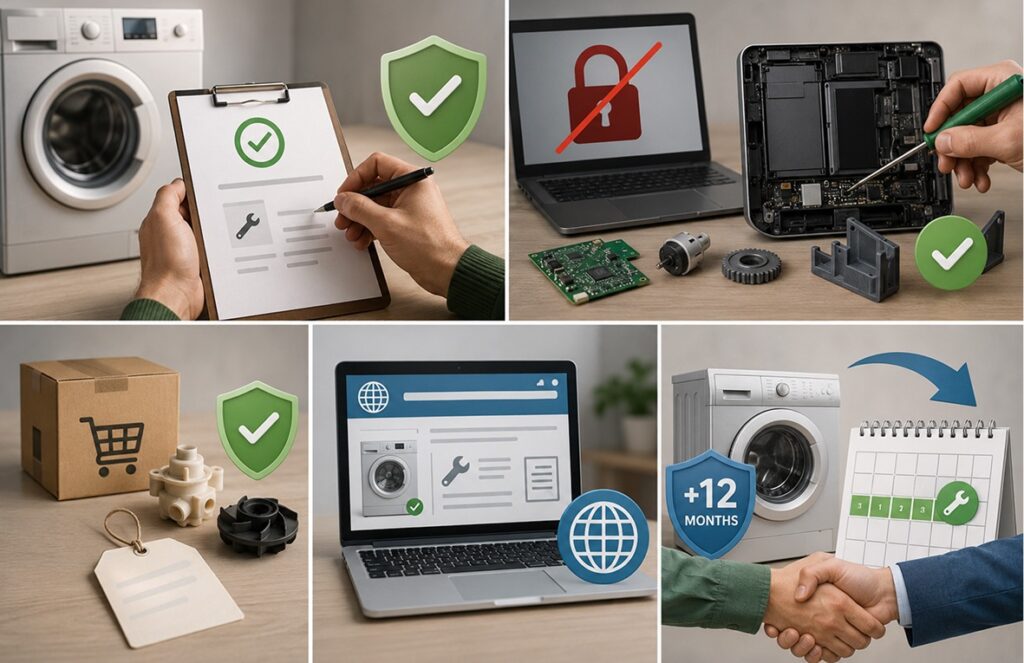
The obligation goes well beyond simply offering a repair service. Here is what each requirement means in practice.
Repairs must be offered at a reasonable price after warranty expiry. Once the legal guarantee period under the sales contract ends, consumers can still go directly to the manufacturer and request a repair. The manufacturer must carry it out at a price that does not deliberately put consumers off. The directive is explicit: pricing cannot be set at a level that is intentionally designed to deter people from using the repair option. The manufacturer can charge for labour, parts, and operating costs, but the price must be reasonable and set competitively. The consumer decides whether to accept the quoted price before committing.
No software, hardware, or contractual obstruction of third-party repairs. Manufacturers cannot use software locks, hardware design choices, or contract terms to block independent repairers from working on their products. This includes preventing the use of original spare parts, second-hand spare parts, compatible parts, or parts made through 3D printing, as long as those parts meet product safety and legal requirements. The only permitted exceptions are those justified by intellectual property protection under EU or national law. A manufacturer also cannot refuse to repair a product just because someone else repaired it first.
Spare parts availability and pricing requirements. Where a manufacturer is already required by ecodesign regulations to make spare parts and tools available, those parts must be priced in a way that does not block repair. Artificially high spare part prices would conflict with the directive. The obligation to supply parts at reasonable prices sits alongside whatever period is already set in the applicable ecodesign regulation.
Repair information must be published and freely accessible. Manufacturers and, where applicable, their authorised representatives, importers, or distributors must publish information about their repair services on a free-access website. This information must be available throughout the entire duration of the repair obligation, which runs from the time a product is placed on the market until the repairability requirements under the applicable ecodesign regulation expire. The information must clearly state which goods are covered and explain what repair is available and how to access it.
12-month warranty extension when a consumer chooses repair over replacement. This part changes the existing consumer sales directive (Directive (EU) 2019/771). When a product is faulty within the legal guarantee period and the consumer chooses repair rather than replacement, the liability period of the seller is extended by 12 months on top of whatever time remains. This extension applies once. The intention is to make repair a more attractive option for consumers at the moment they are deciding what to do with a faulty product.
Who Bears the EU Right to Repair Directive Obligation, and When It Shifts
This is the part of the directive that is most often glossed over, and it is the part that matters most to non-EU brands and their distribution partners.
The starting point is the manufacturer. If the manufacturer is based in the EU, it carries the repair obligation directly. When a consumer requests a repair, they go to the manufacturer.
When the manufacturer is based outside the EU, the obligation does not simply disappear. The directive sets out a clear chain of substitutes:
- Authorised Representative (AR) in the EU. If the non-EU manufacturer has appointed an EU Authorised Representative, that AR steps into the manufacturer’s place and carries the repair obligation.
- Importer. If there is no AR, the importer of the product into the EU takes on the obligation.
- Distributor. If there is no importer either, the distributor of the product within the EU becomes responsible.
Each of these parties may sub-contract the actual repair work to someone else, but legal responsibility stays with them. So if a brand based in the US, China, or elsewhere sells products through an EU importer with no AR appointment, that importer is carrying the manufacturer’s repair obligation, whether or not they know it or have agreed to it in their contract.
This has real consequences for how distribution agreements are written. If your EU importer is carrying your repair obligation but has not been told this, has not planned for it, and has no spare parts access or service infrastructure, you have a compliance problem. The directive does not allow the obligation to fall into a gap just because no one in the chain has formally accepted it.
Non-EU brands need to know: who in your EU distribution chain is legally standing in for you right now? Is it your AR? Your importer? Have those agreements been reviewed in light of this directive?
What the Directive Means for Product Design and Development
Product design teams need to account for this directive, not just after-sales and compliance teams.
The ban on software locks and hardware obstruction is not a customer service policy — it applies at the point of design. If a product going to the EU market falls under an ecodesign regulation, it needs to be built so that independent repairers can access and work on it. That means disassembly, component access, and software access are all design decisions with regulatory consequences.
Spare parts also need to be planned before a product launches. Ecodesign regulations already set minimum periods for which parts must be available. The directive adds that those parts must be priced at a level consumers can realistically use. Withholding parts or pricing them out of reach to drive new purchases would breach the directive.
The practical question for any product going into development now is straightforward: can it be repaired by someone other than the manufacturer? If the honest answer is no, that needs to change before the product reaches the EU market.
What Is Coming Next, Categories Being Added Under ESPR
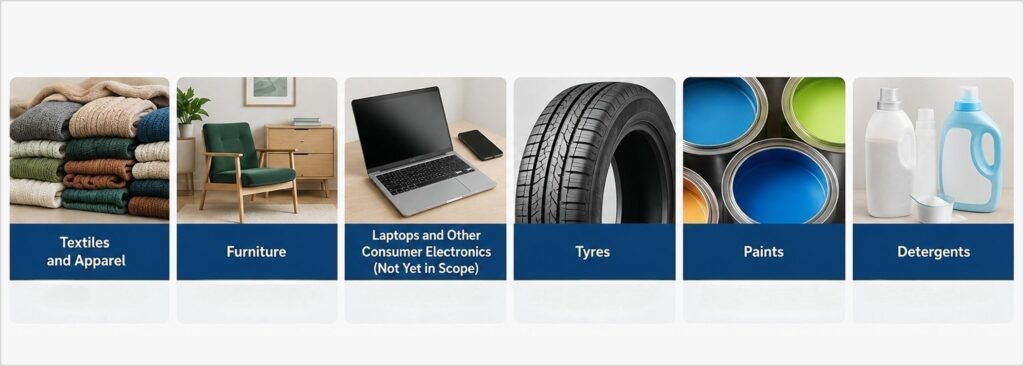
The ten categories in Annex II are not the final scope. Article 5(9) of the directive gives the European Commission the power to update the list by delegated act whenever new ecodesign or repairability requirements are adopted under EU law. It must do so within 12 months of the relevant legal act being published.
The main driver of future additions is the Ecodesign for Sustainable Products Regulation (ESPR), Regulation (EU) 2024/1781, which replaced the old Ecodesign Directive and covers a significantly broader range of products. Categories already in the ESPR work plan include textiles and apparel, furniture, laptops and other consumer electronics not yet in scope, tyres, paints, and detergents. Some are further along in the pipeline than others.
If your products sit in any of these categories, the repair obligation is likely to reach them within the next few years. Worth factoring into product and distribution planning now rather than treating it as someone else’s problem until an announcement lands.
Steps Non-EU Brands Should Take Now
With the July 2026 application date approaching, here are the practical steps worth taking now.
Confirm who holds the repair obligation in your EU distribution chain. Work through the liability chain: do you have an EU Authorised Representative? If yes, does your AR agreement address the repair obligation explicitly? If not, does your EU importer understand they are carrying this obligation? If you have neither an AR nor a clear importer arrangement, you need to resolve this before the deadline.
Review your product documentation against the directive’s information requirements. You need a free-access web page that explains your repair services, covers which products are included, and tells consumers how to access repair. This must be live by 31 July 2026 and must remain available for as long as the repair obligation runs.
Assess your spare parts availability commitments. Check what the applicable ecodesign regulation already requires in terms of spare part supply periods. Then check whether your pricing for those parts could be challenged as unreasonable under the directive. If your spare part supply chain is thin or dependent on a single market arrangement, now is the time to strengthen it.
Check whether your AR or importer agreements address repair liability explicitly. Standard AR or distribution agreements may not have been updated to reflect this directive. If your AR or importer is unaware they may be carrying your repair obligation, that is a contractual gap that needs closing. Review agreements with legal input to make sure responsibilities are clearly allocated and that parties who are taking on obligations have what they need to fulfil them.
Audit products currently being designed. If your development pipeline includes products that will fall under an existing or anticipated ecodesign regulation, get compliance input now on software access, hardware design, and spare parts planning.
How Euverify Can Help
If you are a non-EU brand, the Right to Repair Directive places the manufacturer’s repair obligation on your EU Authorised Representative. If you do not have one in place, that obligation shifts to your importer or distributor, whether or not they are prepared for it.
Getting the right AR arrangement confirmed before 31 July 2026 is one of the most straightforward steps you can take to close that gap.
Euverify provides EU Authorised Representative services for non-EU brands selling into Europe, with appointments confirmed within 24 hours. You can find out more at euverify.com/uk-eu-authorised-representative-services.