A Practical Guide to EU & UK Construction Products Compliance and Safety Regulations
Getting your construction products to market in the EU or UK depends on more than just quality. It depends on meeting the right regulations. For manufacturers, importers, distributors, and compliance teams, knowing the rules can mean the difference between smooth delivery and costly setbacks.
This guide walks you through the EU Construction Products Regulation (CPR), the UK’s post-Brexit requirements, and the regulatory changes shaping the future of the sector. You’ll also get a step-by-step approach to achieving compliance, with tips on how services like Euverify can simplify the process.
Construction Products Compliance: A Free Guide to Meeting Safety Standards

Why Compliance Matters
Construction products such as cement, steel, insulation, windows, adhesives, cables, and roofing are the building blocks of safe, durable structures. If products aren’t properly regulated, the consequences can be serious: structural failures, fire hazards, or harmful emissions.
The risks of non-compliance include:
- Blocked market access at EU or UK borders
- Recalls, fines, or stop-sale orders from regulators
- Damage to your reputation with customers and contractors
The benefits of strong compliance include:
- Building trust with architects and contractors
- Gaining a competitive edge in tenders
- Meeting sustainability and environmental goals
Regulations are changing. From January 2025, the EU’s updated Construction Products Regulation (CPR) puts greater focus on sustainability reporting and digital transparency. In the UK, reforms are aimed at improving safety after the Grenfell tragedy in 2017, which exposed major issues with cladding and product oversight. For now, CE marking is still accepted alongside the UKCA system.
Despite differences, both frameworks share a common goal: ensuring construction products are safe, durable, and sustainable.
The EU Framework: Construction Products Regulation (CPR)

Purpose and Scope
The EU CPR (Regulation EU No. 305/2011) harmonises how construction products are tested and marketed across the EU. Its goal is simple: a product tested once under EU rules can be sold anywhere in the bloc.
Covered products include:
- Structural materials(cement, steel, timber)
- Insulation and cladding
- Windows, doors, roofing materials
- Cables and electrical components
- Adhesives, sealants, flooring
If a product is designed to be permanently incorporated into a building, it will usually fall under the CPR. However, not everything used on a construction site is covered.Hand tools, furniture, and temporary structures, for example, sit outside the CPR framework and are instead regulated under broader product safety laws such as the EU’s General Product Safety Regulation (GPSR) or its UK equivalent.
Key Requirements under CPR
- Declaration of Performance (DoP):The manufacturer must issue a DoP stating the product’s essential characteristics (e.g., compressive strength, fire rating).
- CE Marking:Required for products under harmonised standards or ETAs. This label allows free movement across the EU.
- Harmonised Standards (hENs):Define testing and performance requirements for over 600 product types.
- European Technical Assessments (ETAs):For innovative products not yet covered by hENs, a voluntary ETA can still enable CE marking.
- Technical Documentation:Manufacturers must maintain a technical file (design data, test reports, FPC records, DoP) for 10 years.
- Factory Production Control (FPC):Quality systems ensuring ongoing compliance.
Safety and Performance Goals
The CPR defines eight basic requirements for construction works:
- Mechanical resistance and stability
- Fire safety
- Hygiene, health, and environment
- Noise protection
- Energy efficiency
- Sustainable resource use
- Durability
- Environmental impact (added in the 2024 revision)
These translate into measurable product properties. For example, insulation must meet fire-resistance ratings; cement must meet compressive strength requirements.
The 2024 CPR Revision: Sustainability and Digitalisation
Recognising new priorities like climate change and the circular economy, the EU adopted a major CPR revision (Regulation EU 2024/3110) in December 2024, effective January 2025.
Digital Product Passports (DPPs)
- Every product will eventually require a digital record containing its DoP, safety data, and environmental profile.
- Scannable codes will let regulators, builders, and even consumers see compliance data instantly.
- The goal: transparency, traceability, and integration with tools like BIM (Building Information Modelling).
Environmental Product Declarations (EPDs)
- Now mandatory, EPDs disclose life-cycle environmental impacts such as carbon footprint, recyclability, and energy use.
- Data must follow EN 15804 (the EU standard for life-cycle assessments).
- Reporting will be phased in between 2026 and 2032.
Enhanced CE Marking
- CE marking now signals not just safety but also sustainability compliance.
- Manufacturers must avoid “greenwashing” by backing claims with verified data.
Expanded Declaration of Performance (DoP)
- DoPs must now include environmental indicators alongside traditional performance.
- Example: compressive strength next to Global Warming Potential (GWP) per unit.
Priority Product Categories
The first to require DPPs and environmental reporting include:
- Cement and concrete
- Steel
- Masonry products
- Insulation materials
- Glazing and windows
New Commission Powers
The Commission can now issue “Common Specifications” if CEN standardisation is delayed, ensuring rules keep pace with innovation.
Implementation Timeline

In short, if you’re selling in the EU, get ready to handle environmental reporting and make use of digital compliance tools.
The UK Framework: UKCA and Post-Brexit Rules for Construction Products
From CE to UKCA
The UK mirrored the CPR through the 2013 Construction Products Regulations. After Brexit, it introduced UKCA marking as its domestic conformity label.
As of 2025:
- CE marking remains valid indefinitelyin Great Britain.
- UKCA markingis optional but recognised domestically.
- CE marking is required for EU sales.
Northern Ireland
Under the Windsor Framework, Northern Ireland follows EU CPR rules. Products must carry CE marking (or CE + UKNI if assessed by a UK body).
UK Designated Standards
The UK has its own list of designated standards, which mirror EU hENs. For example:
- EN 197-1 (cement) → BS EN 197-1 (UK designated version).Though technically separate, they remain almost identical.
Stronger Enforcement
The UK has focused on safety since Grenfell. Enforcement bodies include:
- Office for Product Safety and Standards (OPSS):Oversees market surveillance.
- Building Safety Regulator (HSE):Works alongside OPSS for high-risk products.
Powers include:
- Inspections and product testing
- Requests for technical files
- Stop-sale orders, recalls, and fines
The Building Safety Act 2022 also created a framework for “safety-critical” products.
Documentation and DoPs
Like the EU, the UK requires:
- A Declaration of Performance (aligned to UK law/standards)
- A technical file
- Clear marking (UKCA or CE)
Economic Operators
- Manufacturers:Always responsible for compliance.
- Importers:Legally accountable for overseas goods entering GB.
- Authorised Representatives:Allowed but less common in the UK.
Future Divergence
- EU focus:Sustainability (EPDs, DPPs, carbon reporting)
UK focus:Safety (fire performance, stricter enforcement)Future divergence is possible, but for now, CE compliance provides a strong baseline for both markets.
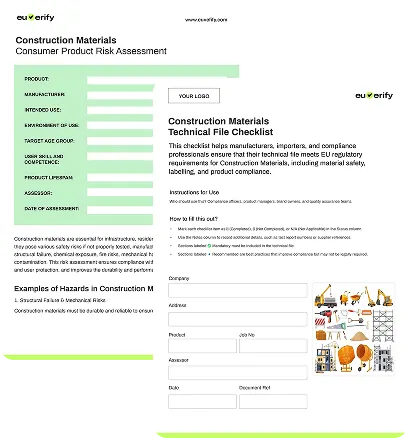
Technical Files Checklist & Risk Assessment Template
Construction Materials
- Ensure Compliance
- Reduce Risk
- Streamline Documentation
- Supports market access
Get it now for just £40!
Step-by-Step Compliance for Construction Products: EU and UK
Though details differ, the compliance journey follows the same structure in both markets.
1. Identify Standards
- Check if a harmonised standard (EU) or designated standard (UK) applies.
- If not, pursue an ETA (EU) or UKTA (UK) for unique/innovative products.
2. Risk Assessment
Conduct a general safety review that includes:
- Mechanical risks (structural failure, sharp edges)
- Fire risks (combustibility, smoke release)
- Chemical risks (VOC emissions, toxic substances)
- Handling risks (dust, electrical hazards)
This supports both CPR and EU GPSR / UK safety law obligations.
3. Product Testing
- Tests must follow the harmonised/designated standard.
- Depending on risk:
- Self-testing (low-risk)
- Notified/Approved Body testing (higher-risk)
- Example:
- Fire doors → lab tested + factory audits (AVCP 1).
- Ceramic tiles → self-declare with in-house testing (AVCP 4).
4. Factory Production Control (FPC)
Factory Production Control (FPC) is an ongoing quality system, similar to ISO 9001. It covers checks on raw materials, in-process testing, calibration, and record-keeping. For higher-risk products, a Notified or Approved Body may also audit the FPC.
5. Technical File
The technical file must include:
- Test reports and certificates
- Risk assessment
- FPC records
- Product datasheets and specifications
- Draft DoP
- Safety Data Sheets (if applicable)Retention: 10 years minimum.
6. Declaration of Performance (DoP)
This is your product’s official CPR compliance document and must follow the EU’s standard template.
Key elements of a DoP include:
- Unique DoP number for identification.
- Intended use of the product.
- Product type/variant (sometimes referencing a test sample).
- Harmonised standard (hEN) or ETA used.
- AVCP system applied.
- Details of any Notified Body involved, including its certificate number.
- Table of declared performance, listing essential characteristics, their performance values or classes, and the test method/standard used.
Declared Performance Table (Example)

7. Marking (CE or UKCA)
- Affix visibly and indelibly on the product, label, or packaging.
- Include DoP reference, manufacturer details, and (if relevant) Notified/Approved Body ID.
- Dual marking (CE + UKCA)is often simplest for companies selling in both markets.
8. Instructions and Safety Information
Instructions and safety information must include clear installation guidance and hazard warnings. Under the EU’s Digital Product Passport (DPP), this step will increasingly move to digital formats.
9. Local Representative
- EU:Required if manufacturer is outside the EU.
- UK:Importer or Responsible Person must be UK-based.
10. Ongoing Compliance
- Maintain production checks and update documents as standards change.
- Cooperate with surveillance authorities.
Correct non-conformities immediately (recall, withdraw, amend DoP).
Other Regulations Affecting Construction Products
Beyond CPR/UKCA, products may fall under additional frameworks:
General Product Safety (GPSR / UK law)
- Applies especially to consumer-facing products (DIY adhesives, paints).
- Requires risk assessments, traceability, and 10-year record retention.
It’s important to remember that even if an item isn’t classed as a “construction product” under CPR or UK CPR, such as tools, furniture, or temporary structures, it still has to meet general product safety laws like the EU’s GPSR or the UK equivalent.
REACH (EU & UK)
Restricts hazardous substances. Examples include:
- Chromium VI in cement
- VOC limits in adhesives and coatings
- Bans on asbestos, PFAS under review
Waste and Circular Economy Rules
- SCIP Database:Requires reporting if products contain SVHCs.
- Packaging Directive:Packaging must be recoverable and low in heavy metals.
- Waste Framework Directive:Trace hazardous components for safe disposal.
Eco-design and ESPR
The EU’s Eco-design for Sustainable Products Regulation (ESPR), introduced in 2024, is gradually expanding sustainability rules to more product groups. It’s expected to set requirements for durability, repairability, recycled content, and carbon footprint limits, with digital product passports helping to increase transparency and traceability.
UK Building Regulations
The UK’s Building Regulations can set stricter requirements than CPR, such as the post-Grenfell ban on combustible cladding in high-rise buildings. This means that even fully CPR-compliant products may be restricted from use in practice.
Using Compliance as a Market Advantage

In today’s construction industry, compliance is often a key factor in winning contracts and earning trust. Rather than being a burden, it shows clients that your products are reliable, sustainable, and built for long-term value.
Benefits include:
- Trusted by architects and regulators
- Preferred in green procurement tenders
- Meets growing client demand for sustainable building materials
- Reduces liability risks
Proactive suppliers highlight CE/UKCA compliance and EPDs in marketing to build trust.
Common Compliance Mistakes in EU & UK Construction Products
- Missing documentation:Passing a test isn’t enough without the DoP and technical file.
- Out-of-date standards:Using superseded standards can invalidate CE/UKCA marks.
- Improper marking:Don’t affix CE/UKCA to non-covered products.
- Ignoring national codes:Local building rules may ban certain products regardless of CPR status.
Final Takeaway
Construction products must meet strict EU and UK regulations to reach the market safely and legally. The 2025 CPR update puts more focus on sustainability and digital product data, while the UK continues to strengthen safety oversight.
For manufacturers and importers, this means staying on top of evolving standards, preparing environmental data early, keeping technical files and FPC systems up to date, and treating CE/UKCA marking as a mark of trust.
At Euverify, we make compliance straightforward. Whether it’s providing technical file checklists or serving as your Authorised Representative in the EU or UK, we help ensure your products reach the market smoothly and with confidence.
With solid systems in place, compliance isn’t just about avoiding penalties. It’s about delivering safer, greener, and more trusted construction products for the future.
For more details on how to stay compliant with EU and UK construction product regulations, download our free guide.
Appoint your authorised representative and ensure compliance for your construction products.
- Stay compliant with EU & UK regulations
- Hassle-free representation for construction products.