
Is Your UV Gel Formula Still EU-Compliant? The TPO Ban Explained
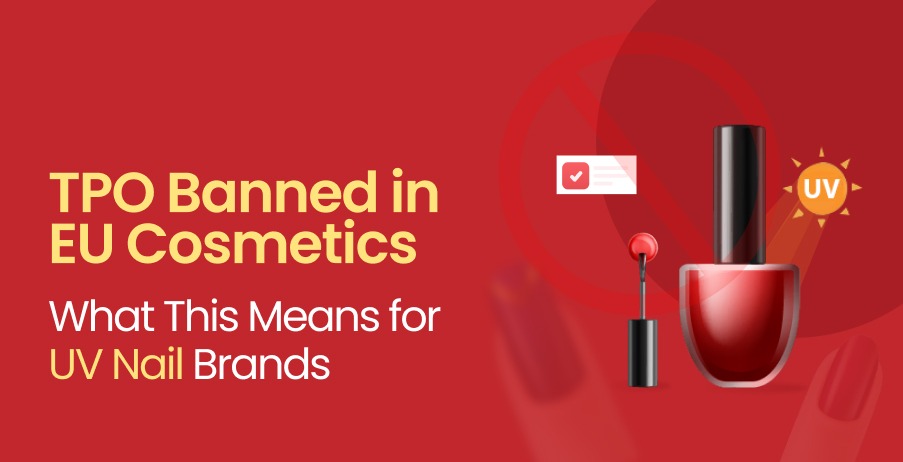
From 1 September 2025, the EU banned TPO, one of the most widely used photoinitiators in UV gel nail products. If you have not reformulated yet, your products may no longer be legally sold on the EU market. This article covers what the regulation includes, who it affects, and what you need to do.
What Changed on 1 September 2025?
In May 2025, the European Commission published Regulation (EU) 2025/877, the seventh in the ongoing series of Omnibus amendments to the EU Cosmetics Regulation (EC) No 1223/2009. It came into force on 1 September 2025, with no grace period for selling through existing non-compliant stock.
One substance was added to Annex II, meaning it is now completely prohibited in any cosmetic product sold on the EU market:
| Substance | Common name | CAS Number | Typical use |
| Diphenyl(2,4,6-trimethylbenzoyl)phosphine oxide | TPO | 75980-60-8 | Photoinitiator in UV gel nails, builder gels, nail lacquers |
It is worth noting that TPO was not entirely unrestricted under EU law before this change. It had previously been listed in Annex III of the Cosmetics Regulation (entry 311), where it was permitted for professional use only in artificial nail systems, at a maximum concentration of 5%. Regulation (EU) 2025/877 deleted that entry and moved TPO to the prohibited list in Annex II, with no exceptions and no concentration threshold.
For many professional nail brands, this came fast. TPO has become a near-universal ingredient in professional UV gel systems over the past decade, used for its effectiveness and compatibility with both UV and LED lamp technologies.
Why TPO Was Banned
The EU Cosmetics Regulation works alongside the Classification, Labelling and Packaging (CLP) Regulation. Under Article 15, substances classified as carcinogenic, mutagenic, or toxic to reproduction (CMR) are prohibited in cosmetics by default. Once a CMR classification takes effect, the Commission aligns the relevant Cosmetics Regulation Annexes to the same application date. Brands can have very little time to react.
TPO was classified as a CMR substance by Commission Delegated Regulation (EU) 2024/197, which applied from 1 September 2025. Specifically, TPO received a dual classification: it is a reproductive toxicant (Category 1B, H360Fd), meaning there is strong evidence it may impair fertility or harm an unborn child, and a skin sensitiser (Category 1B, H317). For a substance applied repeatedly in enclosed professional settings, the cumulative exposure risk was judged unacceptable.
There are no exceptions, no transitional arrangements, and no concentration thresholds. The ban is absolute. Even trace quantities present as manufacturing residuals would technically place a product in breach.
Which Nail Products Does This Cover?

The ban applies to any product manufactured in, imported into, or sold on the EU market. If your product is cured under UV or LED light and contains TPO, it is in scope. This includes:
- UV-curable gel nail polishes (soak-off gels)
- Builder gels (BIAB and builder-in-a-bottle products)
- UV nail lacquers and top coats
- Hard gel extensions and sculpting products
- Polygel and hybrid nail systems
- UV-cure nail adhesives and bonding products
- Any retail or professional nail product cured under UV or LED lamps
This covers both professional salon brands and consumer retail products, including at-home gel kits sold online. It also applies to products made outside the EU but sold into the EU market. The compliance obligation rests with your EU Responsible Person, regardless of where the product is manufactured.
If your formulation has not been reviewed since mid-2024, there is a high chance it is affected. TPO was extremely widely used, and many manufacturers were not tracking CLP classification changes closely enough to anticipate the regulatory consequences.
How Did We Get Here? The Compliance Timeline
The Omnibus amendment process has accelerated since 2023, as the Commission works through a backlog of CLP classifications. Brands that were monitoring finished product regulations only, rather than upstream CLP classifications, were caught off guard.
The timeline ran as follows:
- 2023: TPO and TMPTA receive CMR classifications under the CLP Regulation
- Early 2025: Commission initiates the Omnibus VII amendment procedure
- May 2025: Regulation (EU) 2025/877 published in the Official Journal
- 1 September 2025: Regulation came into force. Products containing TPO or TMPTA may no longer be placed on the EU market.
The gap between publication and enforcement was around four months. For brands that needed to reformulate, update their CPSR, and re-notify on CPNP, this was an extremely tight window. Many were not able to complete the process in time.
Six Steps to Get Back Into Compliance
If you have not already acted, the following steps are legal requirements for returning to market.
1. Audit your formulations
Review every INCI list and raw material specification sheet for your UV nail product range. Check for TPO (CAS 75980-60-8) by both INCI name (Trimethylbenzoyl Diphenylphosphine Oxide) and CAS number, as it may appear differently across supplier documentation. Do not rely on INCI lists alone. Check your raw material safety data sheets and supply chain documentation for any intermediate ingredients that may contain either substance as a component.
2. Identify compliant alternatives
Work with your formulation chemist or contract manufacturer to find suitable replacements. Several alternative photoinitiators are currently permitted under the Annexes, including phenylbis(2,4,6-trimethylbenzoyl)phosphine oxide (BAPO/Irgacure 819) and certain Type II photoinitiator systems. A permitted status in the Annexes does not automatically mean safe for your specific formulation. Any alternative must be assessed in context.
3. Update your Cosmetic Product Safety Report (CPSR)
Any formulation change requires an updated CPSR, reviewed and signed off by a qualified safety assessor meeting the qualifications set out in Article 10 of Regulation (EC) No 1223/2009. Your assessor will need to evaluate the new photoinitiator within the full formulation, taking into account normal and reasonably foreseeable use, exposure levels, and any cumulative risk. Allow adequate lead time. Demand for CPSR services has increased significantly since the September 2025 deadline passed.
4. Re-notify on CPNP
Once your reformulated product has an updated CPSR, it must be re-notified on the EU Cosmetic Products Notification Portal (CPNP) before going back on the market. The re-notification must reflect the updated formulation, including the revised INCI list. Selling a reformulated product under the original CPNP notification without updating the portal entry is a separate compliance breach.
5. Update product labels
If the reformulation changes the INCI list, product labels must be updated before you sell the product. Selling stock with outdated INCI declarations is a labelling non-compliance under Article 19 of the Cosmetics Regulation, even if the physical product has been reformulated. Plan your label changeover carefully to avoid a gap between stock depletion and new label availability.
6. Communicate with your supply chain
If you supply products to distributors, retailers, or salons in the EU, make sure non-compliant stock is withdrawn. Contact downstream partners proactively and provide documentation confirming the compliance status of your current products.
Already past the September 2025 deadline and still selling affected products? You are in breach of EU law. Withdraw affected stock immediately and seek compliance advice. Continued sale of products containing banned CMR substances risks market surveillance action, product recall, and reputational damage.
What Is the UK Position?
Following Brexit, the UK retained its own version of Regulation (EC) No 1223/2009, administered by the MHRA and enforced by local trading standards authorities. In the years since Brexit, the UK largely followed EU Annex amendments at a broadly similar pace. But divergence between the two frameworks is increasing.
Do not assume the EU ban on TPO and TMPTA automatically applies in Great Britain at the same time or with the same scope. The position in Northern Ireland is further complicated by the Windsor Framework. Verify the current UK position with your UK Responsible Person and monitor MHRA guidance, particularly if you supply both markets from the same product inventory.
If you are reformulating for EU compliance, it is generally advisable to reformulate for both markets at the same time where possible. Make sure the reformulated version also meets UK regulatory requirements in its own right.
What Comes After Omnibus VII?
Omnibus VII is not the end. The Commission’s programme of CMR-driven Annex amendments is ongoing, and brands across all cosmetic product categories need to monitor CLP classification developments upstream, rather than waiting for Official Journal publications.
Commission Regulation (EU) 2026/78 was published on 13 January 2026 and applied from 1 May 2026. It addresses substances classified as CMR by Delegated Regulation (EU) 2024/2564 and introduces the following key changes:
- Silver in various forms: Silver nano (particle diameter 1–100 nm) and silver massive (particle diameter ≥ 1 mm) are prohibited in cosmetics. Micron-sized silver powder (100 nm–1 mm) is permitted as a restricted colorant under specific conditions, following a positive opinion from the Scientific Committee on Consumer Safety (SCCS).
- Hexyl salicylate: Permitted in cosmetics only under restricted concentrations set out in Annex III, following a positive SCCS opinion. If you use this ingredient in leave-on or rinse-off products, check the new concentration limits carefully.
- o-Phenylphenol and sodium o-phenylphenate: Permitted as preservatives under updated conditions in Annex V.
- Perboric acid salts: Existing Annex II entries consolidated for clarity, with no substantive change to the underlying prohibition.
Several additional CMR substances were added to the Annex II prohibited list.
If you supply products containing any of these ingredients, your Cosmetic Product Safety Report and CPNP notifications should be reviewed against the updated Annexes.
From 31 July 2026, an expanded list of fragrance allergens must be individually declared on the label of any new cosmetic product placed on the market, under Regulation (EU) 2023/1545. The number of allergens subject to mandatory individual labelling increases from 24 to approximately 80. The labelling obligation applies when an allergen is present above 0.001% in leave-on products or 0.01% in rinse-off products. For brands with complex fragrance compositions, the labelling review alone can be time-consuming. If you have not started this review, now is the time.
Building regulatory monitoring into your product development and compliance calendar, rather than reacting to changes after they are published, is increasingly important for any brand operating at scale in the EU market.
Key Takeaways
- TPO (diphenyl(2,4,6-trimethylbenzoyl)phosphine oxide, CAS 75980-60-8) is completely prohibited in EU cosmetics from 1 September 2025 under Regulation (EU) 2025/877
- The ban covers all UV/LED-curable nail products, professional and consumer, imported and domestically manufactured
- Compliance requires reformulation, an updated CPSR, CPNP re-notification, and updated labels
- The UK position requires separate verification and is increasingly diverging from the EU
- Omnibus VIII is already in force and fragrance allergen labelling changes apply from 31 July 2026
Need help reviewing your nail product formulations?
Euverify’s cosmetics compliance team can review your product portfolio, identify affected ingredients, manage your CPSR updates, and handle your CPNP re-notifications from start to finish. We work with brands across the EU and UK, from independent nail brands to large-scale manufacturers.