Cosmetic Claims Compliance: How to Market Products Without Violating EU and UK Regulations
For cosmetic brands and exporters, how you market your products is just as critical as how you make them.
The global cosmetics industry is becoming increasingly competitive, and for exporters targeting the European Union (EU) and the United Kingdom (UK), compliance goes far beyond product safety.
Every word, image, or promise on a cosmetic label or in advertising is closely regulated. A claim like “dermatologically tested” or “clinically proven” might seem harmless, but if it isn’t supported by solid evidence, regulators can require the product to be withdrawn or impose fines. Likewise, terms such as “natural,” “vegan,” or “cruelty-free” have specific regulatory definitions that must be properly documented.
This guide explains how cosmetic claims are regulated in the EU and UK, outlines the six key criteria that every claim must meet, and shows how working with a Responsible Person helps brands make sure every message they share with consumers is compliant, transparent, and legally sound.
The Legal Framework Behind Cosmetic-Claims Regulation

a) EU Regulatory Basis
The foundation of cosmetic-claims regulation in Europe is Article 20 of Regulation (EC) No. 1223/2009, also known as the EU Cosmetic Products Regulation. It prohibits any text, image, or presentation that could mislead consumers about a product’s characteristics, safety, composition, or effects.
“In the labelling, making available on the market and advertising of cosmetic products, text, names, trade marks, pictures and figurative or other signs shall not be used to imply that these products have characteristics or functions which they do not have.”
Key provisions include:
- Misleading claims ban: Claims cannot suggest functions or properties that the product does not actually have.
- “No animal testing” limitation: This claim can only be used if neither the manufacturer nor its suppliers have conducted animal testing for cosmetic purposes after the EU testing and marketing bans (Article 18).
- Evidence requirement: All claims must be supported by reliable data before the product is marketed.
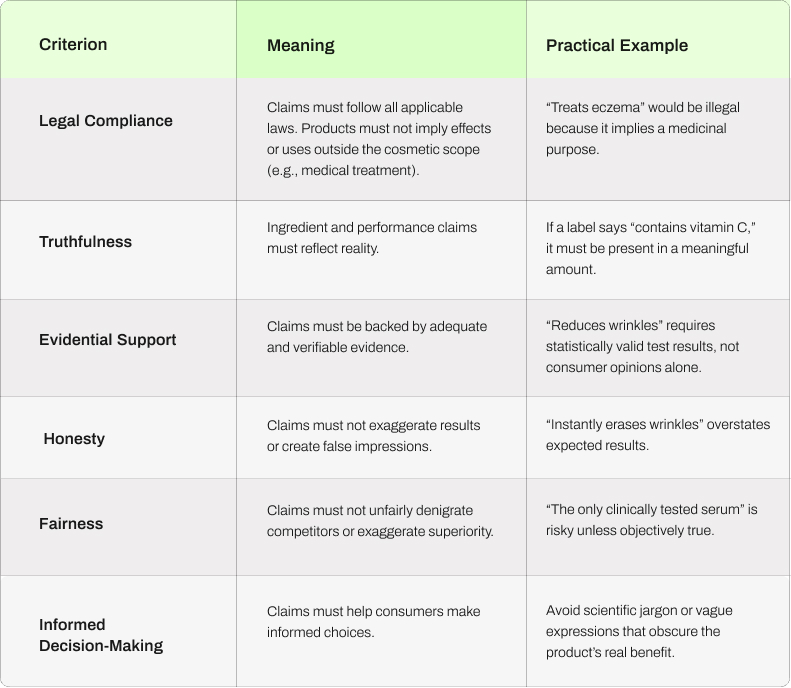
To ensure consistent enforcement across the EU, Commission Regulation (EU) No. 655/2013 sets out six common criteria that all cosmetic claims must meet. The EU Technical Document on Cosmetic Claims, last updated in July 2023, provides practical examples and explains how authorities apply these criteria in real situations.
b) The UK Post-Brexit Position
After Brexit, the UK retained Article 20 and Regulation 655/2013 under domestic law, as outlined in Schedule 34 of the Product Safety and Metrology (Amendment etc.) (EU Exit) Regulations 2019.
Enforcement is now handled by the Office for Product Safety and Standards (OPSS) and local Trading Standards offices.
Manufacturers and importers placing products on the UK market must:
- Notify products through the UK SCPN portal
- Appoint a UK-based Responsible Person
- Ensure all claims meet the same six Common Criteria used in the EU
Although the EU and UK frameworks remain closely aligned, exporters must maintain separate Responsible Persons and Product Information Files (PIFs) for each market.
The Six Common Criteria for Cosmetic Claims Explained
The EU’s Regulation 655/2013 defines how cosmetic claims must be framed and proven. Here’s how each applies in practice:
High-Risk Cosmetic Claims That Trigger EU and UK Regulatory Scrutiny
Some marketing expressions routinely trigger investigations or corrective action by EU or UK authorities:
“Clinically proven” / “Dermatologically tested”
These claims must be supported by credible, reproducible clinical or dermatological studies with measurable outcomes and statistically valid results.
“Hypoallergenic”
This claim is only acceptable if the formula is specifically designed to minimise allergenic potential and supported by scientific evidence. Regulators have raised concerns when this term was used without adequate proof.
“Organic,” “Natural,” “Vegan”
Claims such as “natural” or “organic” should align with recognised standards like ISO 16128 or verified third-party certifications.“Vegan” indicates that the product contains no animal-derived ingredients and has not been tested on animals, so both aspects must be verified.
“Anti-ageing,” “Cell-repair,” “Rejuvenating”
These claims must stay within the cosmetic definition of improving appearance. Any suggestion that the product changes physiological functions or structure, such as “stimulates collagen production,” could lead to it being reclassified as a medical claim.
“Cruelty-free” / “Not tested on animals”
These claims are only allowed if both the manufacturer and suppliers have completely avoided animal testing for cosmetic purposes after the ban took effect.Exporters should carefully verify their supply chain declarations, particularly when ingredients are also registered under REACH.
“Free from [ingredient]”
This type of claim is discouraged unless the ingredient poses a recognised concern or its absence provides a genuine benefit to consumers.For example, “free from parabens” is often viewed as misleading, since certain parabens are considered safe and remain legally permitted.
Compliant vs Misleading Cosmetic Claims: What the Difference Looks Like:
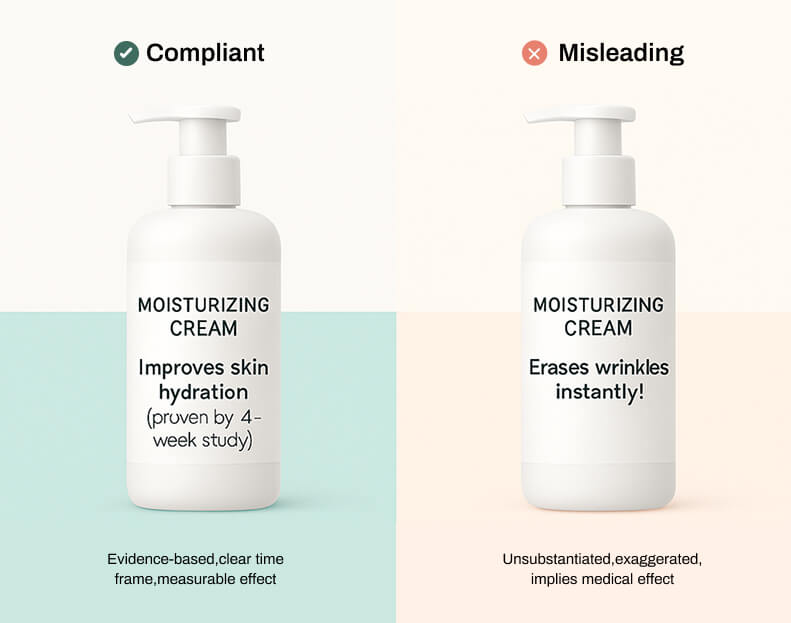
Cosmetic claims must be truthful, verifiable, and within the cosmetic scope under EU Regulation 655/2013.
Proving Your Cosmetic Claims: What Evidence Regulators Expect
Under Article 11 of Regulation 1223/2009, every cosmetic product must have a Product Information File (PIF) that includes evidence to support any claims made.
“……where justified by the nature or the effect of the cosmetic product, proof of the effect claimed for the cosmetic product…..”
Acceptable types of evidence include:
- Laboratory or clinical test reports
- Published scientific studies demonstrating ingredient efficacy
- Consumer perception studies that are statistically valid and use a clear methodology
- Certificates or audit reports from accredited third parties
- Expert assessments prepared by qualified professionals
Key Principles
- Evidence must be in place before the product is marketed, not after complaints arise.
- The data must correspond exactly to the product’s formula and the specific claim being made.
- Claims should fit the product’s legal definition under Article 2(1)(a): improving appearance, cleansing, perfuming, or protecting, rather than treating disease.
“ ‘cosmetic product’ means any substance or mixture intended to be placed in contact with the external parts of the human body (epidermis, hair system, nails, lips and external genital organs) or with the teeth and the mucous membranes of the oral cavity with a view exclusively or mainly to cleaning them, perfuming them, changing their appearance, protecting them, keeping them in good condition or correcting body odours”
For example, if a cream claims to “improve skin barrier function,” the supporting data should demonstrate this through recognised non-invasive measurements such as TEWL testing, not through anecdotal feedback.
What Happens If Your Cosmetic Claims Don’t Comply with EU or UK Rules
EU and UK regulators have clear authority to act against misleading cosmetic claims.
EU enforcement: Market surveillance authorities such as France’s ANSM, Germany’s BfR, and Italy’s Ministry of Health regularly review Product Information Files (PIFs) and product marketing materials.
UK enforcement: The Office for Product Safety and Standards (OPSS) and local Trading Standards offices can require corrective action, seize stock, or issue fines.
Consequences of non-compliance include:
- Mandatory product withdrawal or recall
- Administrative fines or civil penalties
- Reputational damage and potential removal from retailer listings
Regulators are also increasing cross-border cooperation through EU networks such as Safety Gate (formerly RAPEX), sharing data on misleading claims to ensure consistent enforcement across markets.
How Euverify Helps Cosmetic Brands
For exporters and growing beauty brands, ensuring compliance with claim regulations is often one of the most challenging parts of regulatory preparation. Euverify offers complete support to make this process simpler and more reliable.
a) Responsible Person (RP) Services
- Acts as your EU or UK Responsible Person, making sure all marketing and labelling claims comply with Article 20 and Regulation 655/2013.
- Reviews product presentation and ensures that full documentation is included in the Product Information File (PIF) before the product reaches the market.
b) Claim Substantiation and Documentation Audits
- Confirms that every marketing statement is backed by objective evidence.
- Helps compile or arrange third-party test reports to support claims such as “clinically proven” or “dermatologically tested.”
c) Ethical Claim Validation
- Reviews supply chain data and manufacturer declarations to confirm the accuracy of claims such as “no animal testing,” “vegan,” or sustainability-related statements.
d) Cross-Market Readiness
- Aligns EU and UK claim documentation so that a single set of evidence can satisfy both markets.
- Advises on translation accuracy and presentation requirements.
Best Practices for Exporters and Cosmetic Brand Owners
To stay compliant and maintain consumer trust:
- Keep evidence ready: Store claim substantiation data in the Product Information File (PIF) for at least ten years after the last batch is placed on the market.
- Audit your marketing: Regularly review packaging, digital ads, and social media content to ensure they comply with the six common criteria.
- Update your documentation: Refresh claim evidence whenever you reformulate or launch new product variants.
- Stay consistent: Make sure product names, visuals, and taglines accurately reflect the supporting scientific data.
- Coordinate across teams: Regulatory, marketing, and product development teams should collaborate closely before approving any promotional material.
Even a single misleading phrase, such as “clinically proven to cure acne,” can cause a product to be classified as medicinal rather than cosmetic, leading to completely different regulatory requirements.
Final Takeaway
The EU and UK cosmetic-claims rules are among the strictest in the world, but they exist for good reason: to ensure fairness, accuracy, and consumer confidence.
For exporters, compliance is more than just a way to avoid fines. It is an opportunity to build credibility in markets where trust and transparency drive long-term brand loyalty.
By partnering with Euverify, cosmetic companies can:
- Validate every marketing claim before launch
- Avoid costly enforcement actions
- Present consistent, legally sound messaging across both the EU and UK
When every promise is backed by solid evidence and integrity, compliance becomes a true competitive advantage. It helps your brand stand out for all the right reasons.
Frequently Asked Questions
Yes. In both the EU and UK, any promotional statement made by influencers, affiliates, or brand ambassadors is considered a cosmetic claim and must comply with Article 20 and the Common Criteria. Brands are responsible for ensuring influencers do not exaggerate results or imply medical benefits.
Absolutely. Regulatory authorities treat online claims the same as on-pack claims. Any text, video, graphic, or slogan used on websites, Amazon listings, Meta ads, TikTok, or YouTube must be truthful, evidence-based, and aligned with the product’s PIF.
Yes, but only when they are:
- representative of typical results,
- not digitally altered,
- taken under identical conditions, and
supported by solid performance data. Misleading image manipulation is a frequent cause of enforcement.
Brands may use AI or filters, but not in a way that misrepresents the product’s actual performance. If filters artificially enhance skin appearance or hide imperfections, using them in ads can violate the “truthfulness” and “honesty” criteria.
Yes. A product name—such as “Miracle Wrinkle Eraser Cream” or “Collagen Booster Serum”—is treated as a claim. If the name implies medical benefits or unrealistic results, the product may be considered mislabelled or even reclassified as a medicinal product.