
EmpCo and PPWR: How the Empowering Consumers Directive Connects to Packaging Compliance
If you sell into the EU, packaging compliance just got a second layer. PPWR has already applied since 12 August 2026. EmpCo follows close behind on 27 September 2026. Most businesses have been treating these as two separate projects, one for the compliance team and one for marketing. That split does not really hold up. PPWR decides what your packaging has to be. EmpCo decides what you are allowed to say about it. If those two teams are not talking to each other right now, this is the gap worth closing before the end of the month.
What is PPWR
PPWR, or Regulation (EU) 2025/40, replaces the old Packaging and Packaging Waste Directive. It came into force on 11 February 2025 and has been generally applicable since 12 August 2026, with more requirements phasing in through 2030 and beyond.
It covers packaging across its full life, no matter what it is made of. Since August 2026, the main obligations in force are:
- A conformity assessment and an EU Declaration of Conformity for the packaging
- Technical documentation, kept for five or ten years depending on the type of packaging
- Traceability labelling showing who made it and who imported it
- Limits on heavy metals such as lead, cadmium, mercury and hexavalent chromium, and PFAS limits for food-contact packaging
- Rules on the environmental claims printed on packaging
That last one is the part most businesses miss. PPWR is not only about the physical packaging. It also sets conditions on what you can print on it, words like “recyclable,” “compostable,” or “made with recycled content.” That is exactly the same ground EmpCo covers, just from the consumer protection side rather than the product side.
Further down the line, PPWR brings in harmonised material labelling from 2028, QR codes for reusable packaging from 2029, and recyclability and recycled content targets from 2030.
What is EmpCo
EmpCo, Directive (EU) 2024/825, updates two existing pieces of EU consumer law, the Unfair Commercial Practices Directive and the Consumer Rights Directive. It came into force back in March 2024. Member states had until 27 March 2026 to write it into national law, and it starts applying to businesses from 27 September 2026, just a few weeks from now.
At its core, EmpCo is an anti-greenwashing rule. It goes after vague or unproven environmental claims wherever they show up, packaging included. A few of its main points:
- Broad claims like “eco-friendly” or “green” are off the table unless you can back them with recognised proof, or you spell out the specific benefit right there on the same packaging
- Claims about future targets, something like “net zero by 2030,” only hold up if there is a real plan behind them with measurable steps, checked by an independent party
- Sustainability labels have to come from a proper certification scheme or a public authority. A logo your design team made up in-house does not count anymore
- Consumers need to be told how durable and repairable a product is before they buy it
There is no phase-in for existing claims either. Whatever is on your packaging already has to meet these rules from 27 September 2026, not just packaging you design from that date onward.
Where PPWR and EmpCo meet
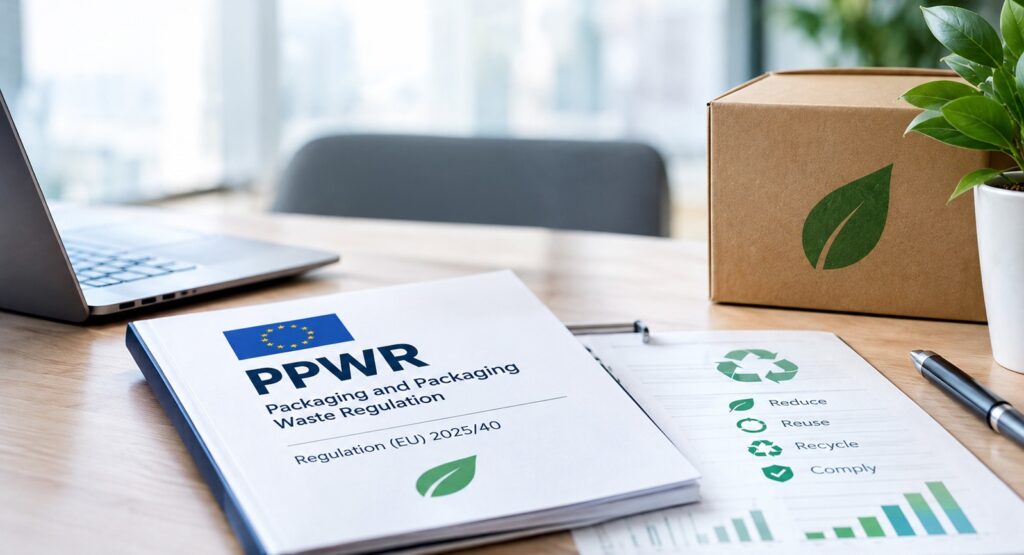
Packaging carries more environmental claims than almost anything else a brand puts out. A recycling symbol, a “made from 30% recycled plastic” line, a compostable mark, a little green leaf that hints at sustainability without saying much at all. Both regulations care about that same piece of packaging, just for different reasons.
PPWR asks whether the claim is technically accurate and properly backed up as a packaging requirement. It has its own rules on environmental claims, and for compostability specifically, it requires European standards bodies to update the compostability standards that packaging in certain formats will need to meet from 2028.
EmpCo asks something different: is the claim, as written and displayed, fair and provable to the person buying the product? A claim can tick every PPWR box on substance and still fall over under EmpCo if the wording is vague or the label behind it was never independently verified.
So a single line of text on a pack now has to clear two different tests. Is the material or process actually compliant with what PPWR requires? And is the claim worded, evidenced and shown in a way EmpCo will accept? A business that redesigns its packaging for PPWR but leaves the marketing copy untouched is setting itself up for an EmpCo problem a month later.
What to do about it
For manufacturers, importers and distributors placing packaging on the EU market, here is where to start:
- Go through every claim already on your packaging. Recyclable, compostable, sustainable, all of it needs a real source behind it. If there is nothing to back it up, reword it or drop it before 27 September.
- Check where your sustainability labels come from. If it is not tied to a recognised certification scheme or a public authority, it will not survive under EmpCo.
- Get your technical documentation and your marketing copy talking to each other. The file you are building for PPWR conformity is the same evidence you will need to defend your claims under EmpCo. Do not let two departments build these separately.
- Look hard at any forward-looking promise. A “net zero by 2030” line needs a published plan with real, measurable milestones, not just something the sustainability team has in mind.
- Keep an eye on compostability specifically. New harmonised standards are coming, and certain packaging formats have to meet them from 2028, so this is a claim worth being extra careful with right now.
The dates side by side
| Date | What happens |
| 11 February 2025 | PPWR comes into force |
| 27 March 2026 | EU countries must have EmpCo written into national law |
| 12 August 2026 | PPWR applies generally: conformity assessment, technical documentation, EU DoC, substance limits, claims rules (already in effect) |
| 27 September 2026 | EmpCo applies across the EU, no exceptions for existing claims (coming up) |
| 12 August 2028 | PPWR harmonised material labelling begins, and compostability criteria start applying to certain formats |
| 12 August 2029 | PPWR QR code requirement for reusable packaging |
| 12 August 2030 | PPWR recyclability grades and recycled content minimums kick in |
Dates subject to change pending EU implementing acts
Why this matters beyond compliance
Neither of these rules showed up by chance. Both come out of the European Green Deal, and both are answers to the same problem, packaging rules that differed from one EU country to the next, and a market full of environmental claims that were never really checked. Treating packaging compliance and sustainability marketing as two unrelated jobs made sense while the rules were separate. Once EmpCo lands in a few weeks, they will not be separate anymore.
If your packaging project so far has only involved the compliance side of the business, this is the moment to bring marketing into the conversation. What goes on the box and what the box is made of now answer to the same set of rules.
Need a hand checking your packaging claims against PPWR and EmpCo before 27 September? Talk to our compliance team.