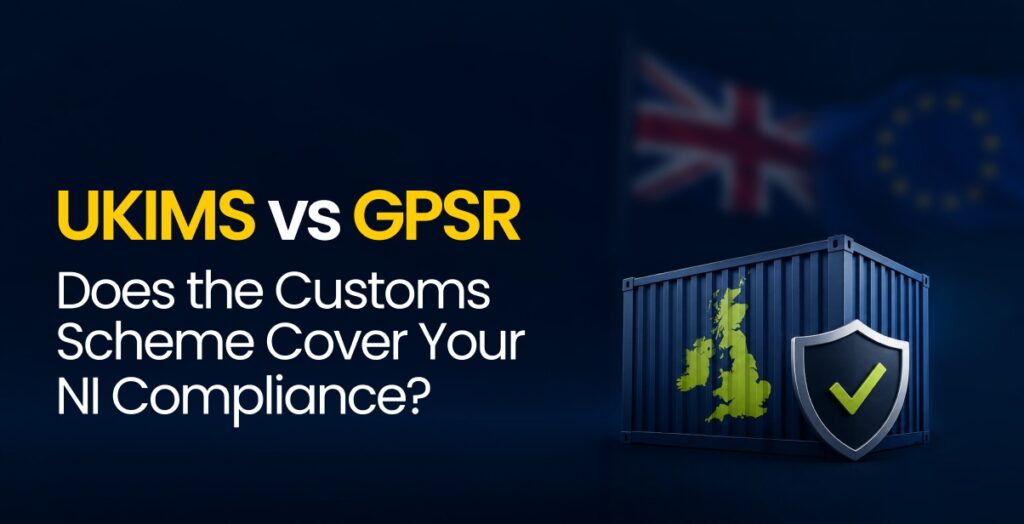

UKIMS and GPSR: Why a Customs Scheme Doesn’t Cover Product Safety in Northern Ireland
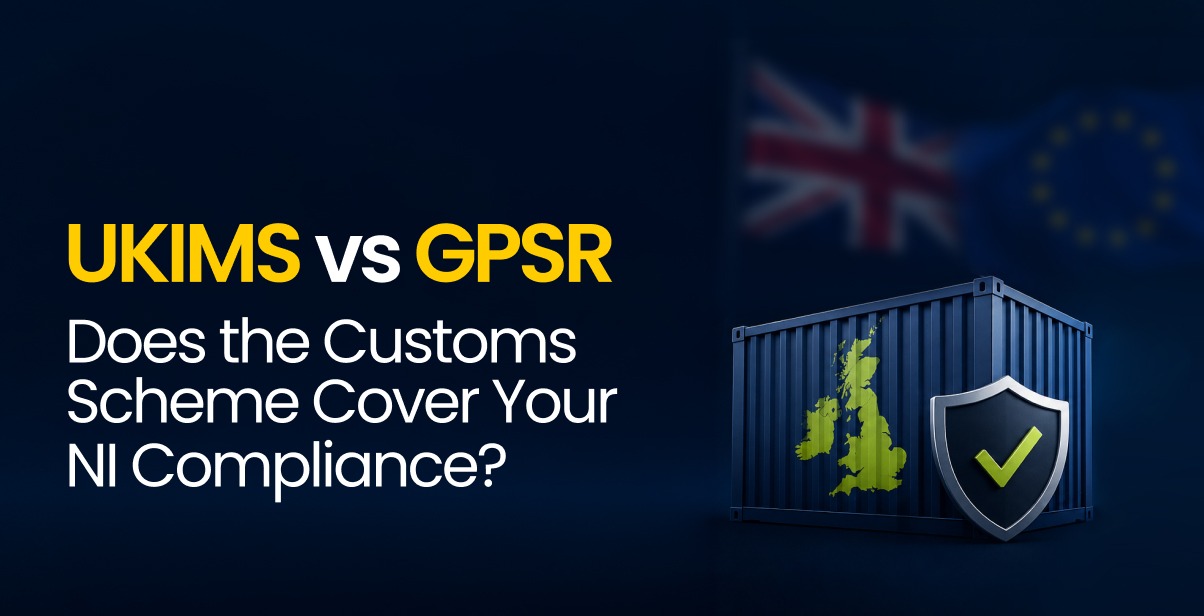
If you move goods from Great Britain into Northern Ireland, you’ve likely dealt with UKIMS. A question we hear often is whether a “not at risk” declaration under the scheme also covers product compliance. It doesn’t. UKIMS and product safety law come from different legislation, are checked by different authorities, and answer different questions entirely.
Take a typical example. A GB-based homeware brand supplies a wholesaler whose entire customer base is in Northern Ireland, with nothing moving on into the Republic of Ireland. That’s a reasonable basis for declaring the goods “not at risk” for customs purposes. It has no bearing on whether those products can legally be sold in Northern Ireland. That’s a separate question, and it needs its own answer.
UKIMS vs GPSR at a glance
| UKIMS (“not at risk” declaration) | GPSR (General Product Safety Regulation) | |
| What it covers | Whether EU customs duty is payable on goods moving GB to NI | Whether a consumer product is safe and can be placed on the NI market |
| Legal basis | UK Internal Market Scheme, under the Windsor Framework’s customs arrangements | EU Regulation 2023/988, applied in NI via the Windsor Framework |
| Who it applies to | Traders moving goods across the Irish Sea | Every economic operator placing a consumer product on the NI market |
| Does the goods’ final destination matter? | Yes, it depends on the goods staying inside the UK with no onward EU movement | No, it applies regardless of how goods were declared at the border or where they end up |
| What “not at risk” gets you | Relief from EU customs duty | Nothing. Product safety law has no equivalent relief |
| In force since | 30 September 2023, replacing the UK Trader Scheme | 13 December 2024, in Northern Ireland |
Does UKIMS affect GPSR obligations in Northern Ireland?

No. Under the Windsor Framework, Northern Ireland continues to apply EU goods legislation. EU Regulation 2023/988, the General Product Safety Regulation, has covered consumer products placed on the NI market since 13 December 2024.
This applies to every consumer product placed on the NI market, regardless of how it crossed the border or whether it moves any further. A shipment can carry a valid “not at risk” declaration and still fall short of GPSR. The two run alongside each other, and one doesn’t stand in for the other. Customs is checking duty status. Nobody there is looking at your technical file or your labelling.
This is where the confusion usually starts, because the paperwork that moves goods smoothly across the Irish Sea has nothing to do with the paperwork a market surveillance authority will ask for once those goods are on sale in Belfast or Derry.
Do non-regulated products have an easier path?
Easier than CE-marked products, yes. Free of obligations, no.
Non-harmonised products, meaning anything outside sector-specific EU rules like those for toys or electronics, don’t need CE marking, a Declaration of Conformity, or a notified body. That cuts out a lot of work. But you still need:
- Internal risk analysis and technical documentation for each product, kept for 10 years
- Traceability marking (type, batch, or serial number) on the product or its packaging
- Your name, postal address, and email address on the product, packaging, or an accompanying document
- The responsible person’s name and address, shown the same way
- Warnings and safety information in a language consumers understand
- The required product information in your online listing, if you sell into NI online
- A register of complaints and non-conformities, and a route to notify authorities through the EU Safety Gate
For most non-regulated ranges, this comes down to documentation and artwork rather than testing. That’s the real saving. But it’s not the same as having no obligations, and businesses that treat “non-harmonised” as “unregulated” are the ones most likely to hear from a market surveillance authority after launch.
Do you need a Responsible Person or Authorised Representative?
Yes, for CE and UKCA-regulated products. And yes, for non-regulated products too.
Every consumer product on the NI market needs a responsible economic operator based in Northern Ireland or the EU. Article 4 of the Market Surveillance Regulation covers CE-marked categories, and Article 16 of GPSR covers everything else. A GB-established business can’t take on this role itself for Northern Ireland, even though the goods stay within the UK. NI applies EU product law, and EU product law requires an EU or NI-established responsible person, not a UK one.
If you already have an EU Authorised Representative under an existing mandate, and that entity is EU-established, it usually meets the NI requirement as well, so a new appointment may not be needed. Two things are worth checking first:
- Whether the specific product range actually falls within the scope of your existing mandate
- Whether your packaging and labelling correctly show the responsible person’s details
Mandates often cover a brand’s core range but miss a newer product line, and labelling can lag behind a compliance appointment by months. Both are easy gaps to overlook, and both are easy to fix once someone checks.
UKCA marking doesn’t work in Northern Ireland
For CE and UKCA-regulated products, UKCA marking isn’t valid in Northern Ireland. NI requires CE marking. If any of your products are UKCA-only, that’s a real obstacle to selling into NI, and a more serious problem than the GPSR points above, because it isn’t a documentation gap. It’s a marking your product isn’t legally allowed to carry there.
If your conformity assessment was done by a UK approved body instead of an EU notified body, you’ll also need the UKNI mark alongside CE. This gets missed even by businesses with otherwise strong compliance records, because it only becomes an issue when the assessment route involved a UK body.
Where this leaves you
UKIMS answers a customs question: is duty payable at the border. GPSR and the Market Surveillance Regulation answer a different one: can this product legally be sold in Northern Ireland. Treating a “not at risk” declaration as proof of compliance is a common mistake, and it’s usually a customer, retailer, or authority who points out the gap, not a customs officer.
If you want to check whether your product range sits within an existing mandate, or where your SKUs fall between non-harmonised and regulated, get in touch. We can screen your product list and flag anything to sort out before the first shipment goes out.