
PPWR and Food Glass Packaging: Why “Glass Is Recyclable” Isn’t the Same as Compliant
Ask most food glass packaging suppliers or food brands about PPWR, and you’ll likely hear the same response. Glass is one of the most recyclable materials out there, so this regulation isn’t really their concern.
But that thinking misses how PPWR, Regulation (EU) 2025/40, actually works. The regulation doesn’t look at your bottle on its own. Instead, it looks at the whole food glass packaging system, including parts that were never made of glass in the first place.
PPWR Compliance for Glass Packaging: Why the Whole System Matters, Not Just the Jar
A food product in a glass jar is never packaged in glass alone. There’s usually a metal or plastic closure, a liner or gasket inside that closure, an induction seal, a label, and the adhesive that holds the label in place. Under PPWR’s chemical restriction rules, each of these components is checked separately. The fact that the jar itself is inert, food-safe glass doesn’t protect the other parts.
In short, passing compliance on the jar tells you nothing about whether the cap passes too.
PPWR PFAS Limits for Food Packaging Explained
From 12 August 2026, PPWR sets limits on PFAS in food-contact packaging. There are three thresholds to know:
● No more than 25 micrograms per kilogram for any single PFAS substance
● No more than 250 micrograms per kilogram for the combined total of targeted substances
● No more than 50 milligrams per kilogram for total PFAS, including polymeric forms
Glass itself almost never contains PFAS. The real risk sits in the components that touch or seal against the food. And those components differ depending on what’s inside the jar.
So it helps to go through this category by category.
1. PFAS Risk in Honey Jar Packaging
Honey jars usually use a metal twist-off lid with a compound gasket that seals against the glass rim. This gasket has traditionally relied on plasticized formulas to create a long-lasting seal. As a result, it’s the part most likely to have never been tested against the specific PFAS thresholds, rather than just older, general food-contact safety checks. Honey is also often exported and stored on shelves for long periods. Because of this, brands in this category are more likely to use a closure supplier who is several steps removed from the original resin or coating manufacturer. So getting a real Certificate of Analysis, rather than a general assurance, becomes even more important, not less.
2. PFAS Risk in Oil Bottle Packaging (Olive Oil, Cooking Oils, Dressings)
Oils are the category most likely to use a pour spout, cap liner, or induction seal chosen specifically for grease resistance. This is because oil is tough on ordinary seals over time. Grease-resistant coatings and liners are exactly the kind of component that has long used PFAS across food-contact packaging, thanks to its resistance to fat and oil. So if a closure performs well on an oil bottle because it resists grease, that’s exactly why it’s worth checking closely.
3. PFAS Risk in Sauce and Pickle Jar Packaging
Pasta sauce, pickles, and similar products usually combine a metal lug or twist cap with an internal plastisol or PVC-based liner. This liner is chosen because it seals well against acidic, moist contents during processing steps like hot-fill or pasteurization. These liners are a known area of regulatory attention for legacy substances in general, and PFAS-based release agents or coatings have shown up in similar sealing components in other food categories. So if your sauce or pickle jars haven’t had their cap liners tested against the current thresholds, that’s where to start, not the jar.
4. PFAS Risk in Baby Food Packaging
Baby food faces the highest scrutiny of any category here, from both regulators and parents. It’s usually packaged with an extra layer of tamper-evidence: an induction seal beneath the cap, sometimes paired with a secondary safety button lid. That’s one more food-contact layer than a honey or sauce jar has, which means one more component to test. Given how sensitive this category is, it’s advisable treating the induction seal liner as a priority for PFAS and heavy metal testing well ahead of the August 2026 deadline. Don’t assume a supplier’s general food-safety certification already covers it.
Who Is the Legal Manufacturer Under PPWR?
Under Article 3(1), point (12) of PPWR, the entity legally responsible for the packaging is whoever’s brand or name appears on it, not whoever physically made it. That manufacturer status is what then triggers the Declaration of Conformity obligation under Article 39. For a jar of honey, sauce, oil, or baby food, that usually means the food brand, not the glass converter who molded and supplied the jar. So if your company’s name is on the label, PPWR treats you as the manufacturer of that packaging. That means the obligation to draw up the Declaration of Conformity sits with you.
There is one narrow exception to be aware of. Under Article 3(13)(b), if your business qualifies as a micro-enterprise and your packaging supplier is based in the same EU member state as you, the obligation shifts to your supplier instead. This only covers genuinely micro-sized businesses sourcing locally within the same country. So it won’t apply to most brands importing glass jars from a different member state or from outside the EU. Outside that narrow case, assume your own brand carries the obligation, not your packaging supplier.
There’s a second nuance worth flagging for brands working with co-packers or under license. If one company’s name appears on the jar (say, a co-packer or contract filler) but another company’s trademark is also on it, the manufacturer is whichever company actually determines the packaging’s design and specifications, not automatically the trademark owner. If your licensor mandates a specific jar, cap, or seal spec to keep packaging consistent across markets, the licensor is the manufacturer. If they simply let the trademark appear without dictating packaging characteristics, they aren’t. This is a case-by-case call based on the contractual relationship, so it’s worth checking your co-packing or licensing agreement rather than assuming.
PFAS Isn’t the Only Substance PPWR Is Watching
PFAS gets the attention because it has hard numerical limits. But PPWR’s Article 5(1) obligation is broader: packaging must minimise substances of concern generally, not just PFAS and the four heavy metals covered above. This includes substances with carcinogenic, mutagenic, or reproductive toxicity classifications, endocrine disruptors, and substances that are persistent and bioaccumulative, as defined by the Ecodesign for Sustainable Products Regulation.
For food glass packaging, this matters most for the same components already under scrutiny for PFAS: cap liners, gaskets, induction seal coatings, and label adhesives. There’s no fixed concentration limit for most of these substances yet, but the obligation to minimise their presence applies from 12 August 2026, the same date as the PFAS limits. It’s worth asking suppliers directly whether liner and coating formulations have been screened against this wider substance list, not just tested for PFAS.
What to Include in a PPWR Technical File for Food Glass Packaging
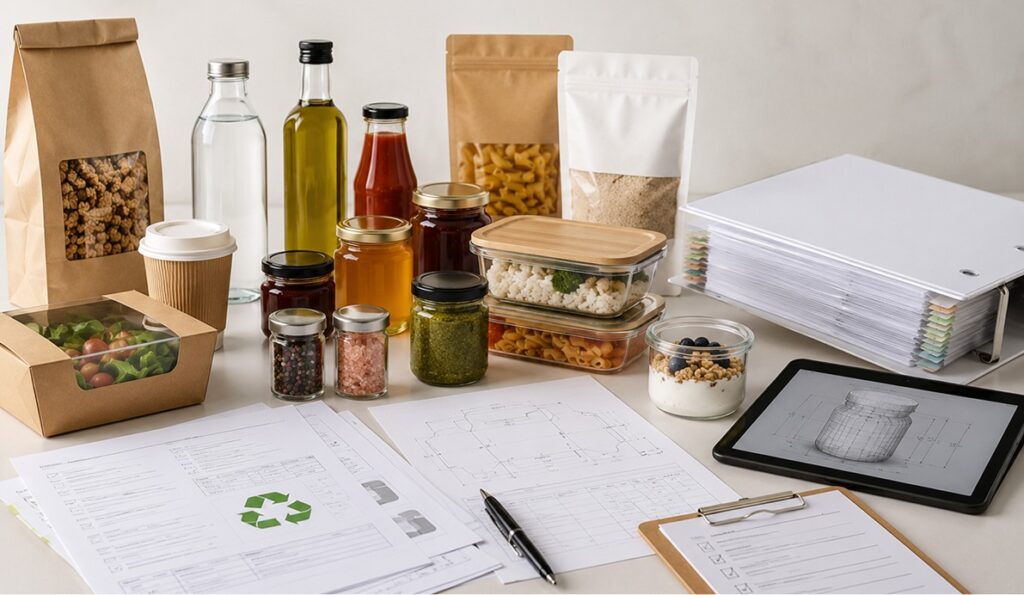
A defensible Declaration of Conformity for a food glass jar isn’t a one-page form. It needs a technical file behind it that covers the whole packaging system. That file should include:
● Substance declarations and, where needed, Certificates of Analysis for the closure, liner, and any coating, specifically addressing PFAS and the separate 100 mg/kg combined heavy metals limit for lead, cadmium, mercury, and hexavalent chromium
● Material datasheets for the label and its adhesive
● Documentation showing which of Articles 5 to 12 the packaging system is being declared against
One important detail: if a Certificate of Analysis doesn’t state a limit of quantification below the 25 microgram threshold, it doesn’t actually prove compliance. This file must be kept for five years for single-use packaging.
PPWR Anti-Greenwashing Rules: Why Your “Recyclable” Label Claim Needs Proof
The EU’s harmonised sorting pictogram doesn’t become mandatory until 12 August 2028, so that isn’t the urgent deadline here. What matters right now is PPWR’s anti-greenwashing provision, which restricts unverified sustainability claims on packaging. Many glass jar labels already carry a home-grown “recyclable” leaf icon that isn’t tied to any real certification. So if your current label makes a recyclability claim that isn’t backed by a recognised scheme, it’s important to review it before either rule tightens further.
PPWR Compliance Checklist for Food Glass Packaging Brands
Before your next production run, it is recommended that you confirm:
● Whether your closure, liner, and induction seal have been tested for PFAS against the actual thresholds, with a Certificate of Analysis and a low enough limit of quantification, not just a supplier assurance
● Whether your label adhesive and any print coatings have been checked for the same substances
● Who legally counts as the manufacturer for each packaging format you use
● Whether any sustainability icon on your label is backed by a certification that would hold up to scrutiny
How to Stay PPWR Compliant Without Redesigning Your Glass Packaging
None of this means redesigning the jar. Glass remains one of the strongest options for food packaging, precisely because the material itself carries so little regulatory risk. The real work is about evidence. It means getting the right test data from your closure and label suppliers for your specific product category, tying that data to the correct packaging component, and keeping it organised under a Declaration of Conformity that names the right legal manufacturer.
Euverify’s PPWR wizard turns that supplier and component data into a Declaration of Conformity and Annex VII technical file in one flow. It can also act as your Article 17 Authorised Representative if you’re a non-EU brand selling glass-packaged food into the EU.
Selling glass-packaged food into the EU from outside it? Book a discovery call to see how Euverify can handle your compliance file and Article 17 representation.