EU Packaging EPR (Extended Product Responsibility) Compliance Guide: What Businesses Need to Know
Packaging is everywhere. From the cup holding your morning yogurt to the box your latest phone came in. It makes products easy to store, ship, and use, but it also creates a huge amount of waste, consumes natural resources, and often harms the environment.
To tackle this, the European Union is tightening the rules with the new Packaging and Packaging Waste Regulation (PPWR). If your business makes, imports, or sells packaged goods in the EU, compliance isn’t optional anymore.
This guide breaks down what Packaging EPR (Extended Producer Responsibility) means, what the PPWR requires, when the rules take effect, and the steps your business should take to stay compliant.
What is Extended Producer Responsibility (EPR) for Packaging?
At its core, EPR means that the companies placing packaging on the market are responsible for what happens to it once consumers are finished with it. That responsibility covers collection, recycling, take-back systems, and proper waste management.
Key parts of EPR:
- Who’s responsible: This can be the manufacturer, importer, brand owner, or retailer. Whoever introduces the packaged product into the market.
- Costs & obligations: Businesses may need to pay fees, join a Producer Responsibility Organisation (PRO), and comply with rules on labelling, documentation, and recyclability.
- Design incentives: Packaging that’s easier to recycle, uses less virgin material, or reduces waste (e.g. less plastic, more reuse) can lower EPR fees or help avoid penalties.
From Directive to Regulation:Previously, the EU relied on the Packaging & Packaging Waste Directive (PPWD, Directive 94/62/EC), which required member states to set up systems for collection and recycling. But because it was only a Directive, each country implemented it differently. The new Packaging and Packaging Waste Regulation (PPWR) makes many of these obligations more harmonised across the EU — bringing clearer, more consistent rules for businesses.
EU Packaging and Packaging Waste Regulation (PPWR) – The Big Shift

What is PPWR
The Packaging and Packaging Waste Regulation (PPWR, Regulation (EU) 2025/40) was adopted in December 2024 and published in the Official Journal in January 2025. It replaces the old Packaging & Packaging Waste Directive (94/62/EC).
The key difference? Because it’s a Regulation and not a Directive, it applies directly across all EU member states as soon as it takes effect. That means less variation between countries and more consistent rules for businesses operating in the EU.
Key Requirements & Timelines
- Entry into force: The regulation takes effect in February 2025, with some provisions applying immediately. Most obligations will fully apply from 12 August 2026.
- Scope: Applies to all packaging materials (plastic, paper, metal, glass, etc.), across both B2B and B2C, including packaging used in manufacturing, distribution, and sales.
- Sustainability & waste prevention: Businesses must minimise packaging weight, cut down on empty space, and avoid unnecessary overpackaging.
- Recyclability targets: By 2030, all packaging must be recyclable. Additional rules set minimum recycled content requirements, especially for plastics.
- Restrictions on substances: Certain harmful chemicals will be restricted. For example, PFAS in food packaging, and heavy metals like lead, cadmium, mercury, and hexavalent chromium (within strict thresholds).
- Labelling & documentation: Companies must provide technical documentation, traceability information, and standardised labelling to prove compliance with the regulation.
How Packaging EPR Works in Practice
Who Must Comply?
If your business does any of the following in the EU, the PPWR and EPR rules will almost certainly apply:
- Manufacture packaging or packaging materials
- Import packaged goods into the EU market
- Use packaging for your own products (as a brand, retailer, or e-commerce business)
- Supply or distribute packaging, or sell packaged products
Even if you don’t make packaging yourself, the moment you place packaging on the EU market, you become responsible for meeting EPR obligations.
Producer Responsibility Organisations (PROs)
In most EU Member States, EPR schemes are run by collective organisations known as PROs. These entities:
- Manage the collection and recycling of used packaging waste
- Handle finances: producers pay fees, and PROs use those funds to operate the system
- Differentiate fees based on material type, recyclability, or eco-design features (e.g., easily recyclable plastic may carry lower fees than mixed plastics)
Fee Structures & Eco-Modulation
Under the PPWR, fee systems are shifting to reward sustainable packaging design, recyclability, and reuse. A principle known as eco-modulation.
Examples:
- Lower fees for packaging made from recycled plastics or materials that can be easily separated for recycling
- Higher fees for packaging that is hard to recycle or contains substances of concern
Reporting & Documentation
To comply with the PPWR, businesses will need to:
- Register with national or regional EPR schemes or authorities
- Track and report the amount of packaging placed on the market, including weight, material type, and recyclability
- Maintain documentation such as Declarations of Conformity (DoC) and technical files proving compliance
- Label packaging where required, including material information and recyclability instructions
Enforcement & Penalties
Non-compliance under the PPWR comes with real consequences, which may include:
- Fines or financial penalties imposed under national laws
- Market restrictions, meaning non-compliant packaging or products could be banned from sale
Reputation risks, as unsustainable or non-compliant packaging can draw criticism from consumers, NGOs, and the media
Who is Affected by Packaging EPR?

Packaging EPR is not just about packaging manufacturers. It covers any business placing packaging on the EU market. Under the PPWR, the “producer” is broadly defined, meaning responsibility doesn’t stop at factories. If you’re the first to place packaged goods (or packaging materials) into circulation in the EU, you’re likely in scope.
Brands and Retailers
If you sell products in packaging, whether you manufacture them yourself or have them made by third parties, you’re responsible. This includes everything from FMCG and cosmetics to electronics and fashion brands. Even small retailers with private-label products need to comply.
Importers and eCommerce Businesses
If you bring packaged goods from outside the EU into the EU market, you’re considered the producer for compliance purposes. This applies to global brands, Amazon/Shopify sellers, and third-party vendors alike. Importers must register, report packaging data, and pay EPR fees just like domestic producers.
Suppliers of Packaging Materials
Companies producing packaging materials such as films, bottles, containers, closures, or labels are also in scope when they place these items on the market. If your business sells packaging that is intended for use by others, you may carry EPR responsibilities unless the downstream brand has already taken them on.
Distributors and Fulfilment Services
Distribution and fulfilment providers (especially in eCommerce) are covered when they place transport packaging, grouped packaging, or sales packaging into circulation. This includes outer boxes, filler materials, and even the amount of empty space in shipments. Online marketplaces are specifically addressed in the PPWR, with obligations to ensure third-party sellers comply.
B2B Packaging
EPR doesn’t stop at consumer-facing products. Business-to-business packaging, such as pallets, shrink wrap, strapping, crates, and industrial packaging, also falls under the PPWR. Even if the end user isn’t a consumer, businesses must still report this packaging, ensure recyclability, and meet the new design and documentation requirements.
Packaging EPR in Key Sectors: What It Means in Practice
Food & Beverage
The food and beverage sector is among the most impacted by Packaging EPR. Common materials like single-use plastics, multilayer cartons, and composites for drinks or ready-to-eat meals now face tougher recyclability rules. Brands are also being pushed toward reusable and refillable systems, especially for takeaway and delivery. On top of that, labels must clearly show recycling instructions and material content. So even a simple yogurt pot has to meet new design and communication standards.
E-Commerce & Retail
The rise of online shopping has also meant a surge in packaging waste, including oversized boxes, fillers, and excessive wrapping. Under the PPWR, e-commerce sellers must reduce “empty space” and avoid unnecessary double-boxing. Marketplaces like Amazon already require proof of EPR registration in the EU, and this is likely to become the norm across platforms. For sellers, compliance will mean striking a balance between protecting products in transit and meeting strict new rules on efficiency and recyclability.
Cosmetics & Personal Care
Cosmetics often use small containers, pumps, sachets, and mixed-material packaging that’s notoriously hard to recycle. Under Packaging EPR, these formats will come under growing pressure to shift toward mono-material, recyclable alternatives. At the same time, the EU is tightening limits on harmful substances in inks, coatings, and plastics. Many plastic bottles and tubes will also need to meet minimum recycled content requirements—pushing the industry to rethink packaging design and supply chains.
Electronics & Appliances
Electronics packaging often relies on a mix of protective materials like foam inserts, multilayer films, and heavy cardboard. These are combinations that are hard to recycle and more expensive under eco-modulated EPR fees. On top of existing WEEE obligations for electronic waste, brands now face new packaging responsibilities. Cutting down on non-recyclable protective materials and shifting to lighter, recyclable, and innovative designs will be essential for staying compliant and cost-efficient.
Logistics & B2B Packaging
Packaging EPR goes beyond consumer products. It also covers packaging used in logistics and B2B supply chains, such as pallets, shrink wrap, and strapping. Companies must include these materials in compliance reporting, but they can also reduce costs and improve sustainability by shifting to reusable or standardised transport packaging. Given the large volumes involved, even small changes in design or materials can create big compliance and efficiency gains.
Packaging EPR vs Textile EPR – Which is Bigger, Which is More Urgent?
Textile EPR focuses on clothing, footwear, and household fabrics, making producers responsible for textile waste collection and recycling. While it’s key for fashion and apparel, its scope is narrower. Packaging EPR, on the other hand, touches every sector, which is why it’s more urgent for most businesses.
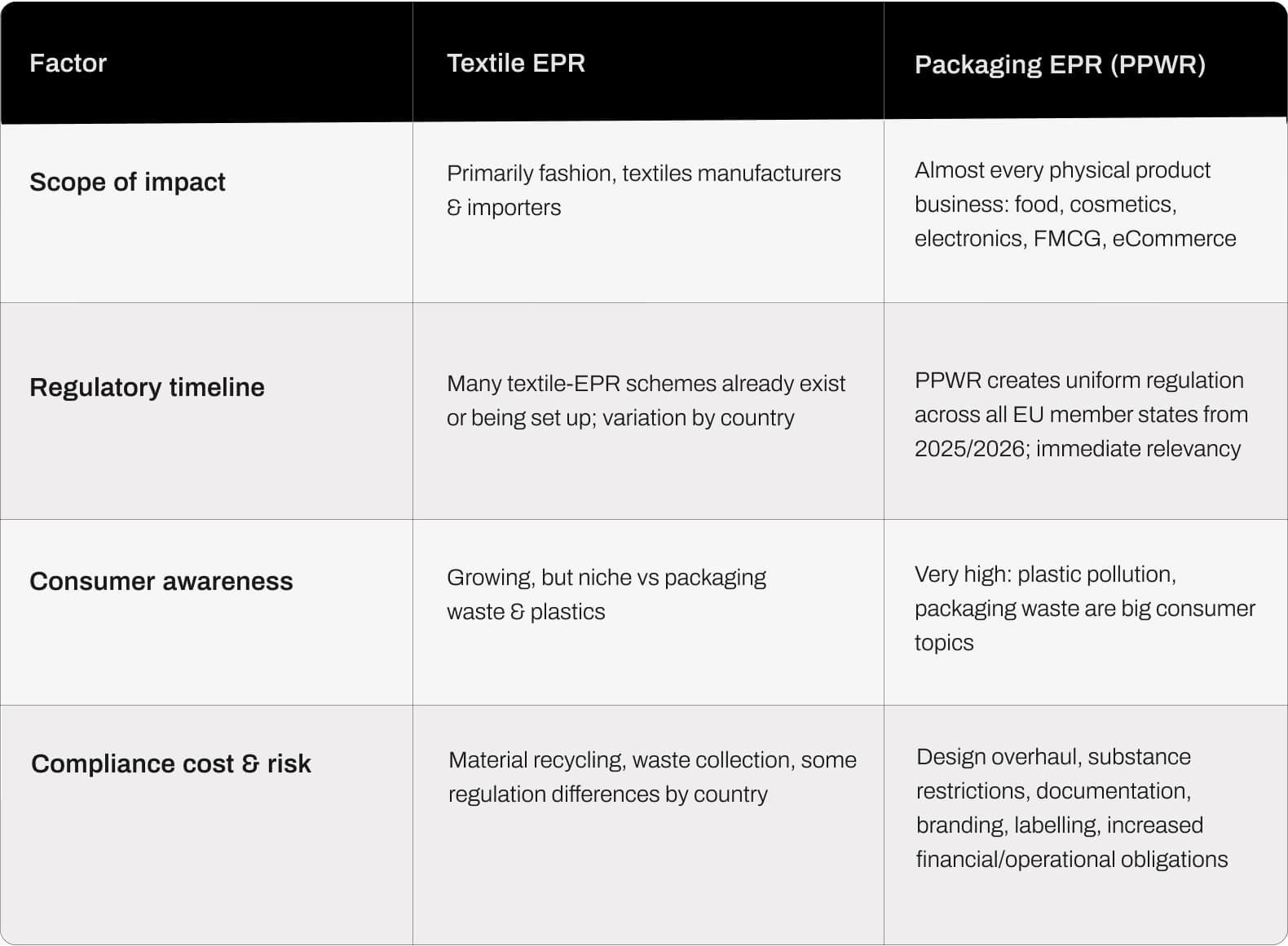
Because packaging is everywhere, the PPWR impacts a wide range of businesses. With growing regulatory pressure and heightened consumer awareness around plastic waste, recycling, and resource use, Packaging EPR is under the spotlight. Companies that fail to adapt risk not just fines, but also public and media scrutiny.
Practical Steps to Stay Compliant in Packaging EPR
Here’s a roadmap for businesses to adapt:
- Audit your packaging
- Identify what packaging you use: materials, packaging type (sales, grouped, transport, etc.), recyclability, weight, empty space.
- Map out suppliers and whether packaging components meet sustainability guidelines.
- Register with EPR schemes in relevant countries
- If you sell in multiple EU Member States, figure out where you need to register and report.
- Join PROs or national schemes; sometimes you’ll need to work with partners who have local presence.
- Redesign packaging for sustainability
- Use more recycled content.
- Reduce weight, avoid non-recyclable additives or mixed materials.
- Minimise “empty space” (buffering, filler materials) especially in grouped or transport packaging.
- Consider reuse/refill systems where applicable.
- Substance & labelling compliance
- Check if any substances you use (inks, coatings, adhesives, PFAS, heavy metals) are restricted under PPWR.
- Ensure packaging is labelled properly (material identification, recycling instructions).
- Prepare technical documentation, declarations of conformity.
- Track and report packaging placed on the market
- Keep accurate records: weight, material types, recycling rates, packaging waste statistics.
- Ensure you meet any deadline-driven targets (these may vary by material and packaging type).
- Be ready for audits or requests by regulators.
- Stay updated and engage with policy
- PPWR is new; secondary legislation, delegated acts, implementing acts will flesh out many specifics (e.g. exact recyclability criteria, eco-modulation rules, labelling standards).
- National rules may also add extra requirements.
- Participation in industry associations or working groups helps get early info.
Comparison: PPWR vs Previous Packaging Laws

applied the rules, leading to inconsistencies in enforcement and definitions.
The new PPWR changes that. It creates uniform obligations across all member states, reducing variation and driving harmonisation.
Compared to the old system, the PPWR places much stronger emphasis on:
- Designing packaging for recyclability and reuse
- Meeting minimum recycled content requirements
- Avoiding harmful substances
- Providing mandatory documentation and proof of compliance
These areas were previously weaker or left optional but are now central to the new regulation.
Final Takeaway
The new EU rules make Packaging EPR a reality for every business putting packaging on the market. The deadlines are clear, the penalties are real, and ignoring them isn’t an option.
But there’s another side to this story. Done right, the same rules can help businesses cut waste, design smarter packaging, and show customers they’re serious about sustainability. It’s not just about avoiding fines. It’s about staying competitive in a market that’s moving quickly toward greener standards.
If you sell across different EU countries, the details can feel complicated. The best place to start is by understanding what packaging you use, how it fits the new requirements, and what you need to document. From there, it’s about building a system that keeps you compliant as the rules evolve.
At Euverify, we work with companies to make this process easier. We help them untangle the requirements, get their paperwork in order, and stay ahead of changes. That way, compliance becomes less of a burden and more of an opportunity to build trust with customers.