EUDR Product Scope Changes: New Exemptions, Removals and What They Mean for Your Business
If you’ve been trying to work out whether your products fall under the EU Deforestation Regulation (EUDR), the answer may have changed.
The European Commission has rewritten Annex I of Regulation (EU) 2023/1115. Annex I is the list that sets out exactly which commodities and products are in scope. The changes were adopted on 13 July 2026 as Delegated Regulation (EU) 2026/2102. They were published in the Official Journal on 17 September 2026 and entered into force on 18 September 2026.
Some products are now out of scope. New exemptions apply. A few products are being added, but not until December 2027. And long-standing questions about product classification have finally been answered.
This article explains what changed, when each change applies, and what you still need to do before the main EUDR deadline on 30 December 2026.
The Key Dates at a Glance
| What | When |
|---|---|
| Removals, exemptions and clarifications apply | 18 September 2026 |
| EUDR applies to large and medium operators | 30 December 2026 |
| EUDR applies to micro and small operators | 30 June 2027 |
| Newly added products come into scope | 30 December 2027 |
What the EUDR Covers
The EUDR applies to relevant products placed on the EU market, made available within it, or exported from it. A product is in scope if it’s listed in Annex I and contains, has been fed with, or has been made using a relevant commodity.
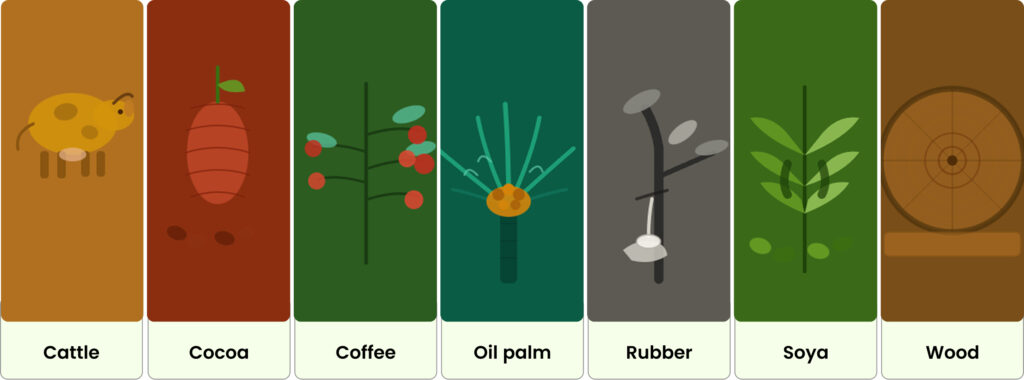
The seven relevant commodities have not changed: cattle, cocoa, coffee, oil palm, rubber, soya and wood.
The new Annex I also defines some of these commodities more precisely:
- Cattle means animals of the genus Bos
- Oil palm means Elaeis species
- Rubber means natural rubber from Hevea brasiliensis
- Wood does not include bamboo, rattan or similar materials
Several entries now carry an “ex” prefix. This means only products made from a relevant commodity are covered, not everything under that customs code. For example, products made from coconut oil, bamboo or synthetic rubber that share a code with an in-scope product are confirmed as out of scope.
Products Currently in Scope
Here’s what Annex I covers following the changes. Always check your specific CN codes against the official text.
Cattle: Live cattle; fresh, chilled and frozen meat; edible offal, fresh or chilled; frozen livers and other frozen offal; and prepared or preserved meat and offal. Hides, skins and leather are no longer in scope.
Cocoa: Cocoa beans; shells and waste; cocoa paste, butter, fat and oil; cocoa powder; chocolate and other food preparations containing cocoa.
Coffee: Coffee, whether or not roasted or decaffeinated; coffee husks and skins; and coffee substitutes containing coffee.
Oil palm: Palm nuts and kernels; palm oil and its fractions; palm kernel oil and its fractions; oilcake and residues; glycerol; palmitic and stearic acids and their salts and esters; and industrial fatty acids and alcohols.
Rubber: Natural rubber in primary forms; compounded unvulcanised rubber; vulcanised rubber thread and cord; new pneumatic tyres; and tyre treads used for retreading.
Soya: Soya beans (excluding those for sowing); soya bean flour and meal; soya bean oil and its fractions; and oilcake and residues.
Wood: Fuel wood, chips and sawdust; charcoal; wood in the rough; sawn wood; veneer sheets; flooring strips; particle board, OSB and fibreboard; plywood and veneered panels; densified wood; pulp and paper (excluding bamboo-based and recovered products); wooden furniture; and prefabricated wooden buildings. Aircraft and motor vehicle seats are no longer covered.
Note: Printed books, newspapers and other printed products were removed from Annex I by Regulation (EU) 2025/2650. For more detail, see our articles EUDR Updates for Books and Publishing and EUDR for Books: What Publishers Must Know.
New Exemptions (Apply Now)
These exemptions apply across all commodities from 18 September 2026.
1. Samples and testing
Samples of negligible value used to win orders are exempt, as are products used up or destroyed during testing or analysis. This helps importers and manufacturers who ship small quantities for quality control or regulatory testing.
2. Single-use packaging
Single-use packing used only to support, protect or carry another product is out of scope, whatever it’s made of. This covers cardboard boxes, paper void fill and single-use wooden pallets. Packaging sold as a product in its own right, such as empty boxes sold to other businesses, is still in scope.
3. Reusable packaging
Reusable packaging is out of scope from the point it’s actually used to pack another product. The first sale of new reusable packaging can still be in scope. This matters for businesses moving to reusable formats under the Packaging and Packaging Waste Regulation (PPWR).
4. Marketing materials and correspondence
Paper-based catalogues, brochures, leaflets and similar marketing materials are exempt, as are items of correspondence. This answers a common question from brands selling across EU markets.
5. Waste
Products placed on the market as waste are exempt. This builds on the existing Annex I rule for goods made entirely from material that has reached the end of its life.
6. Used and second-hand products
Products already placed on the EU market do not trigger the EUDR again when resold in their used state. This matters for second-hand platforms, refurbishers and circular business models.
7. Medicinal products
There’s a narrow exemption for certain palm oil derivatives used to make human or veterinary medicines. It only covers that use. It is not a general exemption for the pharmaceutical sector.
Products Removed from Scope (Apply Now)
The proposed Delegated Act does not alter several things that remain fixed:
The seven core commodities remain unchanged. Cattle, cocoa, coffee, oil palm, rubber, soya, and wood are still the foundation of the regulation. No commodity has been removed from scope.
The compliance deadline is confirmed. The European Commission stated that there will be no third postponement. Under the consolidated text of the regulation, as amended by Regulation (EU) 2025/2650, the compliance deadline is 30 December 2026 for most operators. Micro and small undertakings that were established by 31 December 2024 have until 30 June 2027 to comply, unless they were already covered by the EU Timber Regulation.
The due diligence framework is unchanged. Operators placing relevant products on the EU market must still carry out due diligence under Articles 8 to 11. This includes collecting the required information, conducting a risk assessment, and applying risk mitigation measures where necessary.
The regulation still applies to the full Annex I product list. The proposed exemptions and removals are targeted. The vast majority of products currently in scope remain in scope.
The draft is not yet final. Public feedback closes 1 June 2026. The final Delegated Act may differ from the current draft. Businesses should not make definitive compliance decisions based solely on proposed exemptions that have not yet entered into force.
Products Added to Scope (From 30 December 2027)
These additions don’t apply until 30 December 2027, which gives businesses a year longer than the main deadline to prepare.
Soluble coffee: Instant and freeze-dried coffee (2101 11 00) comes into scope.
Frozen cattle tongues: Fresh tongues were already covered. Frozen tongues (ex 0206 21 00) are now added for consistency.
More palm oil derivatives: A longer list of oleochemicals comes into scope, including certain fatty alcohols, acids, amines, glycerol products and soaps. Cosmetics, personal care and chemical businesses using palm-derived ingredients should check their CN codes against the new Annex I now.
What Has Not Changed
The seven commodities. No commodity has been removed.
The deadlines. The Commission has confirmed there will be no further delay. The EUDR applies from 30 December 2026 for large and medium operators. Micro and small undertakings have until 30 June 2027, unless they were already covered by the EU Timber Regulation.
Due diligence for operators. Operators placing in-scope products on the EU market must still carry out due diligence under Articles 8 to 11. This means collecting information, assessing risk and reducing risk where needed.
Who This Affects and What You Should Do Now

If your only exposure was packaging:
Single-use packaging used to carry or protect your products is now out of scope. Document your scope assessment so you can show authorities why the EUDR doesn’t apply.
If you sell leather goods, footwear or accessories:
Cattle leather is out of scope from 18 September 2026. Keep an eye on the 2030 review, as leather could return.
If you sell rubber products such as belts or other moulded rubber items:
Check whether your CN codes are among the removals. Many rubber articles are now out of scope.
If you work with palm oil derivatives or soluble coffee:
Your exposure is increasing. You have until 30 December 2027, but supply chain mapping takes time. Start now.
If you are a trader or downstream operator:
Regulation (EU) 2025/2650 simplified your obligations. Downstream operators and traders no longer carry out due diligence or submit due diligence statements. You must keep records of your direct business partners. If you are the first downstream operator after the product enters the EU market, you must also keep the due diligence statement reference numbers you receive. Larger downstream operators and traders must register in the EUDR Information System.
If you are an operator placing products on the EU market:
Your due diligence obligations under Articles 8 to 11 apply from 30 December 2026. You must submit a due diligence statement through the EUDR Information System before placing products on the market.
Country Risk Classification
The Commission classified every country as low, standard or high risk in May 2025 (Implementing Regulation (EU) 2025/1093).
- Low-risk countries: Simplified due diligence applies. You still collect information, but a full risk assessment and risk mitigation are not required, unless you become aware of a risk of non-compliance.
- Standard and high-risk countries: The full due diligence process applies.
Micro and small primary operators in low-risk countries, such as farmers selling what they grow, can submit a one-time simplified declaration.
Check the current country list before you finalise your due diligence system, as the Commission can update it.
This article is based on Regulation (EU) 2023/1115 as amended by Regulation (EU) 2024/3234 and Regulation (EU) 2025/2650, and on Commission Delegated Regulation (EU) 2026/2102 amending Annex I, published in the Official Journal on 17 September 2026. This article does not constitute legal advice.