
PPWR Sorting Labels: What the New Pictogram Rules Mean for Your Packaging
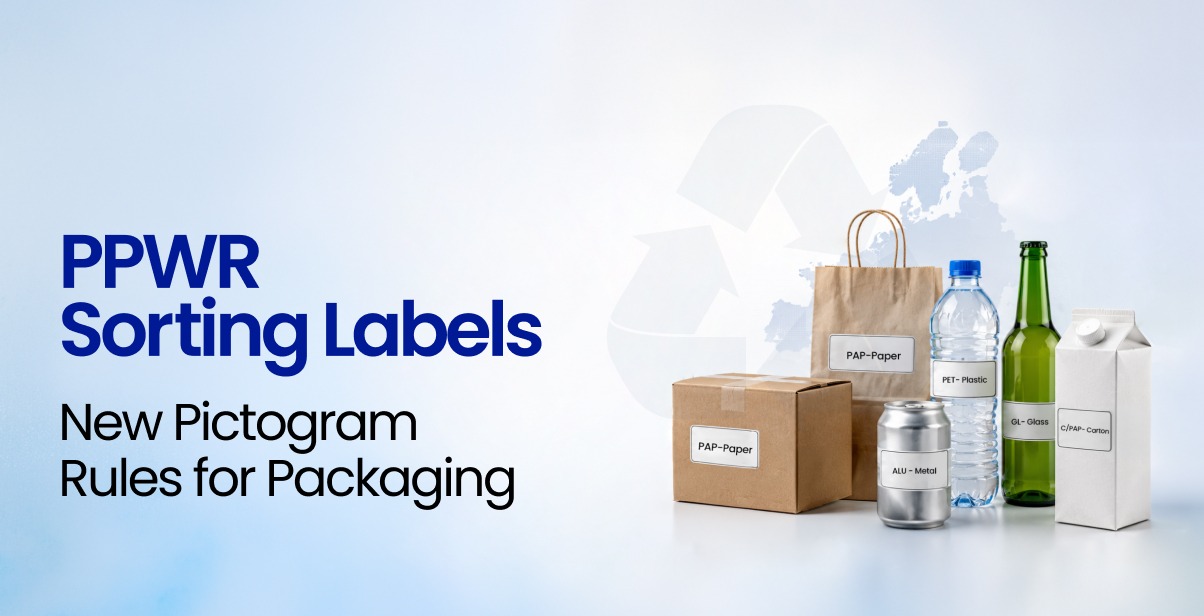
Packaging sold in the EU is about to get a standardised visual language. Under Article 12 of the PPWR, most packaging placed on the EU market will need a harmonised label based on pictograms. The label tells consumers what material the packaging is made from and how to sort it. Some PPWR provisions only touch back-office paperwork. This one changes what actually sits on the pack.
When Does the Sorting Label Requirement Start?
The obligation kicks in from 12 August 2028, or 24 months after the Commission’s implementing acts under Article 12(6) or (7) enter into force, whichever is later. The Commission must adopt the first of those implementing acts, covering how material composition gets identified, by 12 August 2026. So 2028 is the date to plan around.
There’s a second, later deadline for substances of concern, a category that draws on REACH’s candidate list of substances of very high concern, persistent organic pollutants, and substances meeting certain hazard classes under the EU’s CLP Regulation. The Commission has to adopt a separate methodology for digital-marking those substances by 1 January 2030. That marking must include, at minimum, the name and concentration of the substance of concern in each material.
Where Things Stand Before 2028
None of this happens overnight. The PPWR entered into force on 11 February 2025, and most of its provisions started applying from 12 August 2026. But the harmonised sorting label itself doesn’t switch on until 2028, so for now, existing national labelling systems keep running in parallel.
That includes France’s Triman logo and Info-tri sorting instructions, and the older EU-wide material identification system under Commission Decision 97/129/EC, the one behind the familiar numbered plastic codes. Both stay valid until 12 August 2028, when the harmonised label takes over and Member States lose the ability to require their own national labelling on top of it.
The visual design itself isn’t finalised either. The Commission’s Joint Research Centre has already circulated prototype pictogram designs and tested them with consumers and Member States, but the methodology only becomes binding once the Commission adopts its implementing act, due by 12 August 2026. Until that lands, treat any pictogram design you come across as a preview, not a final spec.
What the Label Actually Has to Show
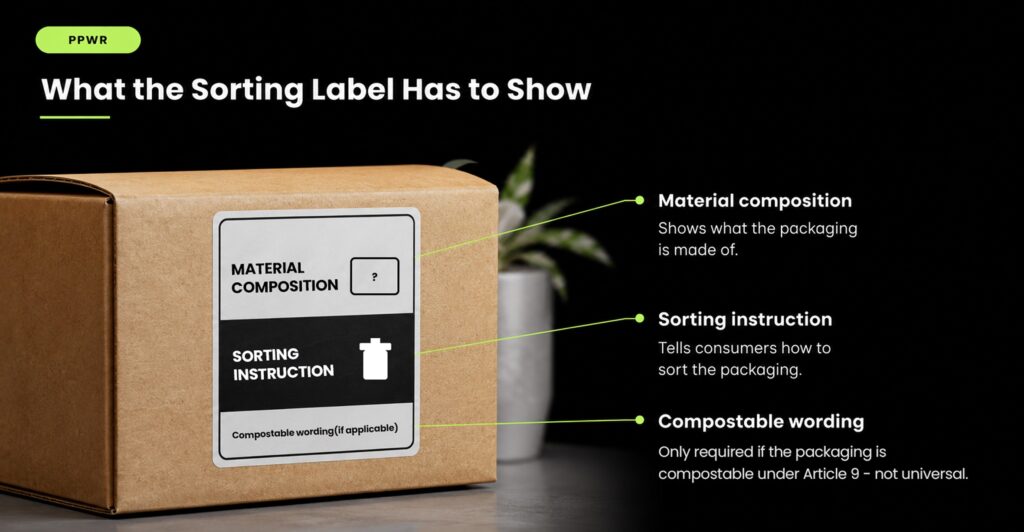
Illustrative only. Not the final pictogram artwork
The label has to be pictogram-based, and it needs to be easily understandable, including for people with disabilities. Its job is to communicate material composition clearly enough that consumers can sort the packaging correctly. If the packaging is compostable under Article 9, the label also has to say the material is compostable, that it isn’t suitable for home composting, and that it shouldn’t be thrown into nature.
Member States can also require a harmonised colour label on packaging that’s part of a deposit and return system, on top of whatever national labelling already exists, as long as that doesn’t create trade barriers within the EU.
Reusable Packaging Gets Its Own Label — On a Different Timeline
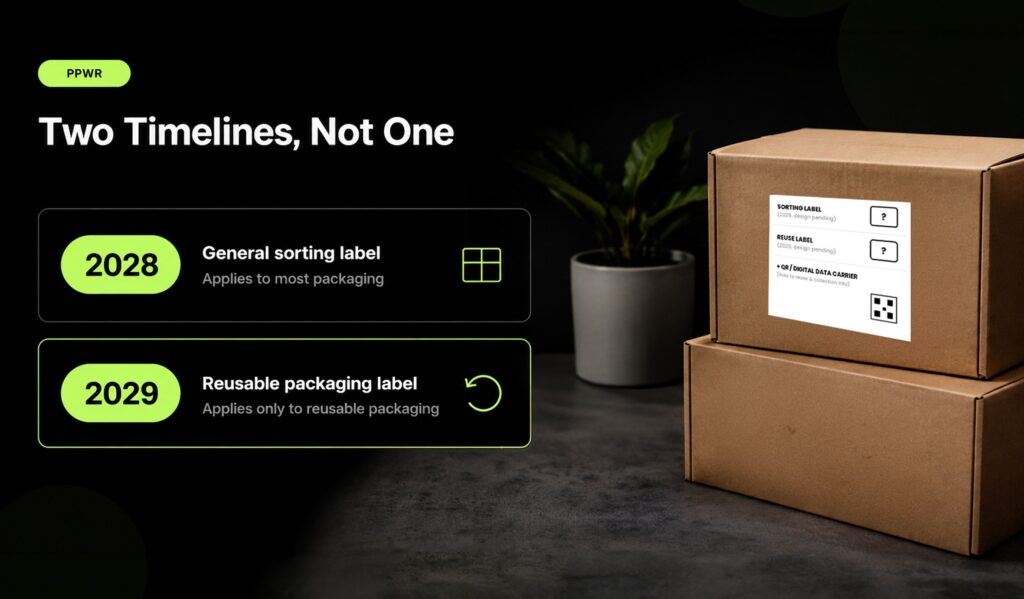
Timelines are confirmed by the PPWR. The pictogram artwork for each label is still pending separate Commission implementing acts.
This detail is easy to miss. Reusable packaging runs on a separate labelling deadline from the general sorting label. From 12 February 2029 (or 30 months from the relevant implementing act, whichever is later), reusable packaging needs a label telling users it’s reusable, plus a QR code or similar digital data carrier linking to information about available reuse systems and collection points. If personal data gets collected through that digital carrier, it can only be used to give the user access to the compliance information itself. Not for marketing.
Who’s Exempt
Not everything needs the sorting label. The main carve-outs are:
- Transport packaging
- Packaging already subject to a deposit and return system (e-commerce packaging is the exception here and stays in scope)
- Packaging used in open loop systems without a system operator under Annex VI
If your packaging falls into one of these categories, document why. That reasoning belongs in your technical file.
Who’s Responsible for Getting the Label Right
Labelling obligations under the PPWR sit with whoever is legally the manufacturer: generally the business whose name or brand appears on the packaging, or the business that commissioned the packaging design even if someone else’s name isn’t on it.
Where that manufacturer is based outside the EU, responsibility for labelling compliance shifts to the importer bringing the packaging into the EU market. That’s worth flagging early if you work with fulfilment partners or private-label manufacturers overseas, since it’s easy to assume the obligation stays with the factory rather than the business actually placing goods on the EU market.
Separately, and this catches people out more often, producers also need to register for extended producer responsibility in every Member State where they sell. Non-EU producers typically need to appoint an authorised representative to handle that registration on their behalf. Getting the sorting label right and meeting EPR registration obligations are two different compliance tracks, but they tend to land on the same desk.
The Anti-Greenwashing Clause Most Articles Skip
Article 12(8) deserves its own mention. Businesses can’t display labels, marks, or symbols likely to mislead or confuse consumers about a product’s sustainability or how it should be disposed of, beyond what’s already permitted under harmonised EU labelling. If your current packaging carries a home-grown “recyclable” icon or a green leaf graphic without a real certification behind it, this is the provision that puts it at risk. The Commission has said it may issue guidelines to clarify exactly where the line sits.
This isn’t an isolated PPWR quirk. It sits alongside the Empowering Consumers for the Green Transition Directive (EU 2024/825), which amended the Unfair Commercial Practices Directive specifically to target vague or unverified sustainability claims. Under that directive, a sustainability label that isn’t backed by a recognised certification scheme or set by a public authority can already be treated as misleading, independent of anything the PPWR adds on top.
Put the two together, and the practical takeaway is straightforward. A self-created “eco” mark, an unverified leaf icon, or a recycling symbol used loosely rather than to indicate genuine recyclability is exposed on two fronts at once: PPWR Article 12(8) on the packaging-specific side, and the broader green-claims rules on the marketing side. If a claim on your packaging isn’t backed by a real, checkable certification, it’s worth reviewing before either regime tightens further.
Extended Producer Responsibility Marking (Optional, Member-State Level)
Separately, Article 12(9) allows, but doesn’t require, packaging enrolled in an extended producer responsibility scheme to be identified within the Member States where that scheme applies, from 12 February 2027. This is a national-level option, not an EU-wide mandate. Check whether the countries you sell into plan to use it.
What Happens If You Get It Wrong
Every Member State has to have penalty rules in place for PPWR infringements by 12 February 2027, and those penalties must be effective, proportionate, and dissuasive. Administrative fines are mandatory for violations of Articles 24 to 29, the due diligence and Declaration of Conformity provisions. Enforcement more broadly has already meant market surveillance action and product delistings in comparable cases. A mislabelled or wrongly-exempted product isn’t just a labelling problem. It can become an enforcement one.
PPWR Sorting Labels: What to Do Now
• Identify which SKUs will need the harmonised sorting label, and which qualify for the transport, deposit-return, or open-loop exemptions
• Check separately whether any packaging is reusable and will need the 2029 reuse label and QR code
• Confirm who carries the labelling obligation on each product line: manufacturer, brand owner, or importer, and check your EPR registration and authorised representative arrangements in parallel
• Audit existing packaging artwork for recyclability or sustainability icons that aren’t backed by a real certification. These now fall squarely under the anti-greenwashing clause
• Keep an eye on the Commission’s implementing acts, due by August 2026, for the exact pictogram design and digital-marking methodology
• Fold labelling decisions into your technical documentation now, rather than waiting for the final artwork specification
Key Takeaways
The 2028 sorting label is one of the most visible PPWR changes for everyday products, but the deadline is really the end of a chain of Commission implementing acts working backward from it. Reusable packaging runs on its own, later timeline. Responsibility for getting it right doesn’t always sit where you’d expect, especially if your manufacturer is outside the EU. And the rule isn’t just about adding a pictogram. It also restricts what unofficial sustainability claims you can put next to it.
Euverify tracks PPWR labelling requirements as they’re finalised and builds them into your Declaration of Conformity and technical documentation. Learn more: https://euverify.com/ppwr/