Does EU Compliance Cover Iceland, Norway and Liechtenstein? A Guide to Selling in the EEA
Your products are CE marked, your labels are in order and you have an EU representative. Then an order comes in from Oslo, and you wonder if your EU compliance counts outside the EU.
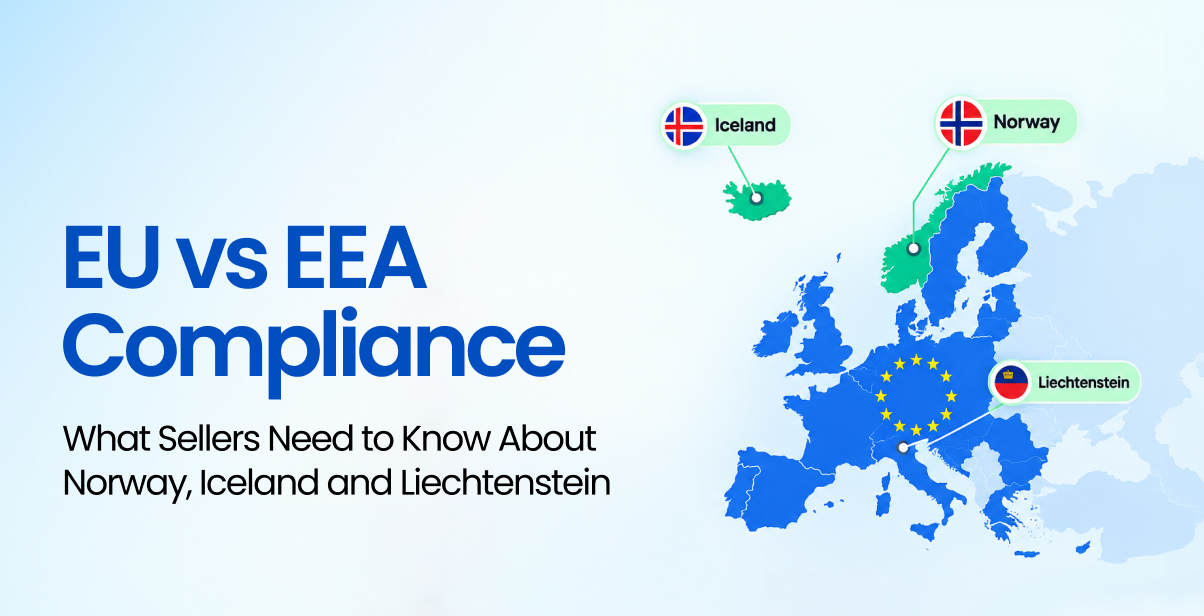
For most products, it does. EU product rules apply in Norway, Iceland and Liechtenstein. These three countries aren’t EU members, but they are part of the European Economic Area (EEA), so they follow most of the same product rules.
Below, we cover what the EEA is, which rules carry over, what it means for your EU representative and how Switzerland is different.
What is the EEA and which countries are in it?
The EEA (European Economic Area) is the EU single market plus Iceland, Liechtenstein and Norway. That makes 30 countries in total:
- The 27 EU countries
- Iceland
- Liechtenstein
- Norway
Iceland, Liechtenstein and Norway are members of the European Free Trade Association (EFTA). They signed the EEA Agreement with the EU in 1994. It gives them full access to the single market. I
n return, they follow EU rules on goods, services, people and money, including most EU product safety laws.
In practice, if your product can be sold in Germany or France, you can usually sell it in Norway under the same rules.
Do EU product rules apply in Iceland, Norway and Liechtenstein?
Yes, EU product rules apply in Iceland, Norway and Liechtenstein for most products. The EEA Agreement has a section called Annex II that covers technical rules, standards, testing and certification. When the EU adopts a new product law, the EEA Joint Committee decides whether to add it to Annex II. Once it’s added, Norway, Iceland and Liechtenstein bring it into their national law.
That’s why CE marking works the same way in all 30 countries. A product with a valid CE mark and the right EU Declaration of Conformity can be sold anywhere in the EEA.
New EU laws don’t always start in the EEA on the same day as in the EU. The gap can be a few months or longer, and the older rules may still apply in those three countries until then.
If you’re compliant in the EU, you’re very likely compliant in the EEA too. For new regulations, check the current status first.
Which regulations apply across the EEA?
Most EU product rules, including CE marking, REACH, the Cosmetics Regulation, MDR and GDPR, apply across the whole EEA. The table below shows the main ones.
| Regulation | What it covers | Applies in the EEA? |
| CE marking directives (LVD, EMC, RED, Toy Safety, Machinery) | Electrical safety, radio equipment, toys, machinery | Yes |
| REACH | Chemicals and substances in products | Yes |
| Cosmetics Regulation (EC) No 1223/2009 | Cosmetic safety, labelling, Responsible Person | Yes |
| MDR and IVDR | Medical and in vitro diagnostic devices | Yes |
| GDPR | Personal data of people in the EEA | Yes |
GPSR in the EEA
The General Product Safety Regulation has applied in the EU since 13 December 2024, but it has not yet been incorporated into the EEA Agreement. Until it is, Norway, Iceland and Liechtenstein still apply the older General Product Safety Directive (2001/95/EC) through their national laws. We recommend meeting GPSR standards for all 30 countries anyway, so your labels, safety information and EU contact details are ready when it takes effect there.
If you sell regulated products such as electronics, toys, cosmetics or medical devices, the rules for your category apply in Norway, Iceland and Liechtenstein in the same way as in the EU.
Does your EU Authorised Representative cover the EEA?

Yes, in most cases an EU Authorised Representative can also cover the products you sell in Norway, Iceland and Liechtenstein. If your business is based outside the EU, you normally need someone in the EU who is responsible for your products. Depending on the rule, this is an Authorised Representative, a Responsible Person or an EU Representative.
EU product law covers the whole EEA, so you don’t need a separate representative in each country.
This applies to GDPR as well. An EU Representative appointed under Article 27 covers people across the whole EEA, not only the 27 EU countries.
In practice, this means:
- One EU address on your labels and paperwork can cover all 30 countries
- Your EU Declaration of Conformity and technical file work across the EEA
- Marketplace checks, like Amazon’s GPSR contact details, are covered by the same EU details
Euverify acts as the EU Authorised Representative and Responsible Person for sellers based outside the EU. We can set up your EU address within 24 hours, and it covers your sales in Norway, Iceland and Liechtenstein too.
What about Switzerland?
Switzerland is not part of the EEA, so EU compliance doesn’t automatically cover it. Many sellers assume it does.
Switzerland is a member of EFTA, like Norway, Iceland and Liechtenstein. But Swiss voters rejected EEA membership in 1992, and Switzerland now trades with the EU through separate bilateral agreements.
Because of this, EEA rules don’t apply there automatically. For some products, the EU and Switzerland accept each other’s conformity checks. For others, Switzerland has its own rules. Cosmetics and medical devices, for example, need a Swiss-based representative.
If you sell in Switzerland, check the Swiss rules for your products separately.
Selling across the EEA
For most sellers, EU compliance covers 30 countries rather than 27. Norway, Iceland and Liechtenstein follow the same core product rules, and one EU representative can usually cover all of them.
Two things are worth checking: the status of new regulations, which can take time to reach the EEA, and the rules in Switzerland, which is outside the EEA.
If you want to check your coverage, Euverify can set up your EU and UK representation and keep your product documents in one place. Try it free for 14 days or book a demo to see how it works.
Frequently Asked Questions
No. Norway isn’t an EU member, but it is part of the EEA and follows most EU product rules through the EEA Agreement.
Yes. CE marking applies across all 30 EEA countries. If your product needs it for the EU, it needs it for these three as well.
In most cases, yes. An EU-based representative can usually cover products sold anywhere in the EEA.
Under the new PLD, yes. Software is treated as a product, whether it’s built into a device or sold on its own.
Yes, GDPR applies in Iceland, Norway and Liechtenstein. It has applied across the EEA since July 2018, and an Article 27 EU Representative covers the whole area.
No. Switzerland is in EFTA but not the EEA. It has its own agreements with the EU and its own rules for some products.
No. The UK left the EU and the EEA on 31 January 2020. Great Britain now uses UKCA marking and needs a UK Responsible Person, which is separate from your EU setup.