
Cosmetic Product Testing in the EU & UK
Complete Guide to Cosmetic Product Safety and Performance Tests
Why Cosmetic Testing Is Important
Before a cosmetic product can be sold in the EU or UK, it must undergo safety and performance testing.
These tests provide the scientific evidence required by Regulation (EC) No. 1223/2009 (EU) and the UK Cosmetics Regulation 1223/2009 to confirm that the product is safe for human use and performs as intended.
The results of these tests form part of your CPSR (Cosmetic Product Safety Report) and PIF (Product Information File) – both mandatory documents for market access.
In short: Without testing, there’s no proof of safety, and without proof of safety, you can’t legally sell your cosmetic product.
Types of Cosmetic Tests and Their Purposes
Below is a list of the most common and regulatory-required cosmetic product tests, along with their purpose and when they’re typically needed.

Stability Test
Purpose : Ensures the product maintains its quality, consistency, and safety over time under various storage conditions.
What it checks : Colour, odour, viscosity, pH, and physical separation during accelerated and real-time storage.
Required for : All cosmetic products.
Outcome : Determines product shelf life and expiry date.

Microbiological or Challenge Test (Preservative Efficacy Test)
Purpose : Confirms that the product can resist microbial contamination during storage and use.
What it checks : Product’s ability to prevent bacterial, yeast, or fungal growth after intentional contamination.
Required for : Water-based and emulsified products (creams, lotions, gels, etc.).
Outcome : Pass/fail based on microbial count reduction and recovery rate.

Compatibility Test (Packaging Interaction Test)
Purpose : Verifies that the product formulation does not react with its packaging.
What it checks : Colour change, leakage, ingredient degradation, or migration of packaging materials.
Required for : All products, especially those with unique packaging (metal, glass, plastic).
Outcome : Confirms packaging suitability and stability.

SPF Test (Sun Protection Factor Test)
Purpose : Measures how effectively a sunscreen or cosmetic with UV filters protects against UV radiation.
What it checks : SPF level (UVB protection), UVA protection factor, and water resistance.
Required for : Sunscreens, day creams, foundations, and tinted moisturisers with SPF claims.
Outcome : Numeric SPF value and UVA/UVB ratio.

Patch Test (Dermatological Test / Skin Irritation Test)
Purpose : Ensures the product does not cause skin irritation or allergic reactions under normal use.
What it checks : Skin response on human volunteers or reconstructed human epidermis models.
Required for : Leave-on cosmetics, facial products, and products for sensitive skin.
Outcome : “Dermatologically tested” or “Hypoallergenic” claim verification.

Sensory / Consumer Use Test
Purpose : Evaluates user satisfaction and perceived product performance.
What it checks : Texture, absorption, fragrance, and overall feel based on user feedback.
Required for : Optional, but valuable for marketing and “consumer-tested” claims.
Outcome : Report summarising consumer ratings and observations.

Heavy Metals and Contaminants Test
Purpose : Ensures the product does not contain prohibited or unsafe levels of heavy metals (like lead, mercury, arsenic, cadmium).
What it checks : Ingredient and final product samples for trace impurities using ICP-MS analysis.
Required for : Colour cosmetics, lip products, and products with mineral pigments.
Outcome : Certificate of Analysis (CoA) confirming compliance with regulatory limits.

Preservative & Ingredient Validation Test
Purpose : Confirms that preservatives, UV filters, and colorants used are approved under cosmetic regulations.
What it checks : Ingredient identification and concentration against Annexes of the EU Cosmetics Regulation.
Required for : All products containing preservatives, filters, or colorants.
Outcome : Compliance confirmation for ingredient safety.

Efficacy and Claim Support Tests
Purpose : Validates the performance claims printed on your product label. What it checks:
- “Moisturises for 24 hours” → hydration test
- “Anti-aging” → wrinkle depth measurement
- “Brightening” → skin tone analysis
Required for: Any product making measurable performance or functional claims. Outcome: Lab report supporting your marketing claims.

Allergen and Fragrance Analysis
Purpose : Identifies allergens and verifies IFRA (International Fragrance Association) compliance.
What it checks : Fragrance composition for restricted or banned substances.
Required for : All fragranced products (perfumes, creams, sprays).
Outcome : IFRA compliance certificate and allergen declaration.

Safety and Toxicological Profile Analysis
Purpose : Evaluates the toxicological properties of ingredients for CPSR creation.
What it checks : LD50 values, systemic exposure dose (SED), and margin of safety (MoS).
Required for : All products as part of CPSR.
Outcome : Scientific justification used in Part B of CPSR.
How Euverify Helps
Euverify partners with accredited laboratories in the UK and Europe that specialise in cosmetic testing and certification.
When you appoint Euverify as your Responsible Person, our compliance team reviews your PIF and CPSR during the gap analysis stage.
If testing is missing or outdated, we will:
- Identify exactly which tests you need
- Connect you with our partnered labs
- Coordinate the process end-to-end
- Upload the resulting test reports directly into your Euverify dashboard
So you can stay compliant without chasing multiple testing agencies.
Label & Packaging Review
Ensure compliance before you print. We review your ingredient lists, claims, and layouts to meet EU & UK labelling rules – helping you avoid costly recalls.

How It Works via the Euverify Dashboard
- Sign up on Euverify and add your cosmetic products
- Upload your PIF, CPSR, and label images
- Our system and experts perform a gap analysis
- If any tests are missing, we recommend the specific ones required
- Upon your confirmation, we connect you with a certified lab
- Results are automatically linked to your product record
All reports and certificates remain securely stored for inspection.
Pricing and Partnerships
Testing fees vary depending on product type and the specific tests required. You can view transparent pricing directly within your Euverify dashboard during product setup.
Euverify partners with:
- UKAS-accredited laboratories in the UK
- ISO/IEC 17025-certified labs across Europe
- Specialist toxicology and microbiology labs for cosmetic formulations
Discounted rates are available for brands submitting multiple products through Euverify.
Frequently Asked Questions
Yes, core tests like stability, microbiological, and compatibility are required for every product. Others depend on claims or product type.
Most tests take 1–4 weeks, depending on the test type and sample volume. Stability tests can take longer (up to 3 months).
Yes, if they were conducted by accredited labs and you have full access to the reports.
No. Cosmetic testing in the EU and UK must be cruelty-free and follow non-animal testing methods.
Yes, any formulation or packaging change requires a new evaluation, especially stability and compatibility tests.
Yes. We regularly work with US, Canadian, and Asian brands exporting to Europe and the UK.
Yes. All testing certificates and reports are securely stored within your product profile and linked to your PIF and CPSR.

Cosmetic Product Safety Report (CPSR)
Mandatory submission before selling. All cosmetic products must be notified to the EU CPNP and UK SCPN portals before market entry. We manage both for you.
Regulatory Notifications (CPNP & SCPN)
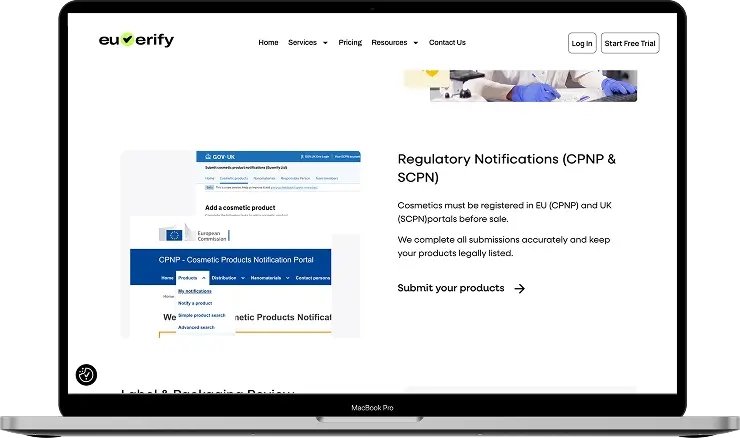
Mandatory submission before selling. All cosmetic products must be notified to the EU CPNP and UK SCPN portals before market entry. We manage both for you.


Responsible Person(EU, UK, or Both)
Appoint your official cosmetic representative. We manage all authority communications, ensure product safety, and let you sell legally across the EU and UK.
