Why Furniture Listings Fail Amazon AHD: Safety, Stability & Testing Requirements
Selling furniture on Amazon in the EU and UK can seem less tightly regulated than categories like toys or electronics. In practice, though, furniture listings are frequently flagged in Amazon’s Account Health Dashboard. When this happens, sellers are often surprised, particularly if the product has been live without issues for months or even years.
Most AHD actions against furniture listings are not random. They are usually triggered by safety or stability concerns, missing documentation, or mismatches between the product and the evidence provided to Amazon.
This article explains the most common reasons furniture listings fail Amazon AHD, what Amazon typically looks for when it asks for verification, and how sellers can reduce the risk of delays, repeated testing, or listing removal.
What Amazon AHD Means for Furniture Sellers
Amazon uses the Account Health Dashboard to monitor product safety and regulatory compliance across its marketplaces. When a furniture product is flagged in AHD, it usually means Amazon needs more evidence that the product is safe for consumers in the EU or UK.
This does not necessarily mean the product is unsafe. Often, it indicates that:
- Required documentation is missing
- The evidence provided does not match the product as sold
- A known safety risk applies to the product type
- Amazon has updated its internal enforcement priorities
Once a listing is flagged, sellers are typically asked to verify the product, often through an Amazon-approved Testing, Inspection, and Certification (TIC) provider.
The Most Common Reasons Furniture Listings Fail Amazon AHD
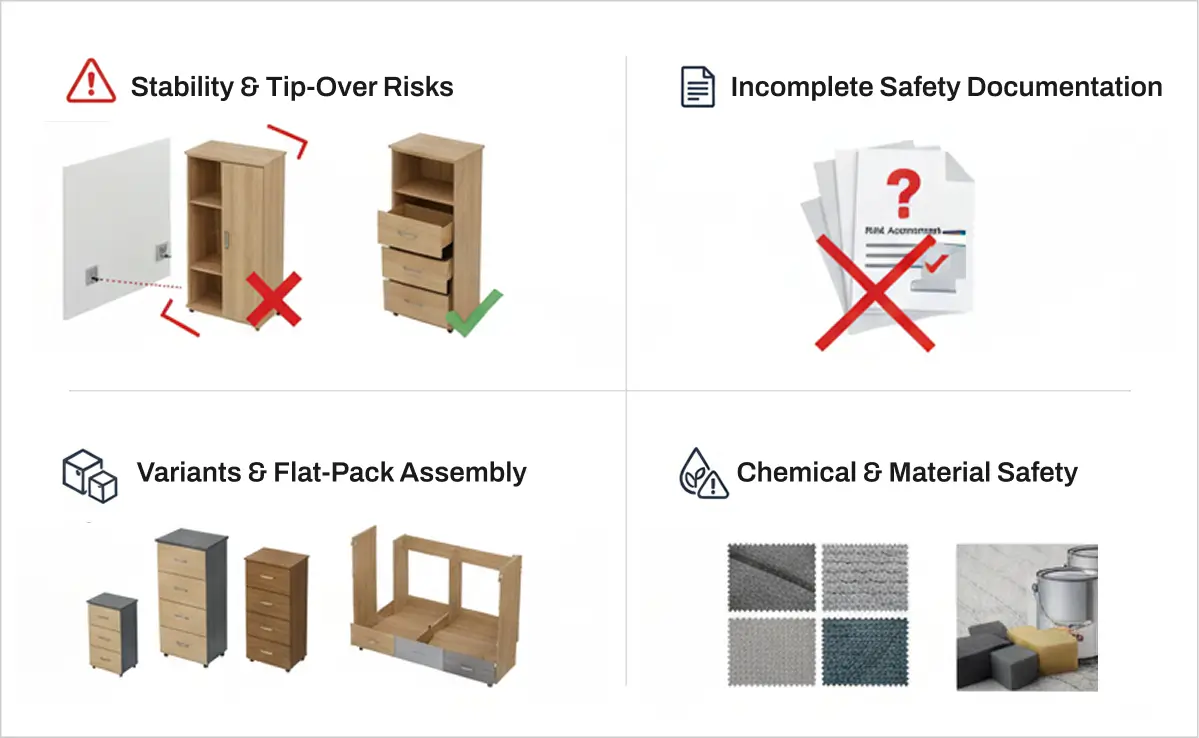
1.Stability and Tip-Over Risks
Stability is one of the main safety concerns for furniture, particularly for:
- Wardrobes
- Shelving units
- Chests of drawers
- TV stands
- Cabinets
- Children’s furniture
Furniture that can tip over presents a serious risk, especially to children. In the EU and UK, tip-over incidents have been a long-standing safety concern, and Amazon actively monitors these types of products.
Listings are often flagged when:
- There is no evidence of stability testing
- The product design indicates a potential tip-over risk
- Wall-fixing requirements are unclear or missing
- Assembly instructions are incomplete
Even when wall anchors are included, Amazon may still expect evidence that the furniture has been assessed for stability under normal and foreseeable use.
2. Missing or Inadequate Safety Testing
Furniture is not always subject to mandatory CE or UKCA marking, but that does not mean testing is irrelevant. Amazon may still ask for test reports or safety assessments to show that a product meets general product safety requirements.
Common triggers include:
- Tall or narrow furniture designs
- Products intended for use by children
- Furniture with moving parts
- Products that make load-bearing claims
When sellers are unable to provide testing or safety evidence, Amazon may treat the product as unverified.
3. Children’s Furniture and Heightened Scrutiny
Furniture that is marketed for children, or likely to be used by them, is subject to closer scrutiny. This includes:
- Children’s beds
- Toy storage units
- Changing tables
- Low shelving
- Furniture promoted for nurseries or playrooms
If a listing includes child-related images, age references, or keywords, Amazon may apply stricter safety expectations.
A common mistake is assuming a product counts as “adult furniture” when the listing content or imagery clearly points to family or child use.
4. Incomplete Risk Assessments and Documentation
Under EU and UK general product safety rules, sellers must be able to show that products have been assessed for safety risks. Amazon increasingly expects sellers to have:
- A basic product risk assessment
- Clear identification of potential hazards
- An explanation of how risks are mitigated
Listings are often flagged when sellers:
- Do not have a documented risk assessment
- Cannot explain how risks were evaluated
- Rely solely on supplier assurances without supporting evidence
This has become more common since the EU’s General Product Safety Regulation (GPSR) came into force.
5. Variant and Configuration Gaps
One of the most common reasons furniture listings fail AHD is a mismatch between product variants.
Examples include:
- The same furniture sold in different sizes under a single parent ASIN
- Different materials or finishes, such as wood, metal, or glass
- Versions sold with or without wall-fixing kits
- Flat-pack products compared with pre-assembled versions
If testing or documentation only covers one version, Amazon may reject it due to incomplete coverage.
From Amazon’s perspective, each variant represents a potential safety risk if it has not been properly assessed.
6. Flat-Pack Furniture and Assembly Risks
Flat-pack furniture comes with its own set of safety challenges, including:
- Incorrect assembly by consumers
- Missing or unclear instructions
- Structural instability if assembled incorrectly
Amazon may ask for:
- Assembly instructions
- Evidence that the instructions address foreseeable misuse
- Clear information on fixings, fasteners, and load limits
Listings that lack clear instructions or warnings are more likely to be flagged.
7. Chemical and Material Safety Concerns
While not always the main trigger, furniture listings can also be flagged because of chemical or material safety issues, including:
- Coatings or paints
- Upholstery materials
- Foams and adhesives
- Metal finishes
If Amazon identifies a potential chemical risk, it may ask for evidence showing compliance with the relevant EU or UK substance restrictions.
This is particularly relevant for:
- Children’s furniture
- Upholstered items
- Imported products with limited material traceability
What Amazon Typically Requests During AHD Verification for Furniture
When a furniture listing is flagged, Amazon usually asks sellers to complete a verification process rather than simply upload a single document. This process often involves an approved Testing, Inspection, and Certification provider.
While the exact requirements depend on the product, Amazon commonly expects:
- Clear product identification, including model, ASIN, and dimensions
- Safety or stability test reports where relevant
- Risk assessment documentation
- Assembly instructions and safety warnings
- Variant mapping that shows which evidence applies to each listing
Providing incomplete or mismatched information is one of the main reasons AHD cases drag on longer than necessary.
Stability and Load Testing: What Sellers Often Miss

Amazon does not always name a specific standard in its AHD messages, but stability and load testing are common areas of focus.
Issues often arise when:
- Sellers assume testing is optional
- Test reports are outdated or not specific to the product
- Reports are generic or issued by suppliers without independent verification
Even where no single harmonised standard applies, Amazon may still expect reasonable and proportionate safety evidence based on the level of product risk.
The Role of EU and UK General Product Safety Rules
Furniture sold in the EU and UK is covered by general product safety laws. These rules require that:
- Products placed on the market are safe
- Risks are assessed before products are sold
- Sellers cooperate with authorities if safety concerns arise
Amazon aligns its enforcement with these expectations. As a result, sellers are increasingly asked to provide risk assessments, technical files, or safety documentation, even for products that were previously sold without issue.
What Happens If You Fail AHD Verification
If verification is unsuccessful or incomplete, Amazon may:
- Keep the listing suppressed
- Remove the listing entirely
- Require additional testing
- Restrict future listings in similar categories
Repeated verification failures can also negatively affect overall account health, not just the individual ASIN involved.
How to Reduce the Risk of Furniture Listings Failing AHD
Sellers can significantly reduce furniture compliance issues by taking a proactive approach.
Prepare Safety Documentation Before Listing
Do not wait for AHD to request evidence. Prepare:
- A basic product risk assessment
- Clear assembly instructions
- Stability considerations for tall or narrow furniture
Map Variants Carefully
Keep a clear record of:
- Sizes
- Materials
- Fixings
- Configuration differences
Ensure evidence aligns with each variant.
Treat Children’s Use as a Red Flag
If a product could reasonably be used by children, apply higher safety standards from the start.
Keep Supplier Information Up to Date
Changes in materials, factories, or components should trigger a documentation review.
How Euverify Can Help
Many furniture AHD issues arise not because products are unsafe, but because documentation is incomplete, unclear, or inconsistent.
Before sellers submit products for third-party verification, Euverify supports furniture brands and sellers by helping them organise safety documentation, risk assessments, variant mapping, and technical information so submissions align with Amazon’s expectations and EU and UK product safety rules.
Preparing early can reduce delays, avoid unnecessary re-testing, and improve the chances of resolving AHD issues on the first attempt.
Final takeaway
Furniture listings fail Amazon AHD most often due to stability risks, missing safety evidence, and variant mismatches, not because sellers intend to ignore the rules. Understanding how Amazon assesses furniture safety and preparing documentation in advance can make the difference between a smooth verification process and weeks of listing disruption.Need support with Amazon AHD furniture verification?
Euverify helps sellers prepare clear, compliant documentation that aligns with Amazon’s requirements and EU and UK product safety rules, reducing delays and unnecessary rework.