PFAS in Cosmetics: What the EU PFAS Ban Means for Beauty Brands
From waterproof mascaras and long-wear foundations to smoothing serums and high-gloss lip products, PFAS in cosmetics have quietly become part of the beauty industry’s performance toolkit. They help formulas last longer, resist smudging, and feel more luxurious. But now, the European Union is moving forward with one of the biggest chemical policy changes in decades. It involves a broad restriction on PFAS, often called “forever chemicals,” and cosmetics are right at the center of the discussion.For any brand selling in the EU or UK, PFAS is no longer a topic you can ignore. It has become a market-access concern, a reputational risk, and increasingly a question of consumer trust.This blog explains what beauty companies need to know, what current data shows about PFAS in cosmetic products, and the practical steps brands can take to prepare.
Understanding PFAS: Why They Matter for Beauty
PFAS (per- and polyfluoroalkyl substances) are a large family of more than 10,000 chemicals known for being extremely stable and resistant. That stability is what makes them useful in cosmetics, but it is also what has turned them into an environmental and public-health concern.
The European Chemicals Agency (ECHA) explains why PFAS have become a major regulatory priority:
“The main concern with PFAS relates to their high persistency, which means that these substances can stay in the environment for a very long time. In addition, many of them can negatively affect human health and the environment.”
Source: ECHA RAC/SEAC Highlights, June 2024
In beauty products, PFAS have been used for:
- Waterproof and smudge-proof performance
- Film-forming (especially in mascaras, foundation, lip gloss)
- Long-wear claims
- Smoothing and soft-focus effects
- Shine, spreadability and texture enhancement
But due to their persistence, PFAS are turning into one of the biggest reformulation challenges in the global beauty market.
How Common Are PFAS in Cosmetics?

PFAS in cosmetics are more common than many brand founders expect.
The OECD (Organisation for Economic Co-operation and Development) conducted the most comprehensive analysis to date on PFAS presence in cosmetic products on the European market:
“In 2020 the highest proportion of PFAS-containing products within defined cosmetic product categories on the European market was for decorative cosmetics (3.7%), followed by skin care (0.8%).”
Source: OECD PFAS Report (2024)
According to Foresight News (2024), EU enforcement authorities have identified PFAS as one of the most frequently detected restricted chemical groups during cosmetics market surveillance activities.
Media reporting has highlighted the same trend. Coverage from the Financial Times notes that many cosmetics tested by authorities were found to contain PFAS — including types that are restricted under EU law.
Together, these findings signal a clear shift: consumers are paying closer attention, and regulators across Europe are stepping up their response.
The EU PFAS Ban: What’s Actually Coming?
The EU is progressing a group-wide PFAS restriction under the REACH Regulation. This is not a ban on a handful of substances. It aims to restrict nearly the entire PFAS chemical family.
Five Member States (Denmark, Germany, the Netherlands, Sweden, Norway) submitted the original proposal. An updated Background Document was published in August 2025 following more than 5,600 stakeholder comments.
A regulatory summary explains:
“The Updated PFAS Restriction Proposal identifies cosmetics as one of the main areas of application of PFAS.”
Source: Coslaw.eu
Beauty products, because viable alternatives exist, are expected to face comparatively tighter timelines.
But what does that timeline actually look like?
Key PFAS Deadlines for Beauty Brands (EU & Industry Timeline)
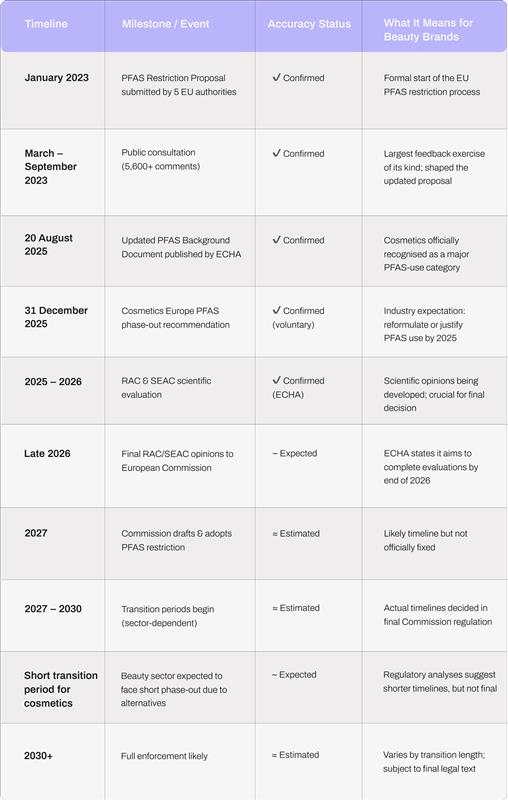
Note: Dates labelled expected or estimated reflect current regulatory trajectory and expert analysis. Final timelines may shift once the European Commission publishes the legal text.
Why PFAS Are Becoming a Brand Reputation Issue
PFAS are no longer just chemistry. They’re a public conversation.
Investigations across Europe have detected PFAS in water, soil, and even blood samples.The Guardian described the situation bluntly:
“PFAS contamination has become a defining chemical pollution crisis across Europe.”
Source: The Guardian, PFAS , November 2025
Consumers increasingly associate PFAS with risk — and beauty products are under heightened scrutiny.
For brands, this translates into:
- Pressure from retailers
- Consumer demand for transparency
- Social media-driven reputational risk
- ESG expectations from investors
- Clean beauty positioning challenges
Early action is now a brand advantage, not just a compliance requirement.
A Practical PFAS in Cosmetics Compliance Roadmap for Beauty Brands
Here’s a realistic, industry-friendly strategy to prepare for the PFAS phase-out.
1. Screen your product portfolio
Identify high-risk categories:
- Waterproof mascara & eyeliner
- Long-wear foundation
- Lip gloss & film-forming products
- Hair smoothing & styling sprays
- Sunscreens with unusual film persistence
Look for PFAS indicators such as “perfluoro-”, “polyfluoro-”, “PTFE”, “fluoro”.
2. Request PFAS declarations from suppliers
Ask suppliers:
- Are PFAS intentionally used?
- Could they be present as impurities?
- Do you have PFAS-free certification?
- Have you assessed upstream ingredients?
Document everything. This will matter later.
3. Perform targeted PFAS testing
Helpful for:
- High-risk SKUs
- Incomplete supplier documentation
- “PFAS-free” marketing claims
- Preparing for retailer audits
Testing methods:
- Total fluorine screening
- Extractable organofluorine (EOF)
- Targeted PFAS analysis
4. Start reformulating early
Focus on:
- Bestselling items
- Products central to your brand identity
- High-PFAS-risk formulations
Check new ingredients carefully for:
- Safety compliance
- CMR or allergen concerns
- Claims alignment
5. Update your documentation (PIF, CPSR, labels)
As formulas change:
- Update PIFs
- Get new safety assessments
- Update INCI and labelling
- Keep PFAS-related evidence on file
This is legally required for EU/UK market placement.
6. Stay updated (monthly)
PFAS rules are evolving quickly across Europe.
Alongside the EU’s restriction proposal, individual countries are also taking action.
France, for example, has adopted one of the most ambitious national PFAS laws, according to reporting by Le Monde (2025).
Continuous monitoring is essential, as national measures may move faster than EU-wide regulations.
PFAS-Free Beauty: A Branding Opportunity
Moving early isn’t just about compliance. It strengthens your brand.
PFAS-free positioning is increasingly linked with clean-beauty values, sustainability, and higher consumer trust. Retailers are also giving preference to products with clearer chemical profiles, and PFAS removal aligns well with broader ESG expectations.
According to reporting from the Financial Times (FT Environmental Reporting), PFAS are becoming a major turning point for consumer-facing industries.
Taking action now places your brand ahead of where the market and regulators are heading.
Final Takeaway: Preparing for the PFAS Era
The EU PFAS ban is set to reshape the cosmetics environment, and cosmetics compliance will become far more demanding as regulators tighten their focus. Although not all dates are final, the direction is unmistakable: cosmetics will be among the first sectors expected to transition away from PFAS.
Beauty brands that begin their PFAS journey now by auditing formulas, engaging suppliers, testing selectively and preparing documentation will be in a strong position. They will be compliant, confident and competitive.
If you need help mapping your PFAS in cosmetics exposure, confirming supplier information or preparing for upcoming EU and UK regulatory changes, Euverify can support you with PFAS audits, documentation guidance and Responsible Person services. Early preparation means fewer surprises and a stronger, more future-proof brand.