How to Prepare Your Supply Chain for the EU Digital Product Passport: A Practical Guide for Fashion Brands
The EU Digital Product Passport is coming for the textile industry, and most fashion brands are not ready for it. Not because they are unaware of it, but because they have not yet looked closely at where the data needs to come from.
That is where the challenge really sits. Creating a Digital Product Passport is not a documentation exercise you can complete in-house. It requires verified data from every level of your supply chain — your fabric suppliers, your yarn spinners, your dye houses, your garment manufacturers. Some of that data will be easy to collect. A lot of it will not.
The good news is that the brands preparing now, before the textiles delegated act is adopted (expected around 2027), have a realistic window to do this properly.
What data does the Digital Product Passport require?
The Digital Product Passport for textiles is expected to require brands to disclose detailed, verifiable information about each product. Based on the European Parliament’s 2024 study on DPP for textiles and the JRC’s preparatory work, this is likely to include material composition, country of origin at each stage of production, substances of concern, environmental metrics such as carbon footprint and water use, and end-of-life instructions. The exact data fields will be confirmed in the textiles delegated act.
What data does the Digital Product Passport require?

Why supply chain data is the hardest part of DPP compliance
You need documentation from your supplier confirming it, such as GOTS or OCS transaction certificates, traceable to the source. Under the ESPR, market surveillance authorities will have full access to DPP data and can investigate whether what is in the passport matches what is actually in the product.
Most brands find that their data situation looks something like this. They have reasonable information about their Tier 1 suppliers — the factories that cut and sew their garments. They have some information about their Tier 2 suppliers — the fabric mills. Below that, things get patchy. Yarn spinners, chemical suppliers, raw material sources: this is where the gaps appear, and these are exactly the gaps the DPP is designed to close.
How to audit your supply chain data before the DPP deadline
Before you can prepare your supply chain, you need to understand where you actually stand. That means mapping what data you currently have against what the DPP will require.
Go through each product category you sell into the EU and ask some straightforward questions. Do you know the exact fibre composition of every fabric, confirmed by your mill? Do you know the country of origin for your raw materials, not just your finished garment? Do you have documentation on the chemical substances used in dyeing and finishing? Do you have any environmental metrics at all, such as carbon footprint or water consumption data?
Most brands find significant gaps when they do this exercise honestly. That is not a reason to panic. It is useful information, and the earlier you have it, the more time you have to address it.
Understanding supply chain tiers and where DPP data comes from
The DPP data framework works across multiple tiers of the supply chain. It helps to think of it this way.
- Tier 0 is your brand. You are responsible for the passport and its accuracy.
- Tier 1 is your garment manufacturer. They can provide data on the finished product — assembly location, production dates, quality certifications.
- Tier 2 is your fabric mills, dye houses, finishing units and component suppliers. They hold data on material composition, fabric weight, dyes and chemicals used, certifications, and the processes used to create the fabric.
- Tier 3 is your yarn and fibre producers. They hold data on raw material origin and initial processing.
- Tier 4 is your raw material sources. Cotton farms, wool producers, chemical manufacturers. This is the deepest level and typically the hardest to reach.
Supply chain tiers and DPP data responsibility
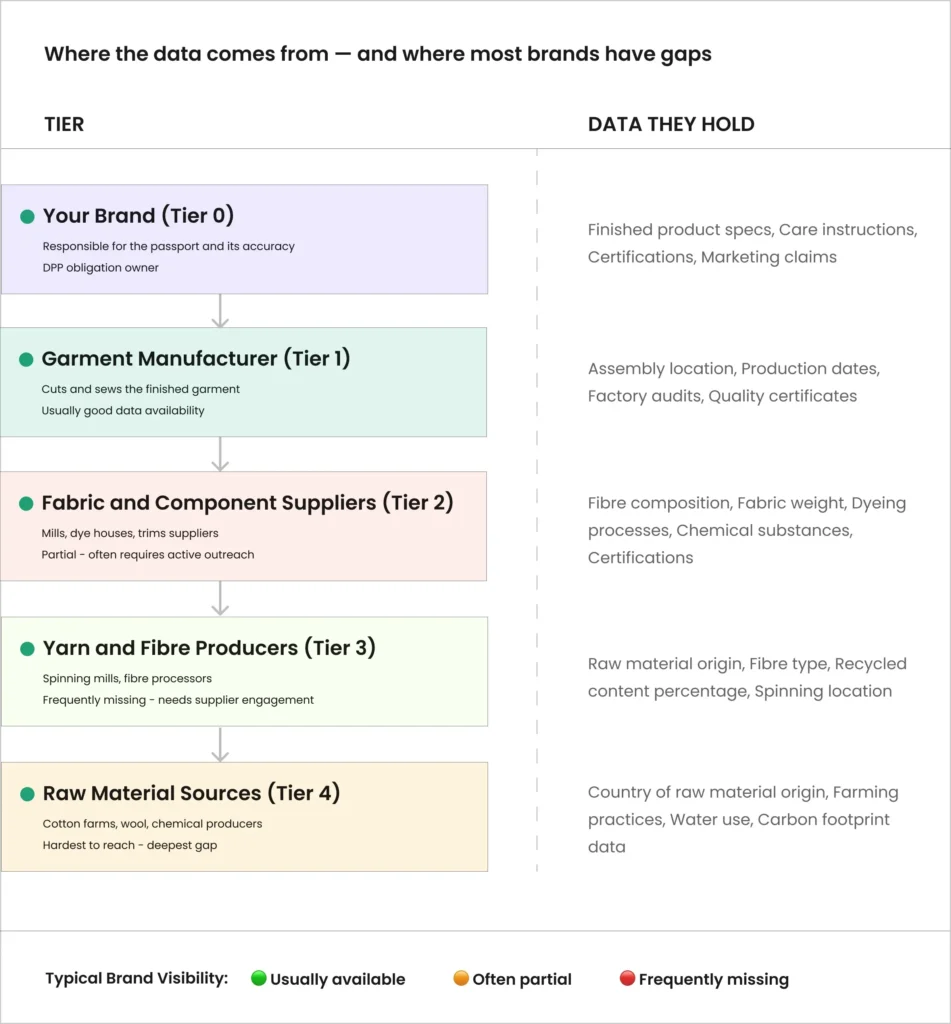
Most brands have good visibility of Tier 1 and partial visibility of Tier 2. Below that, the data gaps widen — and that is exactly what the DPP is designed to close.
The DPP does not require every brand to have data from every single tier from day one. The European Parliament’s 2024 study on the Digital Product Passport for the textile sector (EPRS, PE 757.808) recommends a phased approach, starting with the most critical data categories and building out over time. This is a recommendation rather than law, but it gives a good indication of how requirements may be introduced. But the direction of travel is clearly towards full supply chain transparency. Starting to build those relationships and data flows now puts you in a much stronger position than waiting.
How to work with suppliers to collect DPP data
This is the part brands often underestimate. Collecting DPP data is not something you can do by sending a questionnaire and waiting. It requires genuine engagement with your supply chain partners, many of whom may be unfamiliar with what is being asked and why.
Some suppliers, particularly larger, more established ones, will already be collecting this data. They may be working with other brands who have similar transparency requirements, or they may already be familiar with frameworks like the Higg tools from Cascale (formerly the Sustainable Apparel Coalition) or Textile Exchange standards. These suppliers will be relatively straightforward to work with.
Others, particularly smaller Tier 2 and Tier 3 suppliers in regions where sustainability reporting is less common, may need more support. They may not have the systems to track and report on environmental metrics. They may not understand what chemical substance disclosure involves.
The approach that tends to work is treating this as a collaborative process rather than a compliance demand. Explain what you need and why. Give suppliers time to develop their reporting capability. Where possible, work with industry initiatives and shared platforms that reduce the burden on individual suppliers.
The brands that build strong supplier relationships around data transparency will find DPP compliance far more manageable than those that try to extract information from unwilling or under-equipped partners at the last minute.
How to manage DPP data updates across your supply chain
Collecting data once is one thing. Keeping it accurate over time is another, and this is where the DPP creates a genuinely new operational requirement for most brands.
The Digital Product Passport is a living record. If you change your fabric supplier, the passport needs to be updated. If a supplier changes their dyeing process, that may affect the chemical substance disclosures. If you move production to a different factory, the country of origin data changes.
This means you need a process for managing data updates, not just an initial data collection exercise. You need to know when relevant changes have happened and have a way to reflect them in the passport accurately and quickly.
For brands with complex, multi-market supply chains or frequent product updates, this is a real operational consideration. It is also why having an EU-based economic operator, such as an Authorised Representative, is an ongoing role rather than a one-off setup task.
What non-EU fashion brands should do now to prepare for the Digital Product Passport
You do not need to wait for the textiles delegated act to be adopted before you start preparing. The likely data categories can already be anticipated from the European Parliament’s study and the JRC preparatory work. The brands acting now are building supply chain data capabilities that will serve them across multiple regulations, not just the DPP.
Start with the audit. Understand your gaps. Then begin the supplier conversations, starting with your Tier 1 and Tier 2 partners, where the most critical data such as material composition sits, before working down to Tier 3 and 4, where the gaps are usually deepest. Build the relationships and data flows you will need, and think about how you will maintain them over time.
If you are unsure where to start or what your specific data gaps look like, a compliance gap analysis is a practical first step. It maps your current position against the anticipated DPP requirements and gives you a clear picture of what needs to be addressed and when.
Euverify works with non-EU fashion brands on exactly this. From initial gap analysis through to supply chain data coordination and ongoing Authorised Representative services, we help brands build compliance structures that are practical and built to last. Get in touch at euverify.com if you would like to talk through what DPP preparation looks like for your brand specifically.
Frequently Asked Questions
You do not have to do it all manually. There are emerging industry platforms and data-sharing initiatives designed to help brands collect and verify supply chain data more efficiently. Some certification bodies and standards organisations are also developing DPP-compatible data outputs. That said, the responsibility for the accuracy of what goes into your passport remains with you, regardless of how the data is collected.
This is a real challenge, particularly at Tier 2 and below. If a supplier will not provide the required data, you have two options: work with them over time to build that capability, or consider whether that supplier relationship is compatible with your EU compliance obligations long term. The DPP is creating a new baseline for what it means to be a viable supplier for EU market access.
The ESPR allows a Digital Product Passport to be set at model level (one passport per product model), batch level (one per production batch) or item level (one per individual product). The textiles delegated act will specify which level applies to garments, so brands will not be able to choose freely. Whichever level applies, the passport must accurately reflect the materials, production and other regulated attributes of the products it covers.
The platform is not responsible for creating or maintaining your DPP. Under the ESPR and the EU Digital Services Act, online marketplaces must cooperate with market surveillance authorities and remove listings of non-compliant products when notified. Where a retailer buys your stock and resells it, as Zalando does for part of its range, that retailer acts as a distributor and must check that the DPP is present before selling. In all cases, creating and maintaining the passport remains the brand’s responsibility.