
Digital Product Passport Compliance: Why Non-EU Fashion Brands Need an EU-Based Representative
Selling Clothes in the EU? The EU’s Digital Product Passport is coming, and if you manufacture garments outside the European Union, your passport will need to name an EU-based business that authorities can contact. Here’s what that means and what you should be doing about it now.
Why the DPP requires an EU presence
The Ecodesign for Sustainable Products Regulation (ESPR), Regulation (EU) 2024/1781, entered into force on 18 July 2024. It will require a Digital Product Passport (DPP) for textiles once the textiles delegated act is adopted, delegated act expected late 2026 / early 2027 and compliance applying from approximately mid-2028.
In simple terms, once the rules apply, garments sold in the EU will need to be linked through a data carrier, such as a QR code, NFC tag or RFID chip, to a digital record. The delegated act will set whether that record is per model, per batch or per item. This record will include information about the product’s materials, supply chain, sustainability features, and how it should be handled at the end of its life.
Here is an important point many non-EU brands overlook. The ESPR puts responsibility for the DPP on the manufacturer, wherever it is based, but the passport must also name an economic operator established in the EU that authorities can contact. If you manufacture in Asia, the US, or outside the EU, you may not automatically have a company that can take on this role.
What the regulation says:
Under ESPR Article 27, the manufacturer must make sure a digital product passport is available for each product covered by a delegated act. Under Article 29, an importer must check that the DPP is available before placing a product on the market. Importers only take on the manufacturer’s obligations if they sell the product under their own name or trademark, or modify it.
Under Article 28, a manufacturer may appoint an Authorised Representative by written mandate. However, the manufacturer’s core obligations, including making the DPP available, and the drawing up of technical documentation cannot be delegated to the AR. The AR’s role is to keep documentation available for authorities, cooperate with them, and provide information on request, within 15 days.
The DPP must also show the name, contact details and identifier of the economic operator established in the EU that is responsible for market surveillance tasks under GPSR or Regulation (EU) 2019/1020. For a non-EU brand with no EU importer, that is usually an Authorised Representative.
What does an Authorised Representative do under the DPP?
Under the ESPR, an Authorised Representative performs specific, mandated tasks on behalf of the manufacturer. For DPP compliance, the AR is your EU contact point for authorities. The AR holds your documentation, responds to requests, and cooperates on any corrective action. Creating and maintaining the passport data stays with you as manufacturer.
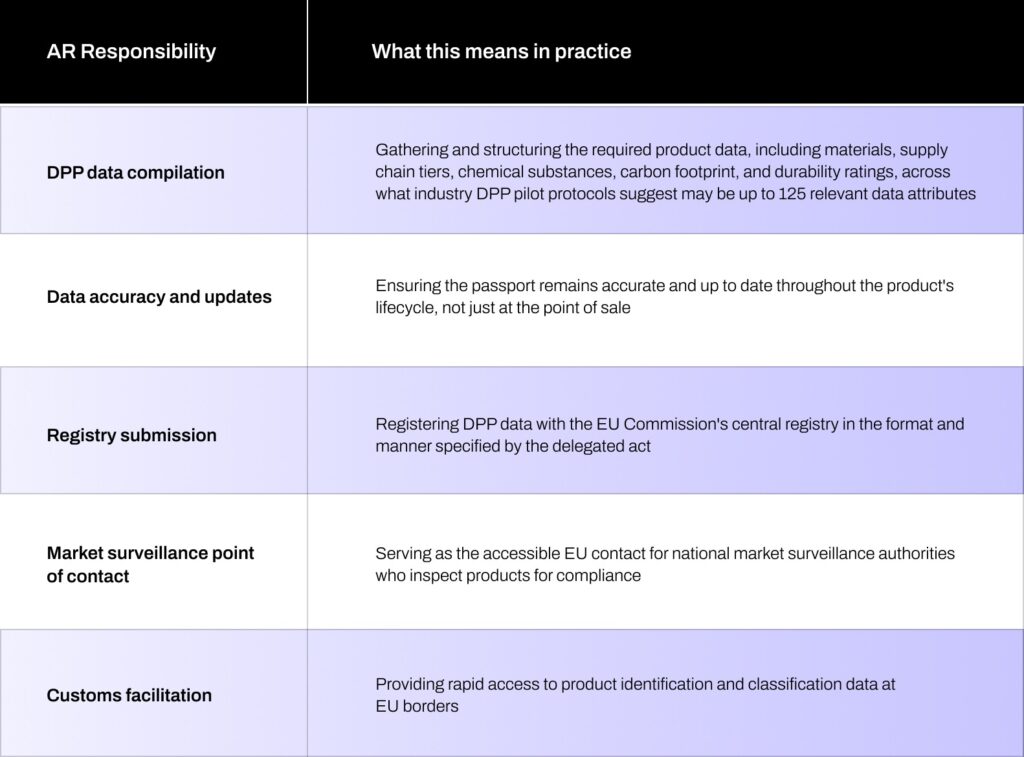
This is not a one-time filing. The DPP is a living record that must be maintained, updated, and accessible at all times. Market surveillance authorities have full access and can order product withdrawal for non-compliance.
Why this is especially urgent for non-EU manufacturers
If you sell garments into the EU through distributors or retailers, you might assume the compliance burden falls on them. It does not, at least not in full.
Distributors and retailers are only required to check that a DPP is in place before putting a product on the shelf. They are not responsible for creating it, maintaining it, or ensuring its accuracy. That responsibility stays with the manufacturer, wherever it is based. The importer must check the passport exists, and the EU-based operator named in the passport, often the AR, is who authorities will contact first.
What happens if you don’t comply with the DPP?
The ESPR requires each EU country to set penalties that are effective, fair, and strong enough to discourage violations. Authorities can remove products from the EU market if they do not comply.
A study by the European Parliamentary Research Service (EPRS) suggests that penalties could include fines between €10,000 and €100,000 per violation, and up to 5% of annual turnover for repeated or widespread non-compliance. Higher penalties may also apply if data is falsified, although each country will define its own exact rules.
For brands outside the EU, the risk is straightforward. If you have no EU importer and no Authorised Representative, there is no EU-based operator for authorities to contact, and your passport cannot list one. As a result, your products could be removed from the market.
How the Authorised Representative role under the DPP connects to what Euverify already does

If you are already working with Euverify for GPSR compliance, you may already be close to meeting DPP requirements. The Authorised Representative role under the DPP is set up in much the same way as the role Euverify already provides under the General Product Safety Regulation.
This means the same compliance setup can be used:
- GPSR product safety data management → DPP product data management
- GDPR data protection frameworks → DPP data security and privacy (DPP systems must comply with GDPR for any personal data they contain)
- Cosmetics compliance documentation → Chemical compliance and substances of concern tracking (REACH/SVHC)
- EU AR network → DPP responsible actor role
Euverify can act as your EU Authorised Representative, the EU-based operator named in your passport, and help you prepare by identifying gaps in your product and supply chain data. The passport itself remains your responsibility as manufacturer.
What should non-EU brands be doing right now?
The textiles delegated act is expected late 2026 / early 2027, with compliance applying from approximately mid-2028. The EU’s DPP registry was due to be set up by 19 July 2026, and the ban on large companies destroying unsold apparel and footwear has applied since the same date. That means brands that begin preparing now have a realistic window to get ahead of the requirement without the scramble of a last-minute rush.
Step 1 — Map your current data availability
Industry protocols developed for textile DPP pilots suggest up to 125 data points may be relevant. This includes details such as where raw materials come from, fibre composition, where the product is made, any chemicals used, carbon footprint, durability, and how the product should be handled at the end of its life.
Most brands do not have all this information yet. The sooner you identify what is missing, the more time you have to work with your supply chain partners to gather it.
Step 2 — Designate your Authorised Representative
If you sell directly to EU customers without an EU importer, you’ll need an EU-based operator to name in your passport. An Authorised Representative fills that role without taking over your brand. Your importer, if you have one, only becomes the “manufacturer” if it sells the product under its own name or modifies it.
Appointing a dedicated Authorised Representative gives you more control, clear responsibility, and a partner focused on your compliance needs.
Step 3 — Build your compliance stack
DPP compliance does not stand on its own. It connects with other rules such as GPSR, REACH, the Empowering Consumers Directive (EU 2024/825, rules on environmental claims since September 2026), CSDDD, and EPR requirements.
Brands that treat it as part of a wider compliance effort, rather than a separate project, will be in a much stronger position.
Key takeaway
The Digital Product Passport is a major change in how textile brands share product information. For manufacturers outside the EU, it brings a clear requirement. You must create and maintain your own Digital Product Passport, and your passport must name an EU-based economic operator. Without an EU importer, that usually means appointing an Authorised Representative.
Brands that see this as a chance to improve supply chain transparency, strengthen access to the EU market, and stand out with verified sustainability claims will be better prepared than those who leave it until the last minute.
Euverify can support you through this process. It combines existing EU compliance systems with DPP expertise to help make compliance easier for brands of all sizes. Ready to get your DPP compliance in order? Get in touch with Euverify today.
Frequently Asked Questions
It applies to all non-EU brands selling textiles in the EU, regardless of size. The European Parliament’s research service has suggested simplified requirements for smaller businesses, but these are proposals, not law. Under the ESPR, micro and small businesses are already exempt from the ban on destroying unsold products. The exact thresholds will be confirmed in the textiles delegated act, but no brand should assume they are exempt based on size alone.
Yes. One AR can act as your EU representative across all your product lines under a single written mandate. This makes it far more practical than relying on separate importers in different markets to handle it product by product.
Not automatically. A GPSR AR handles product safety documentation. Under the ESPR, your mandate would need to cover the AR’s tasks under that regulation: holding documentation, cooperating with authorities and responding to their requests. Compiling the passport data, uploading it to the EU registry and keeping it accurate remain the manufacturer’s (or importer’s) responsibility. If you have an existing AR relationship, check explicitly whether your mandate covers DPP obligations.
The passport must always reflect the actual product on the market. If your manufacturer, materials or production location changes, the DPP needs to be updated. Keeping the passport up to date is the manufacturer’s ongoing responsibility, so build a process for updating it whenever your supply chain changes.
Only products placed on the market from the compliance deadline onwards, currently expected around mid-2028, need a DPP. Existing stock already in market is not affected retroactively. However, the rules apply to each individual item, so any new units of an existing product line placed on the market after that date will need a DPP, even if the line launched earlier.