Children’s Book or Toy? How the EU Classifies Your Product and Why It Matters
If you import or publish children’s books for the EU market, there is one question you need to answer before your product goes on sale: does EU law see it as a book, or as a toy?
It sounds like a simple question. In reality, it catches a lot of businesses off guard. A children’s book and a toy that happens to look like a book sit in completely different regulatory categories, with different safety standards, different documentation requirements, and different consequences if you get it wrong.
The European Commission has published specific guidance on this, developed by its Expert Group on Toy Safety. This post walks through what that guidance says, how to apply it to your product, and what steps to take if you are not sure where you stand.
Why the Line Between “Book” and “Toy” Exists in EU Law
The EU Toy Safety Directive (2009/48/EC) defines a toy as any product designed or intended, whether or not exclusively, for use in play by children under 14 years of age. That last part, “whether or not exclusively,” is worth paying attention to.
A product does not have to be only a toy to fall under the Directive. A children’s book that also functions as a play object can be brought into scope. And for many children’s books, especially those aimed at babies and toddlers, this is not a theoretical risk.
When the Toy Safety Directive was being revised, the European Parliament actually considered excluding books from it altogether. That proposal did not go through. Instead, the Commission issued a statement acknowledging that standard toy safety tests under EN 71-1 are not always easy to apply to paper and cardboard books, and asked the standards body CEN to develop more suitable testing approaches for children’s books specifically.
That context tells you something useful. The regulatory framework here is still developing, national authorities have genuine discretion in borderline cases, and children’s books with play features are actively watched by market surveillance teams across the EU.
The Paper Weight Rule in EN 71-1
EN 71-1 is the harmonised standard covering mechanical and physical safety for toys. If your book is classified as a toy, this standard applies. There is one specific rule that is particularly relevant for book manufacturers and importers.
EN 71-1 defines paper as any material with a mass per unit area of 400 g/m2 or less. Paper below this threshold is excluded from the choking hazard requirements in clause 5.1, which covers toys for children under 36 months. So standard paper and light cardboard will generally not trigger the size and choking tests that apply to other toy components. Heavier board materials above that threshold may still be caught. If your book uses materials near that boundary, it is worth checking before you assume you are in the clear.
How to Tell Whether Your Book Is a Toy
The Expert Group identified five factors that, when looked at together, help determine whether a book’s main purpose is play rather than reading or learning. No single factor gives you a definitive answer on its own. It is always a combination.
Factor | What it suggests about your product |
Number of pages | Fewer pages point toward a toy. More pages point toward a reading or educational product. |
Materials | Fabric, plastic, or foam are associated with toys. Standard paper and light cardboard are less likely to trigger toy classification. |
Sensory elements | Sound features, tactile textures, crinkle effects, or interactive keyboards all suggest a toy rather than a book. |
Level of detail | Simple bold images with little text suggest the product is designed for play. Detailed content with substantial text suggests it is designed for reading or learning. |
Colour and contrast | Very high contrast and vivid colours targeting infants are more common in toys designed to stimulate than in books designed to be read. |
The principle running through all of this is fairly consistent. Ordinary reading books and ordinary educational books are not toys. The classification shifts when a manufacturer deliberately builds significant play value into a product through its materials, format, or features.
“Virtually, everything has playing value for a child, but this does not make every object fall into the definition of toy. To be considered as a toy for the purpose of the Directive, the playing value has to be introduced in an intended way by the manufacturer.” – European Commission Guidance Document No. 9.
Your Label Is Not Enough on Its Own
A lot of manufacturers assume that labelling a product “not a toy” settles the question. It does not. Under EU rules, the manufacturer’s stated intended use is taken into account, but it is the reasonably expected use by a child that ultimately determines classification.
“The reasonably expected use shall prevail over the declaration of intended use by the manufacturer. If the manufacturer labels the products as not being toys, he has to be able to support this claim.” – European Commission Guidance Document No. 9.
What this means in practice is that if your product has clear play features, a national authority can override a “not a toy” label based on how a child would actually interact with the product. If you want a “not a toy” position to hold up, you need evidence to back it up. The design, materials, content, and intended function all need to point in the same direction.
Important: Labelling a product “not a toy” is a position you have to be able to defend, not just a statement you put on the packaging. If a market surveillance authority challenges it, you need documented evidence based on the product itself.
Books That Are Classified as Toys: Real Product Examples
The Commission’s guidance document includes a detailed list of book types that are classified as toys. They are grouped by age, because the safety requirements for children under three are stricter than those for older children.
For Children Under 3 Years
Any product in this category that is classified as a toy must comply with clause 5.1 of EN 71-1, which covers choking and ingestion risks. The following types are all considered toys:
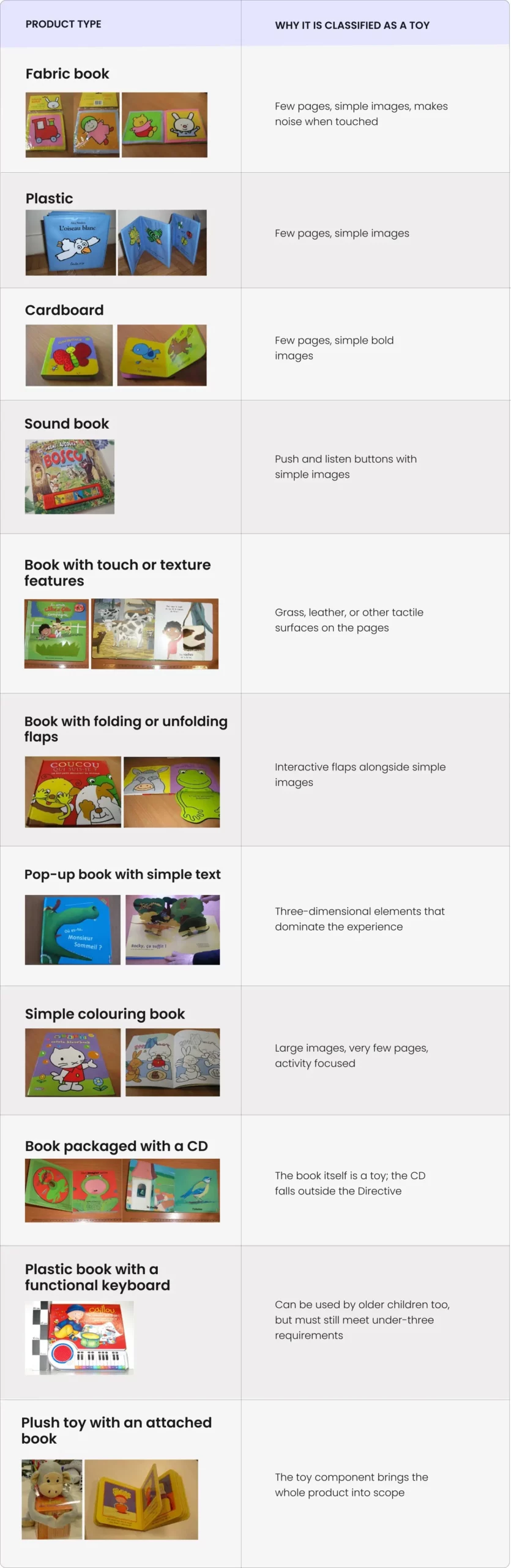
If your product could reasonably be used by both under-threes and older children, you need to apply the stricter under-three requirements regardless of how you have labelled the age range.
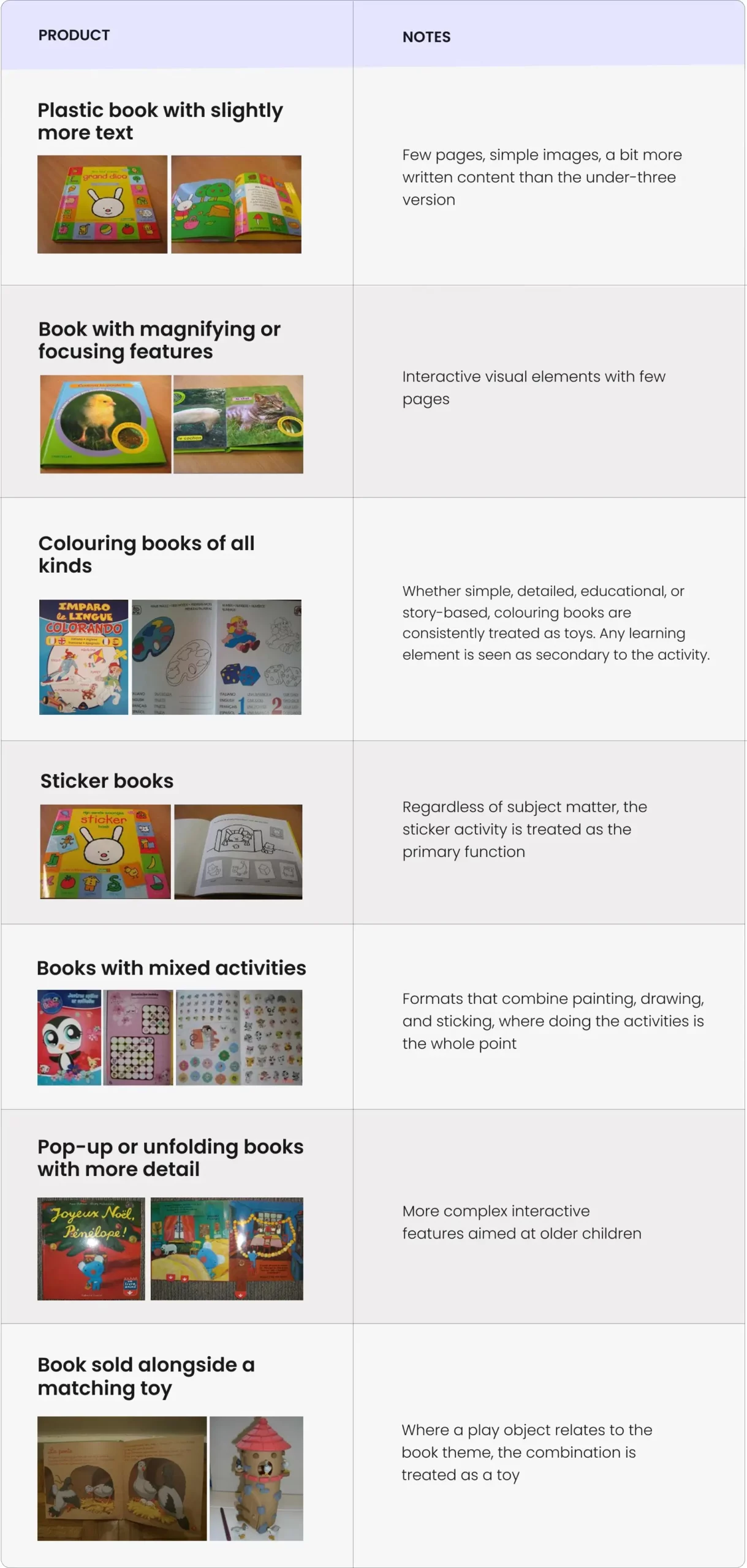
For Children Over 3 Years
These products are still classified as toys, but fall under the requirements for older age groups:
Books That Are Not Toys: Where the Line Falls
Knowing what does not count as a toy is just as useful as knowing what does. The following types are consistently treated as ordinary books or educational materials, outside the scope of the Toy Safety Directive:
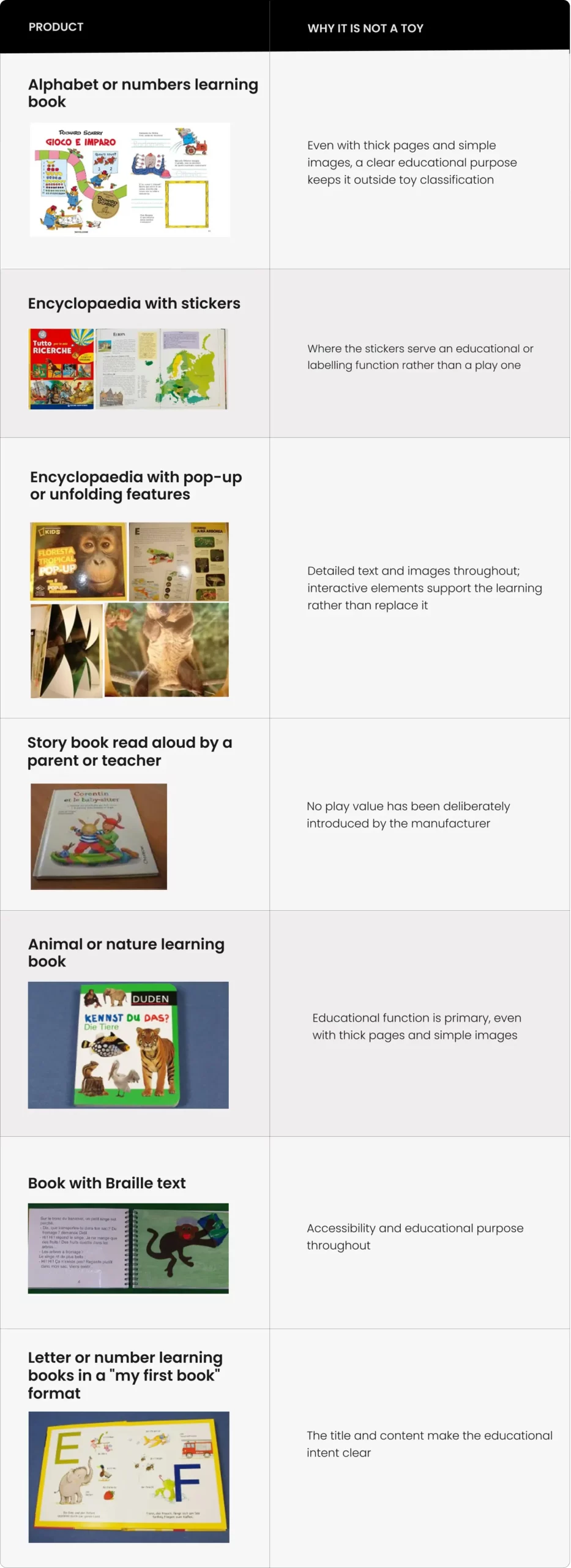
Some of these products have features that might look toy-like at first glance, such as stickers, pop-ups, thick pages, or bold simple images. What keeps them outside toy classification is that those features clearly support an educational or reading purpose rather than replace it.
The Tricky Cases: Products That Could Go Either Way
The products that cause the most compliance headaches are the ones that sit between the two lists above. Here are some real examples from the guidance document that show how close the line can be:
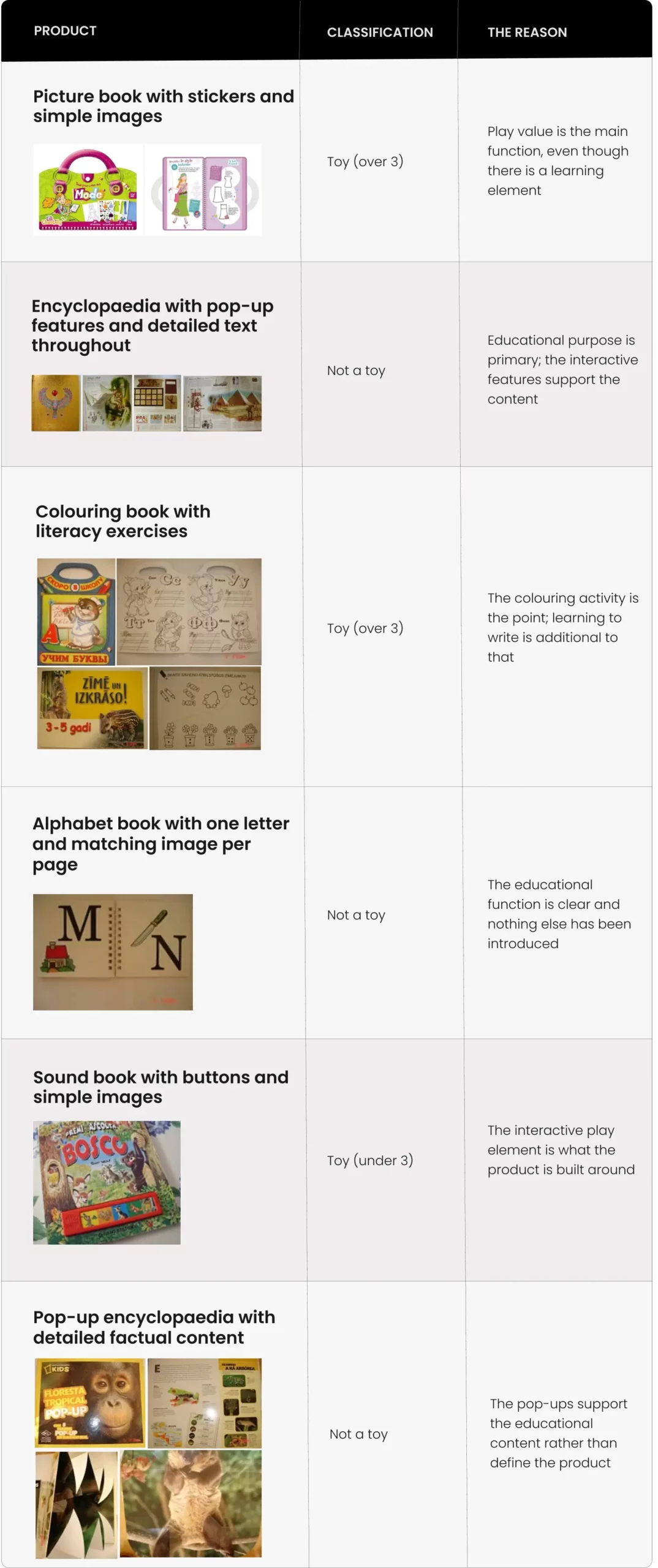
In each case, the deciding factor comes down to a single question: what is this product primarily designed to do? If the honest answer is that it is designed to be played with, it is a toy. If it is designed to be read or to teach something, and any play elements are genuinely secondary, it is more likely to fall outside toy classification.
One thing worth keeping in mind is that the Commission’s guidance on this is non-binding. National authorities assess products individually, and two authorities in different EU member states could reach different conclusions on the same borderline product. That is not a reason to ignore the guidance. It is a reason to make sure your classification position is well thought through and documented before you go to market.
What to Do If You Are Importing or Publishing Children’s Books
Whether you are a publisher, importer, or distributor bringing children’s books into the EU or UK, here are the practical steps to work through:
- Go through the five classification factors for your product and be honest about what they point to.
- If your product is a toy, make sure you have completed a conformity assessment against EN 71-1, and that your CE marking and Declaration of Conformity are in order.
- Check your materials against the 400 g/m2 paper weight threshold if you are concerned about EN 71-1 choking requirements.
- If your product could be used by children both under and over three, apply the stricter under-three requirements even if you have labelled it for older children.
- If you are taking a “not a toy” position, document your reasoning clearly based on the product’s design, content, and materials.
- Check both EU and UK requirements separately if you are selling into both markets, as the rules have diverged since Brexit.
Market surveillance authorities across the EU regularly check children’s products. Books with toy-like features are well within their scope, and the cost of dealing with a compliance issue after launch is significantly higher than sorting it out beforehand.
Market surveillance authorities across the EU regularly check children’s products. Books with toy-like features are well within their scope, and the cost of dealing with a compliance issue after launch is significantly higher than sorting it out beforehand.
Not Sure Where Your Product Sits?
Euverify helps importers, publishers, and manufacturers work through product classification questions like this one. We can assess your product against the classification factors, review your technical documentation, check your CE marking position, and make sure you are covered for both EU and UK market entry.
We also support publishers and distributors with book compliance questions, including children’s books and activity formats that may fall close to toy regulations.
If you are not sure whether your children’s book needs to comply with the Toy Safety Directive, the right time to find out is before it goes on sale. If you need help assessing your product or clarifying your compliance obligations, get in touch with Euverify to discuss your situation.
Frequently Asked Questions
No. The classification of a product as a toy under Directive 2009/48/EC is based on the product’s characteristics and intended use, not where it is sold. A children’s book with toy-like features sold in a bookshop can still be classified as a toy, and a product sold in a toy store is not automatically a toy. Point of sale is one indicator used in the classification process, but it is never the deciding factor on its own.
The whole product needs to comply with the Toy Safety Directive, including CE marking and conformity assessment. There is no mechanism to CE mark part of a product. If the book as a whole meets the toy definition, the entire product must meet the relevant safety requirements, including those under EN 71-1 for mechanical and physical properties.
Companies established outside the EU are not directly bound by REACH or the Toy Safety Directive. The responsibility falls on the EU importer, meaning the company bringing the product into the EU customs territory, or on an Only Representative appointed by the non-EU manufacturer. If you are exporting to EU distributors, your EU buyer is legally responsible for compliance, but in practice most EU importers will require you to provide the necessary technical documentation before they will accept your products.
Yes, in limited cases. The EU Borderline Products Manual confirms that a product can fall under more than one regulatory framework simultaneously. For example, a bath product for children that both performs a cosmetic function and has play value can be both a cosmetic and a toy. In those cases, the product must comply fully with both sets of requirements. Neither classification cancels out the other.
Yes, it can. Where a toy element is physically attached to or packaged with a book, the combination is assessed as a whole. The guidance document gives the example of a plush toy with an attached book holder, which is classified as a toy. If a toy component forms part of the product, the entire product may need to comply with the Toy Safety Directive, even if the book itself would not qualify as a toy on its own.
No. The Toy Safety Directive applies to physical products. Digital products, e-books, and apps fall outside the scope of the Directive regardless of their content or intended audience. However, if a digital product is bundled with a physical toy or interactive physical product, the physical component would still need to be assessed against the Directive in the usual way.