Upcoming Cosmetic Ingredient Bans in the EU: What Brands Must Reformulate (and When)
From retinoids to fragrance allergens, Europe’s latest cosmetics updates are reshaping formulation standards. What’s safe, what’s banned, and what’s still under review are constantly evolving, making it essential for every EU brand to stay informed.
Under the EU Cosmetics Regulation (EC) No. 1223/2009, new ingredient limits and proposed PFAS restrictions are raising the bar for product safety and transparency. For formulators and beauty brands, this means staying alert as the European Commission tightens rules in response to scientific findings and consumer expectations.
In the past two years, the Commission has introduced several notable changes, including stricter limits on retinoids, an expanded fragrance allergen labelling list, and a new set of CMR ingredient bans under the Omnibus VII Regulation. More updates are coming, with Omnibus VIII in draft and a PFAS restriction proposal under REACH that could impact entire product categories.
Whether you’re reformulating skincare, fragrance, or colour cosmetics, understanding what’s already law and what’s still in proposal is important. This guide breaks down the latest updates, timelines, and practical steps EU brands can take now, all explained clearly without getting lost in legal jargon.
How the EU Decides Which Cosmetic Ingredients to Ban or Restrict
The EU’s approach to ingredient safety is structured, science-led, and constantly evolving. All updates stem from Regulation (EC) No. 1223/2009, the foundation of cosmetics safety across the European market.
Here’s how the process works in practice:
- Scientific review: The Scientific Committee on Consumer Safety (SCCS) evaluates data on ingredients that may pose health risks.
- Commission decision: Based on the SCCS’s opinion, the European Commission prepares an amendment to update the regulation’s annexes.
- Adoption and publication: Once approved through a comitology vote, the change is published in the Official Journal of the European Union (OJ), along with an official start date and a grace period for reformulation.
Ingredients classified as CMRs (carcinogenic, mutagenic, or reprotoxic) under the CLP Regulation (EC) No. 1272/2008 are automatically banned under Article 15 of the Cosmetics Regulation, unless a specific exemption is granted.
“The use in cosmetic products of substances classified as CMR substances, of category 2, under Part 3 of Annex VI to Regulation (EC) No 1272/2008 shall be prohibited. However, a substance classified in category 2 may be used in cosmetic products where the substance has been evaluated by the SCCS and found safe for use in cosmetic products.”
Rather than releasing one major update every few years, the EU runs a continuous cycle of amendments. This rolling system keeps the cosmetics framework closely aligned with the latest scientific findings and consumer safety expectations.
What’s Already Under the Cosmetics Regulations: 2023 – 2025 Updates
1. More Transparency on Labels for Fragrance Allergens
Legal act: Commission Regulation (EU) 2023/1545 of 26 July 2023
Status: Adopted and in force, with transition periods
This update to Annex III expands the list of fragrance allergens that must appear on product labels. Over 80 additional allergens, including limonene, linalool, citronellol, eugenol, and geraniol, now need to be disclosed when they exceed specific concentration limits.
Why it matters:
- Previously, only 26 allergens had to be listed, so this marks a major step toward greater ingredient transparency.
- The change is designed to protect people with fragrance sensitivities and help all consumers make more informed choices.
- Manufacturers had until July 2026 to update labels and ingredient lists for newly placed products (3 years from publication). Products already on the market before that date have until July 2028 to comply.
Source: EUR-Lex – Commission Regulation (EU) 2023/1545; SGS implementation guidance.
2. Vitamin A (Retinoids) & Arbutin Restrictions
Legal act: Commission Regulation (EU) 2024/996 of 3 April 2024
Status: Adopted and published in the Official Journal
Following several assessments by the Scientific Committee on Consumer Safety (SCCS), the EU has introduced stricter limits on retinol, retinyl acetate, and retinyl palmitate. These limits address potential cumulative vitamin A exposure from both diet and skincare use.
New maximum concentrations (Annex III, Regulation 2024/996):
- Face and hand leave-on products: ≤ 0.3% retinol equivalent
- Body leave-on products: ≤ 0.05% retinol equivalent
- Rinse-off products: ≤ 0.3% retinol equivalent
Arbutin and alpha-arbutin were also reassessed for their potential to release hydroquinone. The amendment sets new concentration limits and purity standards for both substances.
What brands need to do:
- Review all leave-on formulations containing retinoids.
- Update Product Information Files (PIFs) with revised toxicological data.
- Adjust labels where new warning phrases are required.
Source: EUR-Lex – Commission Regulation (EU) 2024/996; SCCS Opinion SCCS/1643/22.
3. Newly Banned CMR Ingredients: Omnibus VII
Legal act: Commission Regulation (EU) 2025/877
Status: Adopted — applies from 1 September 2025
The Omnibus VII Regulation is the latest in the EU’s ongoing updates that align cosmetics laws with the CLP Regulation. Each Omnibus amendment adds newly classified carcinogenic, mutagenic, or reprotoxic (CMR) substances to the cosmetics regulation based on the latest Adaptation to Technical Progress (ATP).
What’s new:
- Several ingredients newly identified as CMRs under the CLP’s 18th ATP are now banned (Annex II) or restricted (Annex III).
- The regulation takes effect 20 days after publication. From 1 September 2025, products with affected ingredients can no longer be placed on the EU market.
What brands should do:
- Review all supplier documentation and Safety Data Sheets (SDS) for CLP classification updates.
- Cross-check ingredient lists against Annex II to ensure compliance before the deadline.
Source: EUR-Lex — Commission Regulation (EU) 2025/877; Official Journal L series; COSlaw summary.
Recent and Upcoming EU Regulations for Cosmetic Ingredients

1. Omnibus VIII
Legal act: Commission Regulation (EU) 2026/78 of 12 January 2026
Status: Adopted, applied from 1 May 2026
The Omnibus VIII Regulation added 18 new substances to the list of prohibited or restricted cosmetic ingredients, based on the latest CLP classification updates. Products containing the affected ingredients could no longer be placed on the EU market from 1 May 2026.
What brands should do:
Cross-check formulations against the updated Annex II and III entries introduced by Regulation 2026/78.
Confirm with suppliers that any affected substances have been removed or reformulated.
Update PIFs and CPNP/SCPN entries where affected ingredients were previously declared.
Source: Commission Regulation (EU) 2026/78; HPRA guidance.
2. PFAS Restriction Proposal (Under REACH)
Status: Proposal — updated ECHA submission, 2025
The EU’s proposed restriction on PFAS (per- and polyfluoroalkyl substances) under REACH would apply across multiple industries, including cosmetics. The proposal, submitted by five Member States (Germany, Denmark, Norway, Sweden, and the Netherlands), aims to phase out the entire PFAS group while allowing only limited exemptions where justified.
Why it matters for cosmetics:PFAS are commonly used in long-wear foundations, waterproof mascaras, hair styling products, and sunscreens for their film-forming and water-resistant qualities. Transition periods of up to 12 years are expected for sectors without ready alternatives, but cosmetics may see a shorter window. Regulators have noted that PFAS-free alternatives are already technically and economically feasible for most cosmetic uses, with no signs of supply shortages.
What brands should do now:
- Review all raw materials for fluorinated compounds.
- Discuss PFAS-free alternatives with suppliers.
- Begin testing reformulations to maintain performance without PFAS.
Source: ECHA — Updated PFAS Restriction Proposal (2025); European Commission Chemical Strategy for Sustainability.
Reformulation Playbook: How Cosmetic Brands can Adapt Early to EU Regulations
The best compliance strategy is proactive, not reactive. Here’s a practical path for EU cosmetic brands.
- Prioritise by regulatory certainty:
- Adopted acts (2023/1545, 2024/996, 2025/877) → act now.
- Draft/proposals (Omnibus VIII, PFAS) → plan and prototype.
- Map affected formulations:
- Create a matrix listing each product → affected ingredient → regulatory status → deadline.
- Validate substitutes:
- Retinoid replacements: bakuchiol, retinyl sunflowerate, encapsulated systems.
- Fragrance allergens: reformulate blends to stay below labelling thresholds.
- PFAS: explore silicones, waxes, natural polymers; document comparative testing.
- Re-test & re-label:
- Run stability and performance studies on all changed formulas.
- Update PIFs, safety assessments, and packaging artworks.
- Document everything:
Maintain a record of decisions, supplier letters, and test results for market surveillance.
Updating the PIF and Labelling for Cosmetics
When an ingredient’s status changes, documentation must too.
- Product Information File (PIF): Update Part A (formula, exposure assessment) and Part B (safety assessment) with new toxicological data.
- Labelling: Apply the expanded fragrance allergen list (2023/1545) and any Annex III warnings (e.g., retinoid cautions from 2024/996).
- Notification: Re-submit or update your Cosmetic Product Notification Portal (CPNP) entry if composition or labelling changes affect safety data.
Neglecting documentation updates can trigger enforcement action even if the formula itself is compliant.
Timeline: Key Milestones for 2023–2026
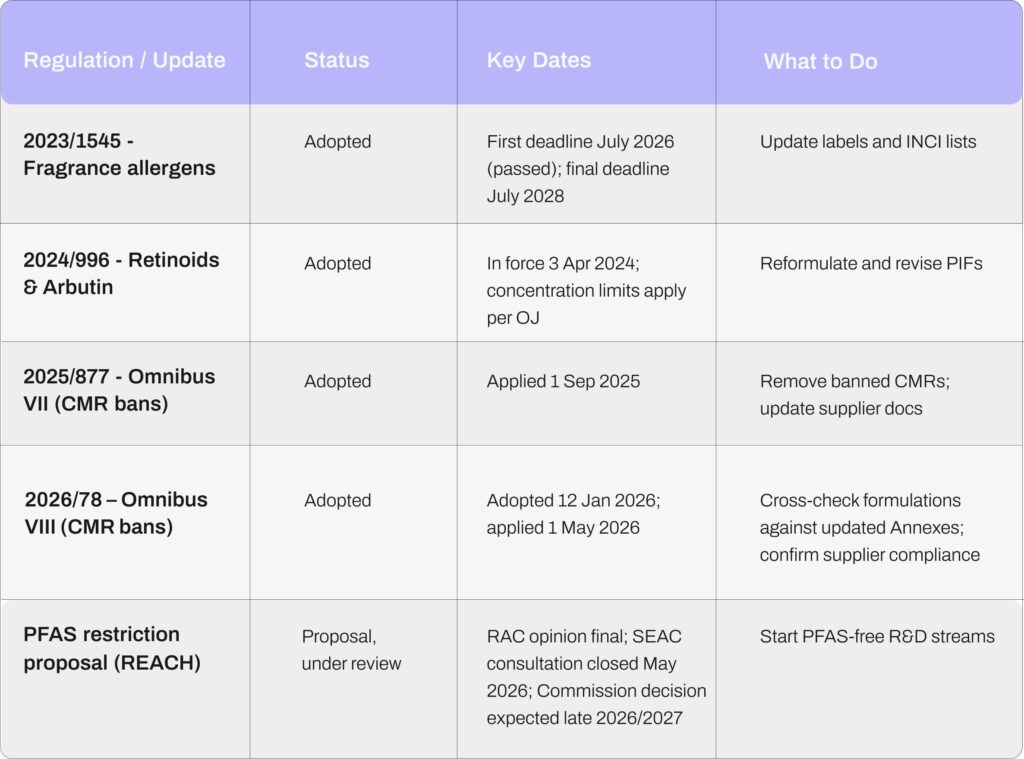
Sources: EUR-Lex regulations listed above; ECHA PFAS proposal documentation.
Compliance for Smaller Cosmetic and Indie EU Brands
Compliance isn’t just for multinationals. Indie and SME brands face the same deadlines, but smaller teams can still manage efficiently by:
- Using EU-based testing labs that already reference new Annex limits.
- Outsourcing safety assessment updates to accredited professionals.
- Building a rolling compliance calendar (track OJ publications and Commission press releases).
- Leaning on raw-material suppliers for SDS and Annex status confirmations.
Early organisation often costs less than last-minute reformulation.
Looking Ahead: Omnibus VIII and the PFAS Era
As EU cosmetics regulations continue to evolve, Omnibus VIII has already tightened the EU’s stance on eliminating CMR substances, and further rounds are expected as new CLP classifications are adopted. Meanwhile, the upcoming PFAS restriction could mark one of the most significant shifts in cosmetic formulation in decades. If approved, it would establish the strictest global limits on fluorinated ingredients used in beauty and personal care products.
Together, these developments reflect the broader goals of the EU Chemicals Strategy for Sustainability, which aims to create a toxic-free environment and streamline safety evaluations under the “one substance, one assessment” principle.
Ultimately, these changes signal an industry in constant motion. Instead of treating compliance as a one-time task, brands will need to plan for ongoing reformulation and proactive regulatory alignment to stay ahead.
Final Takeaway
The EU’s cosmetics regulations continue to keep products safe and trusted, but they also require constant attention from brands. Between 2023 and 2026, four binding updates are already in effect, with the PFAS restriction still the major proposal on the way. For consumers, this means clearer labels and safer formulations. For businesses, it means reviewing ingredients regularly, reformulating where needed, and keeping documentation in step with the law.
If you’re unsure how these updates affect your products or where to begin, Euverify can help. We specialise in EU and UK cosmetics compliance, including PIF reviews, safety assessments, label checks, and ongoing regulatory monitoring. Our goal is simple: to help your brand stay compliant, confident, and ready for the next phase of EU cosmetics regulation.