
What is a CPSR? Complete Guide to Cosmetic Product Safety Reports
Everything You Need to Know About CPSR for Cosmetic Products
What is a CPSR (Cosmetic Product Safety Report)?
A Cosmetic Product Safety Report (CPSR) is a mandatory safety assessment document required for all cosmetic products placed on the market in the European Union (EU) and United Kingdom (UK).
Under EU Cosmetics Regulation (EC) No. 1223/2009 and the UK Cosmetics Regulation 1223/2009, no cosmetic product can be legally sold unless a qualified toxicologist has reviewed its composition, exposure data, and toxicological profile — and has issued a CPSR confirming that the product is safe for human use. see euverify CPSR service page
In short: CPSR is the scientific proof that your cosmetic product is safe.
Why is a CPSR legally required in the EU and UK?
The CPSR ensures that every cosmetic product meets strict health and safety requirements before it reaches consumers.
Authorities such as OPSS (UK) or national enforcement agencies in the EU can request the CPSR at any time during inspection or investigation.
Having a CPSR:
- Confirms your product’s safety for human health
- Prevents product recalls, fines, or bans
- Enables your Responsible Person to submit the product on CPNP (EU) and SCPN (UK) portals
- Builds confidence with distributors and marketplaces like Amazon EU, Etsy, and Douglas
Without a CPSR, your product cannot legally enter the EU or UK cosmetic market.
What’s inside a CPSR — Part A and Part B explained
Part A – Cosmetic Product Safety Information
- Qualitative and quantitative composition (INCI list)
- Physical/chemical characteristics and stability data
- Microbiological quality
- Impurities, traces, and packaging material safety
- Normal and reasonably foreseeable use
- Exposure assessment and toxicological profile
- Undesirable effects or serious undesirable effects (if any)
Part B – Cosmetic Product Safety Assessment (CPSR)
- Certified safety assessment by a qualified toxicologist
- Overall conclusion on product safety
- Name, qualifications, and signature of the safety assessor
- Date of assessment
CPSR vs PIF — what’s the difference?
The Product Information File (PIF) is the complete regulatory dossier you must maintain for 10 years. The CPSR is one essential component within that larger framework.
| Aspect | CPSR | PIF (Product Information File) |
|---|---|---|
| Definition | Safety assessment document | Complete regulatory dossier |
| Legal Reference | Annex I of Regulation | Article 11 of Regulation |
| Content Scope | Safety data + assessment | CPSR + manufacturing + claims + more |
| Required Contents | Part A (data) + Part B (assessment) | CPSR, product description, manufacturing method, GMP statement, claim evidence, animal testing data |
| Who Prepares It | Qualified safety assessor | Responsible Person (compiles all elements) |
| Retention Period | Part of PIF (10 years) | 10 years after last product supplied |
| Access for Authorities | Via PIF access | Accessible to competent authorities on request; typically within 24 hours in the relevant local language |
Think of the PIF as the complete compliance folder and the CPSR as its most critical document. You can’t have a compliant PIF without a valid CPSR – but a CPSR alone isn’t the full regulatory picture.
Who can prepare a CPSR? Article 10(2) explained
Only a qualified safety assessor or toxicologist can prepare and sign the CPSR. According to EU law, this individual must hold:
- A degree in pharmacy, toxicology, medicine, or a related scientific discipline
- Proven experience in cosmetic safety assessment and toxicological analysis
- Knowledge of EU/UK cosmetic regulations, toxicological databases, and exposure calculation methods
The CPSR must include the toxicologist’s:
- Full name
- Signature
- Qualifications
- Date of assessment

Euverify works with certified toxicologists and UK/EU-based labs who meet all regulatory criteria for issuing CPSR documents.
What Information Is Needed to Prepare a CPSR?
If you don’t already have a CPSR, you will need to gather specific details to provide to the toxicologist.
The required documents typically include:
Product and Formula Data
- Full INCI list (International Nomenclature of Cosmetic Ingredients)
- Exact percentage or concentration of each ingredient
- Function of each ingredient (e.g., emollient, preservative, fragrance)
- Physical and chemical characteristics of the formulation
Product Details
- Product name and description
- Product category (e.g., cream, shampoo, lip balm)
- Country of manufacture
- Intended use and instructions for application
- Target consumer (adult, child, sensitive skin, etc.)
Test Reports
- Stability test report
- Microbiological (challenge) test report
- Compatibility with packaging (if applicable)
- Efficacy or performance test results (if product makes claims)

Label & Packaging
- Final label artwork showing ingredients, warnings, and claims
- Packaging images
Additional Information
- Fragrance or allergen declarations (if perfume is used)
- Certificates from ingredient suppliers (e.g., purity, safety data sheets)

The toxicologist uses this information to calculate exposure, assess ingredient interactions, and confirm the overall safety of the cosmetic product.
How long does a CPSR take to prepare?
A typical CPSR takes 2 to 4 weeks end-to-end once all documentation is complete. Here’s how that breaks down:
File Gathering
Collect formulations, CoAs, MSDS, packaging specs, and test reports
Technical Verification
Review documentation for completeness and regulatory compliance
CPSR Drafting
Safety assessor evaluates data and prepares Parts A & B
CPNP/SCPN Notification
Submit product notification to EU and/or UK databases
Note that lab testing if needed adds 2–6 weeks separately.
How much does a CPSR cost?
Industry range is £180 to £700 per product. Costs vary by ingredient count, formulation complexity, lab testing requirements and whether variants are included.
For detailed pricing, including per-ingredient-tier rates and variant options:
CPSR PricingCPSR for Different
Product Types
Skincare Emulsions
Challenge testing required. Qualify into essential, most complex category
Anhydrous Balms & Oils
Fewer data req, no challenge testing, skin simple and near cost
Makeup
Colour to consider, and pigment stability check required for every shade
Haircare
Inside of CPNP Representative exercise and full compliance documentation
Sun Care
Packaging Evidence, and INSO reporting required, in development
Fragrance
Covers IFRA, Deroga labelling, and future Digital Product Regulation (DPR.act)
When does a CPSR need to be updated?
A CPSR is a living document. Any material change to your product requires a review and potentially a new assessment.
Material Changes Requiring Update
- Any formulation change (even swaps)
- New supplier with different specifications
- Change of packaging material
- New product claims
- New use pattern or target group
- New SCSS opinion affecting on ingredient
- New ingredient restriction or ban
- Post-market signals (cosmetovigilance)
Best Practice Recommendation
- Annual Review
Even without known changes, we recommend reviewing your CPSR annually to ensure continued compliance with evolving regulations, new SCSS opinions, and updated ingredient restrictions.
Regulations evolve – stay ahead of changes!
CPSR after Brexit – EU vs UK requirements
Same regulatory content but two separate regimes. CPNP (EU) and SCPN (UK) are separate notifications. Different Responsible Person required in each market. UK retained the EU regulation as UK Cosmetics Regulation 2019; Annexes are slowly diverging.
Euverify Dual-Market CPSR
We handle both EU and UK assessments in a single CPSR package, ensuring you’re covered for both markets.
Common CPSR mistakes to avoid
Six common mistakes:
- Using a non-qualified assessor
- Missing CoA or MSDS for raw materials
- Inadequate stability data
- Wrong INCI declaration order
- Failing to update after formulation tweaks
- Trying to reuse a CPSR across the EU and UK without checking Annex divergence.
How to order a CPSR
Getting your CPSR with Euverify is a straightforward three-step process designed for efficiency and compliance.
Gather your formulation, manufacturing details & any test reports
Start an order on Euverify’s CPSR service page
Receive your signed CPSR + CPNP/SCPN notifications
How Euverify Helps with CPSR
Many cosmetic brands outside the EU or UK — especially from the United States, Canada, and Asia – are unfamiliar with CPSR requirements.
Euverify bridges this gap by helping you complete the entire process.
We work with:
- In-house toxicologists with extensive cosmetic safety experience
- Partner laboratories in the UK and EU specializing in cosmetic testing and CPSR preparation
If you already have your product data ready, simply upload it to your Euverify dashboard and select “Request CPSR Preparation.”
Our team will connect you with a qualified toxicologist or prepare the report internally through our verified partners.
CPSR Within the Euverify Dashboard
When you add your cosmetic products in the Euverify dashboard:
- Select your product type from clickable categories.
- The system automatically tells you which documents you must provide, including the CPSR.
- If you don’t have a CPSR, choose “Request CPSR Service.”
- Our team will review your ingredients and testing data, then assign your case to an accredited toxicologist.
- Once completed, your CPSR will be uploaded directly into your Euverify account and linked to your product record.
This ensures your Responsible Person has direct access to all compliance documents for CPNP/SCPN submissions.
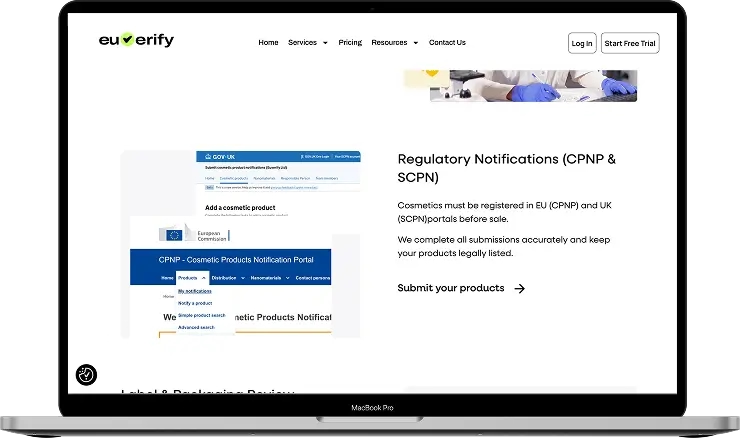
Regulatory Notifications (CPNP & SCPN)
Mandatory submission before selling. All cosmetic products must be notified to the EU CPNP and UK SCPN portals before market entry. We manage both for you.
Pricing Overview
CPSR preparation is not included in the base Responsible Person plan, as it depends on the complexity of your product formula and the number of variants (e.g., shades or fragrances).
The exact cost will be shown transparently in your dashboard before confirming the service.
The Euverify Base Plan (£490 / year) covers up to 5 products and includes either the EU or UK Responsible Person service.
Add both the EU & UK Responsible Person representation for an additional £200 / year.
CPSR preparation and lab testing are available as add-on services.
Frequently Asked Questions
If the composition changes (different colourants, perfumes, or actives), a separate CPSR is required. If only the shade name changes but ingredients are identical, you may use the same CPSR with updated product references.
Only if it’s prepared and signed by a qualified EU/UK toxicologist and the Responsible Person has full access to it. Otherwise, it must be reissued.
No. CPSR is specific to EU and UK markets. However, U.S. brands exporting to Europe must obtain a CPSR before listing or shipping their products.
Typically 3–7 working days, depending on the availability of documents and product complexity.
The Responsible Person (e.g., Euverify) holds and verifies the CPSR as part of the Product Information File (PIF) and provides it to authorities upon request.
Yes. Euverify can coordinate both through our in-house and partner toxicologists. You can manage both services directly in your dashboard.
Depending onYes. All toxicologists working with Euverify are qualified professionals based in the EU or UK with recognized credentials in toxicology, pharmacy, or cosmetic science.



Testing Services
Comprehensive safety & performance testing. From stability and microbiological challenge tests to SPF and efficacy validation – we partner with trusted, accredited labs.
View testing options

Label & Packaging Review
Ensure compliance before you print. We review your ingredient lists, claims, and layouts to meet EU & UK labelling rules – helping you avoid costly recalls.
