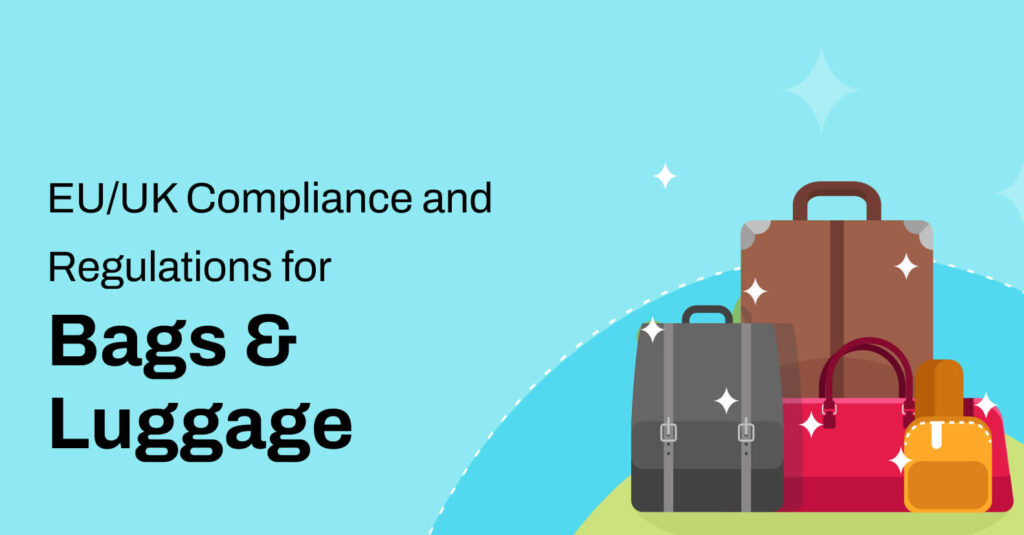
Bags and Luggage Compliance in the EU & UK: A Packed Guide to Regulations
Selling bags and luggage, including backpacks, handbags, suitcases and trolleys, in the EU or UK requires full compliance with strict product safety laws. This is not just about meeting legal obligations; it is about protecting consumers and maintaining your brand’s credibility.
The EU’s General Product Safety Regulation (GPSR), which replaced the older GPSD, and the UK’s equivalent framework ensure that all consumer goods placed on the market are safe. This guide outlines the key areas of bags and luggage compliance, including chemical safety, mechanical durability, labelling, packaging, supply chain responsibilities, and penalties for non-compliance.
Material Safety and REACH Compliance
One of the most critical areas of bags and luggage compliance is chemical safety. Under the EU REACH regulation, certain hazardous substances such as lead, cadmium, phthalates, and azo dyes are restricted in consumer products. These chemicals may be found in components like zippers, synthetic leather, adhesives, and printed fabrics.
To stay compliant, manufacturers and importers must:
- Use certified, tested materials
- Test products for restricted substances
- Keep detailed documentation (lab reports, declarations, technical files)
If a product contains any Substance of Very High Concern above 0.1%, the manufacturer must notify customers and may need to inform the European Chemicals Agency.
The UK now follows its own version called UK REACH. While the rules currently align closely with EU REACH, businesses must treat them as separate obligations and monitor for divergence over time.
Mechanical and Physical Safety for Bags and Luggage Compliance
Beyond chemical risks, bags and luggage must also be physically safe and structurally durable. While CE marking isn’t typically required, these products must still comply with general consumer safety requirements. That includes eliminating hazards such as sharp edges, small breakable parts, or components that could cause entanglement.
Manufacturers often conduct tests based on recognised standards (e.g. EN, ISO, or SATRA) to assess:
- Seam and material strength
- Drop and impact resistance
- Wheel and handle durability
- Zipper and fastener reliability
- Abrasion and tear resistance
Following industry standards isn’t mandatory, but it offers strong evidence that your product meets legal safety expectations.
Bags and Luggage Labelling and Packaging Requirements
Labelling
Accurate labelling is essential for traceability and consumer safety. Bags and luggage must include:
- Manufacturer/importer name and address (EU and/or UK-based)
- A product identifier (e.g., model or batch number)
- Safety instructions if applicable (e.g., max weight)
Textile fibre labels are generally optional for bags, as most are exempt under EU rules. However, if included, they must be accurate and not misleading.
Products with electrical features or toy-like elements must carry specific conformity markings and usage instructionsfor bags and luggage compliance.
Packaging
Packaging must comply with the Packaging and Packaging Waste Regulation (EU) 2025/40 (PPWR), applied from 12 August 2026:
- Heavy metal content (lead, cadmium, mercury, and hexavalent chromium combined) must stay below 100 ppm
- Packaging must meet PPWR’s design-for-recycling requirements and avoid excessive or unnecessary packaging
- Producers may have Extended Producer Responsibility (EPR) obligations, which vary by country
- Some countries require recycling labels or participation in local schemes
- Any necessary conformity marks must also appear on the outer packaging if applicable
Responsibilities of Manufacturers, Importers, & Retailers for Bags and Luggage Compliance
Manufacturers
Manufacturers are responsible for designing safe products and conducting risk assessments. They must keep a technical file with test results, materials used, and a safety statement. Products should be clearly labelled with their contact information and batch or model numbers. If a safety issue arises, they must act quickly. This could mean recalling the product and informing authorities.
Importers
Importers are responsible for ensuring that overseas-manufactured bags and luggage comply with EU and/or UK regulations. Their duties include:
- Verifying product safety and documentation
- Including their own name and address on the product or packaging
- Retaining technical documentation for 10 years
- Responding to safety issues and cooperating with market surveillance authorities
Post-Brexit, businesses importing into Great Britain from the EU now count as importers and must fulfil these duties.
Distributors and Retailers
While their responsibilities are more limited, distributors must:
- Avoid selling non-compliant products
- Preserve labelling and instructions
- Cooperate with authorities during investigations or recalls
- Act promptly if a safety issue arises
All parties must be able to trace where products came from and where they were sold (one step up and down the supply chain) for at least 10 years.
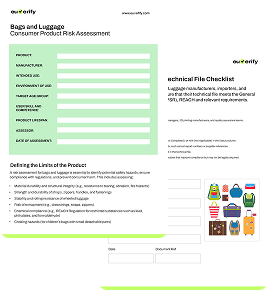
Technical Files Checklist & Risk Assessment Template
Bags and Luggage
- Ensure Compliance
- Reduce Risk
- Streamline Documentation
- Supports market access
Get it now for just £40!
Market Surveillance & CE/UKCA Marking for Bags and Luggage Compliance
Authorities in both the EU and UK actively monitor markets to enforce compliance. They conduct inspections, review documents, and coordinate recalls across borders. In the EU, these actions are centralised through the Safety Gate system. In the UK, the OPSS and local Trading Standards lead these efforts.
If a product is found to be unsafe, authorities can:
- Halt sales and order recalls
- Require corrections to labelling or documentation
- Issue public warnings
- Impose fines or take legal action
Traceability is essential for responding to these situations. Batch numbers and proper records help ensure quick and targeted action.
CE and UKCA Marking
Most bags and luggage do not require CE or UKCA marking. These marks are only needed if the product falls under specific categories such as:
- Toys(e.g. children’s bags with play features)
- Electronics(e.g. bags with power banks or GPS trackers)
- PPE(e.g. bags with bulletproof inserts)
For such products, manufacturers must meet additional regulations and include the relevant conformity mark. The UK has extended recognition of the CE mark indefinitely, but businesses should still prepare for UKCA marking where required.
Penalties for Non-Compliance
Failing to meet compliance requirements can lead to:
- Fines: Ranging from thousands to millions, depending on severity. In the UK, fines can be unlimited.
- Recalls: Authorities can force products off shelves, and the business bears the cost.
- Criminal prosecution: In cases of serious negligence, responsible individuals may face jail time.
- Reputational damage: Publicised enforcement actions can harm brand trust. Online marketplaces may ban non-compliant sellers.
Staying compliant protects your business from these risks and strengthens your credibility.
How Euverify Helps with Bags and Luggage Compliance
Euverify offers an all-in-one platform to help businesses meet EU and UK compliance requirements for bags and luggage. Services include:
- Product testing and risk assessment: Guidance on REACH testing and mechanical durability checks
- Documentation support: Tools to create and store technical files, declarations of conformity, and safety documents
- Regulatory updates: Ongoing alerts and guidance to keep you current with changing rules
- Authorised Representative service: Essential for non-EU/UK businesses to sell in these markets
- Compliance tools: A simple interface for managing labels, checklists, and document generation
Whether you’re a small brand or a large importer, Euverify can help you simplify compliance, reduce risk, and get your products to market with confidence.
Final Takeaways
Bags and luggage compliance in the EU and UK is essential. From chemical safety and product durability to proper labelling and supply chain accountability, every step matters. With increasing regulatory scrutiny and evolving standards, having the right systems and support in place is essential. Euverify offers practical solutions to help businesses manage compliance, conduct risk assessments, maintain technical files, avoid penalties, and build trust with customers in both markets.
For a deeper look at specific regulations, testing requirements and documentation examples, download our detailed guide on bags and luggage compliance to stay fully informed and prepared.
Appoint Your EU Representative & Ensure Compliance for Your Bags & Luggage
- Stay compliant with EU regulations
- Hassle-free representation for Bags & Luggage