10 Common Textile Labelling Mistakes That Lead to EU Compliance Failures
Most brands think that if a product is made well and described honestly, the label will take care of itself. It sounds reasonable. But when it comes to textile labelling under EU law, that assumption can quickly lead to trouble.
In reality, labelling is its own technical space, with specific wording, fixed formats, and very little room for error. A small mistake is not just a minor issue. It can hold up shipments, trigger fines, or even get products pulled from shelves.
This guide breaks down the ten mistakes that show up most often, what the rules actually require, and why these slip-ups so often turn into compliance problems.
Using Unauthorised or Invented Fibre Names
It is tempting to get creative with fibre names, especially when marketing teams want something that sounds distinctive or premium. But under Regulation (EU) No 1007/2011, this is one of the quickest ways to fall out of compliance.
The rule is clear. Only the fibre names listed in Annex I can be used on textile labels (Article 5). These names are tightly defined and reserved for fibres that match their exact technical descriptions. They cannot be adapted, shortened, or used loosely to describe something similar.
This matters more than it might seem. Annex I includes around 50 recognised fibres, from familiar ones like wool and cotton to synthetics such as elastolefin and polyacrylate. If a label uses a name that is not on that list, it is not just a wording issue, it is a compliance breach.
That includes invented terms like “CloudSoft fibre” or “NanoWeave” when they are used in place of a proper fibre name. It also covers misusing real terms. For example, “silk” cannot be used to describe how a fibre looks or feels if the material is not actually silk as defined in the regulation.
If a manufacturer has genuinely developed a new fibre, there is a formal route under Article 6 to have it recognised. Until then, the material has to be labelled as “other fibres”, along with its percentage by weight.
Incorrect Fibre Composition Percentages
At first glance, listing fibre percentages seems simple. You name each fibre and show its percentage by weight, in descending order, as required by Article 9(1). But this is where many brands slip up.
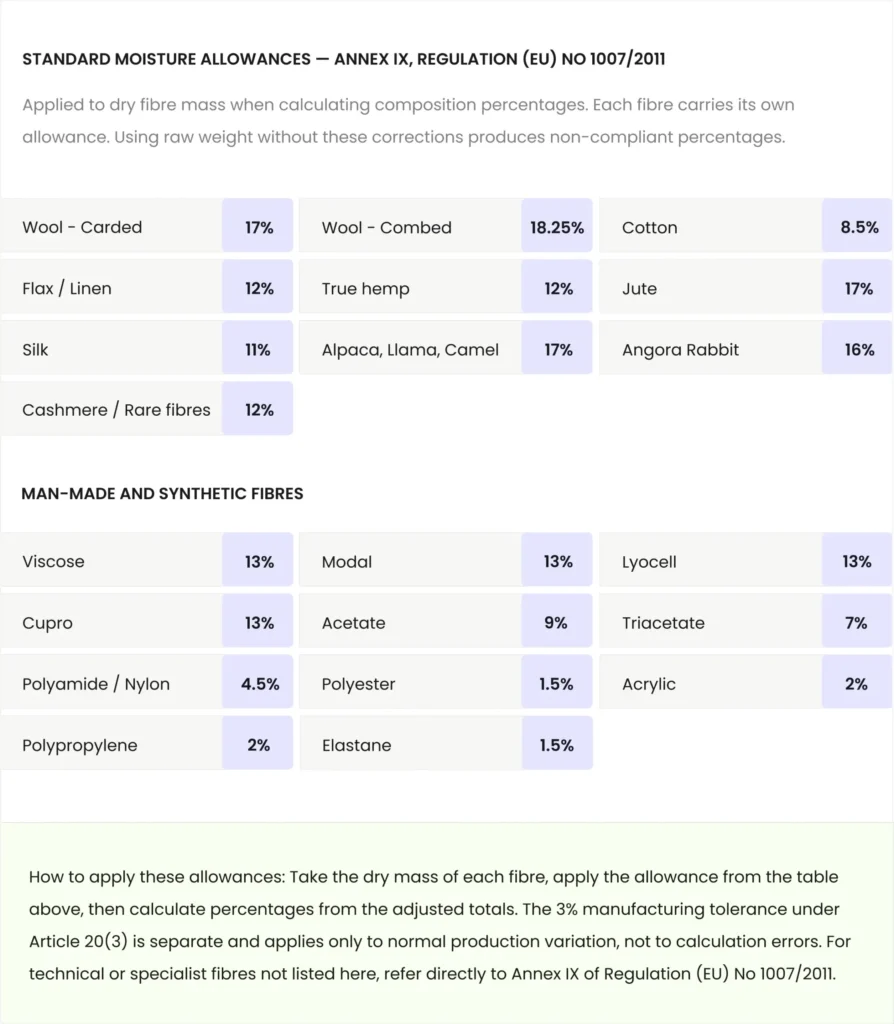
The key issue is how those percentages are calculated. They are not based on the raw weight of the fibres. Instead, they must be calculated using the dry mass of each fibre, adjusted with standard moisture allowances set out in Annex IX. Each fibre has its own allowance. Cotton is 8.5%, wool is 17% for carded or 18.25% for combed, acrylic is 2%, polyester is 1.5%, and so on.
If these allowances are ignored and simple weight is used, the final percentages will almost always be off. It is a small detail, but it makes a big difference in compliance terms.
There is some flexibility, but it is limited. A fibre that makes up no more than 5% of the total, or several minor fibres that together do not exceed 15%, can be grouped under “other fibres” with a combined percentage, as set out in Article 9(2). This only applies when those fibres cannot reasonably be identified during manufacturing. It is not meant to cover gaps in analysis or incomplete data.
The regulation does allow a small manufacturing tolerance when lab results are compared with the label, but it is narrow and does not cover calculation errors. We explain how it works in mistake 8 below.
The table below shows the standard allowances for the most common fibres.
Failing to Label Multi-Component Products Correctly
Things get more complicated when a product is made up of different parts. If those parts have different fibre compositions, the law expects each one to be labelled separately.
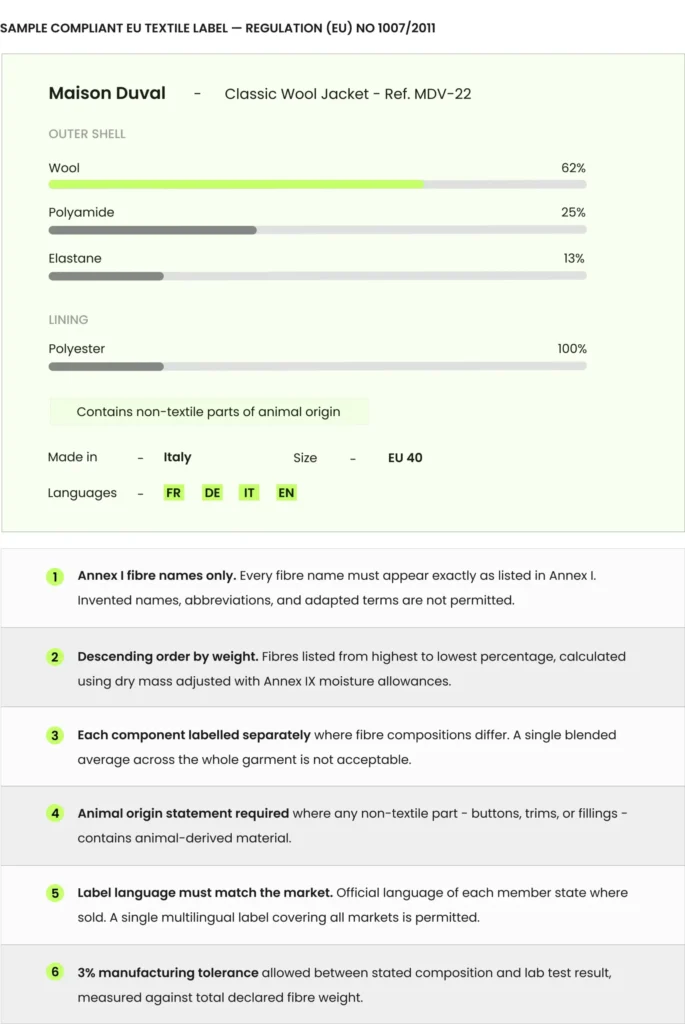
Under Article 11(1), you cannot rely on a single overall composition if the product has distinct components. Each part with a different fibre content needs its own breakdown. For example, a jacket with a polyester outer and a cotton lining must show both, not an average across the whole garment.
There are a couple of limited exceptions:
- A component does not need separate labelling if it is not a main lining and makes up less than 30% of the total weight (Article 11(2)).
- There is also some flexibility for products that are usually sold together as a single unit. If they share the same fibre composition, they can carry one label between them (Article 11(3)).
Where brands tend to go wrong is assuming that one combined percentage is enough. If the product is built from clearly different parts with different compositions, that approach will not meet the requirement.
Here is what a fully compliant label looks like when all of these requirements are applied correctly.
Ignoring the Pure Product Rules
Labels like “100% cotton” or “pure wool” carry more weight than they might seem. Under Article 7(1), these terms can only be used when the product is made entirely from a single fibre.
There is a small allowance for trace fibres, but it is tightly controlled. For most products, up to 2% by weight of other fibres is acceptable, as long as their presence is genuinely unavoidable in good manufacturing and not added on purpose (Article 7(2)). For products that go through carding, this limit increases to 5%.
Products labelled with the protected terms “virgin wool” or “fleece wool” (listed in Annex III) face stricter rules under Article 8. Extraneous fibres must not exceed 0.3% by weight, even for carded products. The wool must also not have been previously incorporated in a finished product, must not have undergone any spinning or felting beyond what manufacture requires, and must not have been damaged by treatment or use. These terms can also describe wool in a blend, but only if that wool meets the same conditions and makes up at least 25% of the total weight (Article 8(2)).
Where things go wrong is in how this tolerance is used. It is there to account for technical limits in production, not to allow deliberate blending. If a different fibre is added on purpose, even in a small amount, the product cannot be labelled as “100%”, “pure”, or “all” of a single fibre.
Missing the Animal Origin Statement
Some products include small details that are easy to overlook, like leather trims, horn buttons, or feather fillings. But under Article 12(1), these details trigger an extra labelling requirement.
If a product contains any non-textile parts of animal origin, the label must include the exact phrase: “Contains non-textile parts of animal origin.” This sits alongside the fibre composition label. It does not replace it or form part of it.
This is often missed because most attention goes to fibre percentages. Trims and accessories tend to be treated as secondary, even though they still count. If they are made from animal-derived materials, the statement is mandatory.
Wrong Language on the Label

Language requirements are easy to overlook, especially when selling across multiple countries. But under Article 16(3), textile labels must be in the official language or languages of the Member State where the product is sold, unless that country allows otherwise.
In practice, this means a label in English alone may work in Ireland, but not in markets like France, Germany, Italy, or Spain. Each country expects information to be accessible to its consumers, and that includes fibre labelling.
There is a limited exception for small items like bobbins, reels, skeins, and similar sewing or embroidery yarns. In these cases, the language requirement applies to the outer or inclusive packaging. Individual items can use any official EU language, as long as the full information is provided elsewhere on the packaging.
Confusion Between Labels and Commercial Documents
There is often confusion about when a physical label is required and when documents are enough. Article 14 makes the baseline clear: textile products must be labelled or marked when they are placed on the market.
That label has to meet a few practical conditions. It must be durable, easy to read, clearly visible, and accessible. If it is a physical label, it also needs to be securely attached to the product (Article 14(1)).
There is some flexibility within the supply chain. When products are moving between businesses rather than being sold to consumers, the label can be replaced or supported by commercial documents like invoices or delivery notes (Article 14(2)). These documents still need to clearly state the fibre names and composition. Abbreviations are not allowed in them, except for a mechanised processing code or an abbreviation defined in an international standard that is explained in the same document (Article 14(3)).
Where things go wrong is in how this flexibility is used. It is not a blanket exemption. Once the product is offered to consumers, a proper physical label is required. Relying on business-to-business documentation and then forgetting to add a compliant label before retail is a common and entirely avoidable mistake.
Exceeding Permitted Tolerances Without Justification
Tolerance rules are often misunderstood, and it is easy to see why. The regulation does allow some margin for variation, but it is tightly controlled.
Under Article 20(3), there is a 3% manufacturing tolerance between the stated fibre composition and what a lab test might find. Article 20(2) also allows small amounts of extraneous fibres, up to 2% for most products or 5% for carded ones, without needing to list them on the label.
The key detail is how these tolerances interact. They cannot simply be added together in every case. Article 20(4) only allows both tolerances to be used at the same time if the extraneous fibres identified during testing are of the same chemical type as fibres already declared on the label. If they are different, the tolerances cannot be combined.
There is a route for more complex cases. If a product genuinely requires higher tolerances due to how it is made, the manufacturer can apply for authorisation under Article 20(5). This has to be done before the product is placed on the market, with clear evidence to support the request. It is not a way to fix a label that is already non-compliant.
Skipping Labels for Products That Actually Require Them
Some products are exempt from labelling, but this is where things often get misread. Annex V lists 42 categories where labelling is not mandatory, including items like watch straps, slide fasteners, textile-covered buttons, and flags (Article 17(2)).
The issue tends to go in two directions. Some businesses add labels to exempt products anyway, then get the details wrong and create a compliance problem that did not need to exist. More often, though, products are wrongly assumed to be exempt, and the label is skipped altogether.
There is an important catch. Even if a product falls under Annex V, the exemption does not apply if the brand name or trade mark includes a recognised fibre name from Annex I. In that case, the full labelling rules under Articles 11, 14, 15, and 16 still apply.
It is also worth keeping Annex VI in mind. This covers products where individual labelling is not required, but fibre information must still be provided through inclusive labelling. Items like handkerchiefs, belts, ribbons, and sewing yarns fall into this category. One label can cover a group, but the composition still needs to be clearly stated.
Distributor Responsibilities Being Overlooked
It is easy to assume that labelling is the manufacturer’s responsibility. In most cases, that is true. If the manufacturer is based outside the EU, the responsibility shifts to the importer (Article 15(1)).
But the regulation goes further than many expect. A distributor can be treated as a manufacturer in certain situations. If they sell a product under their own name or trademark, apply the label themselves, or change what is on the label, they take on full responsibility for its accuracy (Article 15(2)).
This comes up often with private label products, retailer own brands, or when labels are adjusted for different markets. Once a distributor steps in like this, they are no longer just passing the product along. They are accountable for whether the labelling is correct.
There is also a broader obligation across the supply chain. Any information provided with a textile product must not be confusing or misleading when compared with the regulated fibre names and composition rules (Article 15(4)). That includes marketing language. Using fibre names in a way that does not match their legal definitions can create compliance risks at any stage. Sustainability wording needs the same care. Since 27 September 2026, rules under the Empowering Consumers for the Green Transition Directive (EU) 2024/825 restrict generic environmental claims such as “eco-friendly” or “sustainable” on labels and product pages unless they can be properly substantiated.
Looking ahead, this is only becoming more important. Under the Ecodesign for Sustainable Products Regulation (ESPR), large companies have been banned from destroying unsold apparel and footwear since 19 July 2026, and rules for textiles, including a Digital Product Passport, are expected to follow from around 2027. Member States must also set up extended producer responsibility (EPR) schemes for textiles by 2028 under the revised Waste Framework Directive. In addition, the Commission is revising the Textile Labelling Regulation itself, with digital labelling on the agenda. Businesses that get their labelling and documentation right now are already building the systems they will need for what comes next.
Final Thoughts on EU Textile Labelling Compliance
EU textile labelling rules may seem complex at first, but they are consistent once you understand them.
Most compliance issues do not come from intentional mistakes. They usually happen because requirements are misunderstood, outdated templates are used, or expert guidance is not involved early enough.
Businesses that avoid issues treat labelling as part of the process, not a last step. They verify fibre composition, use the correct fibre names, apply the right language for each market, and understand their responsibilities in the supply chain.
Enforcement is active across EU Member States, and labels are regularly checked. Having a clear review process in place is far easier and less costly than dealing with issues after products reach the market.
For businesses looking to simplify this process, Euverify supports textile compliance with structured guidance and documentation aligned with EU requirements.
Frequently Asked Questions
Generally, yes. The regulation applies to textile products whenever they are made available on the EU market (Article 2), and it does not specifically exclude second-hand or vintage items. Where the original label is still intact and accurate, it will usually meet the requirement. However, if a seller removes or alters the label, or sells the product under their own name, they take on the manufacturer’s responsibilities under Article 15(2). Because enforcement practice for second-hand goods can vary, it is worth checking guidance from the market surveillance authority in each country where you sell.
No. You can use a single multilingual label. Under Article 16(3), the requirement is that fibre composition information is available in the official language of each Member State where the product is sold. A label carrying multiple languages at once satisfies this, provided all required information is present and legible in each language.
Yes, and it does create an obligation. If a brand name, product name, or trademark incorporates an Annex I fibre name, the full labelling requirements apply even if the product would otherwise be exempt under Annex V. A product name that implies a specific fibre content triggers the same rules as a standard fibre composition label, regardless of exempt status.
Yes. Regulation (EU) No 1007/2011 applies to all textile products made available to consumers in the EU regardless of the sales channel. For products sold online, Article 16(1) requires the fibre composition to be clearly visible to the consumer before the purchase is made, including where the purchase is made by electronic means. It is not enough for this information to appear only on the physical label once the product arrives. This means product listings and descriptions must reflect the correct fibre names and composition in line with the regulation.
The product is considered non-compliant and the responsible economic operator, whether manufacturer, importer, or distributor, must take corrective action. This typically means relabelling affected stock and reviewing the production process. Depending on national enforcement rules, authorities can also require market withdrawal or impose financial penalties. Penalties are set by each Member State (Article 25), and deliberate mislabelling can lead to more serious consequences, including prosecution in some countries.