B2B Products Under the EU GPSR: Compliance Essentials for Businesses
The General Product Safety Regulation (GPSR), is changing the way companies think about product safety in Europe. Many assume it only applies to direct business-to-consumer (B2C) sales, but that’s not the case. The GPSR focuses on consumer safety across the entire supply chain, which means even businesses that sell only business-to-business (B2B) may still be affected if their products could eventually reach consumers.
In this blog, we’ll break down when and how the GPSR applies to B2B products, whether within the EU or imported from outside. The aim is to give manufacturers and B2B operators a clear picture of their responsibilities and practical steps to stay compliant.
Scope of Products: It’s About Consumer Use, Not Just B2C Sales

The European Commission has indicated that products made only for professional use, and unlikely to reach consumers, are outside the GPSR. But in reality, many B2B products do not meet this strict standard.
The GPSR is not limited to B2C sales. What matters is whether a product is intended for consumers or could reasonably end up being used by them. Article 3(1) defines a “product” as any item placed on the market that is intended for consumers, or likely to be used by them even if not designed for that purpose.
In simple terms: if your product is meant for consumers (or could realistically reach them), it falls under the GPSR, unless another EU product safety law applies.
This definition has two crucial parts:
- Products made for consumers. These are the classic consumer goods like toys, electronics, furniture, and appliances. If your product is designed or marketed for people to use at home, it clearly falls under the GPSR. It doesn’t matter if you first sell it to a retailer or wholesaler. What matters is that it reaches consumers in the end.
- Products that could end up with consumers. This is where many B2B items come in. The regulation also covers products originally meant for professional use if it’s realistic they might reach the consumer market. For example, a business tool could be resold second-hand to a consumer, or a hobbyist might buy a professional-grade device. If consumer use is reasonably foreseeable, the GPSR treats it as a consumer product.
If a product is genuinely for professional use only – with no realistic chance of ending up in the hands of the general public – it may fall outside the GPSR. This can apply to heavy industrial or commercial equipment that is clearly not designed for consumers. But manufacturers should be cautious: the line between “professional-only” and “consumer use” is not always clear, and the GPSR takes a safety-first approach.
It’s also important to remember that the GPSR only applies when no other EU law already covers the same safety risks. Many industrial and B2B products are regulated under specific rules, like the Machinery Directive for factory equipment or medical device regulations. In those cases, the GPSR doesn’t duplicate existing requirements. However, if certain risks are left unaddressed – or if a product isn’t covered by any other law – the GPSR steps in as a catch-all. For example, high-voltage lab equipment might be covered for electrical safety under the Low Voltage Directive, but the GPSR could still apply to other risks such as chemical or mechanical hazards.
In short, the GPSR’s guiding principle is consumer safety: if there’s any reasonable chance a product could end up with consumers, it falls within scope, no matter how it was originally sold.
B2B vs B2C: Does GPSR Distinguish Between Professional and Consumer Sales?
The GPSR doesn’t exempt products just because they are sold B2B. Its focus is consumer safety, and if there’s any chance a product could reach consumers, it must be safe for their use. Article 2 (Recital 9) of the GPSR spells this out directly:
“Products which are designed exclusively for professional use, but which have subsequently migrated to the consumer market, should be subject to this Regulation because they could pose risks to the health and safety of consumers when used under reasonably foreseeable conditions.”
In practical terms:
- If you make or distribute everyday consumer goods like electronics, toys, clothing, or home appliances, the GPSR definitely applies. It doesn’t matter if you sell directly to retailers or through other businesses. These products are designed for consumers, so you must meet all GPSR requirements such as safety checks, documentation, and traceability before placing them on the market.
- For industrial or professional-only equipment, like heavy machinery, lab instruments, or specialised tools, the rules are different. If there’s no realistic way for a consumer to access or use the product, it may fall outside the GPSR. But you need to be confident about that. Many “professional-grade” items — such as advanced cameras, drones, or power tools — often end up with hobbyists or second-hand buyers, which may bring them back into scope.
- If a product is marked “for professional use only” but is still fairly accessible, don’t assume that label shields you. GPSR takes into account foreseeable misuse or resale. For example, bulk chemicals or commercial appliances could eventually reach consumers through resale or repurposing. Manufacturers are expected to think beyond their direct customers and consider all possible ways a product might reach consumers.
Risk-Based Perspective:
The GPSR takes a risk-based view for products that sit on the edge between B2B and B2C. If you think your product is only for professional use, ask yourself:
- How specialised is it? Is it a tool only trained experts could use, or something an enthusiast might get hold of?
- What barriers prevent consumer access? For example, is it only sold under contracts or installed by licensed technicians?
- What could go wrong if a consumer did use it? Would untrained or vulnerable users face serious risks?
- How likely is it to “migrate” into consumer hands? Could it be resold online, or might a simplified version appear in retail?
If there’s any realistic chance that consumers could end up with your product, it should be treated as falling under the GPSR and managed for safety accordingly. On the other hand, if it’s highly technical, sold only in small volumes to a few industrial clients, and essentially impossible for consumers to use, the GPSR may not apply. However, you need to be sure no part of its foreseeable lifecycle involves consumers.
Intra-EU B2B Sales: What Are Your Responsibilities?

Even in a purely B2B transaction within the EU, the GPSR can apply if the product qualifies as a consumer product. Let’s break down a few scenarios:
- Manufacturer → Distributor/Retailer (B2B) → Consumer (B2C).
Even though the first sale is B2B, everyone knows the product is meant for consumers. The manufacturer must ensure the product is safe, compliant, and properly labelled, with the right documentation and instructions. Distributors and retailers also have duties, such as not supplying unsafe goods, storing them correctly, and sharing safety or recall information when necessary. In short, GPSR assigns responsibilities at every step of the supply chain, even when the first transaction is B2B. - Manufacturer → Business End-User (no consumer sale):
If you sell a product to another business only for internal use (like industrial cleaning equipment for a factory), the GPSR usually won’t apply since the product isn’t meant for consumers. In that case, workplace safety or other industrial laws take over. However, if there’s any chance the product could leave that controlled environment—say it’s resold at auction or ends up in untrained hands—the GPSR can still apply. To stay safe, manufacturers should document why they believe the product is outside the GPSR and use clear warnings such as “For professional use only.” Contractual clauses against resale may help, but they won’t shield you if consumer use is reasonably foreseeable. - Component or Raw Material Sales (B2B):
If you sell parts or materials to other businesses (like electronic components to a device maker or fabric to a clothing brand), the GPSR usually does not apply to those items on their own. Compliance is assessed at the level of the finished consumer product, so the final manufacturer carries that responsibility. If a component can also be sold directly to consumers, such as a spare part or replacement item, it must be safe and may fall under the GPSR. In B2B-only contexts, your focus should be on managing downstream risks, such as providing accurate safety data for chemicals or ensuring your parts meet other applicable regulations.
Key GPSR obligations for businesses in the supply chain
If your B2B product falls under the GPSR, here are two core obligations to keep in mind:
- General Safety Requirement:
You can only place products on the market if they’re safe for normal or reasonably foreseeable use (Article 5). This applies to manufacturers, importers, and distributors. For B2B businesses, don’t assume a product is “safe enough” just because it’s sold into a professional setting. Always consider how it might be misused or end up in consumer hands. - Technical Documentation & Risk Assessment:
Manufacturers must perform a risk analysis and keep technical documentation showing how the product is safe (Article 9). For B2B products, this means documenting how you assessed potential hazards for consumers. For example, what could happen if an untrained person used it or if it were used outside an industrial setting. This not only meets compliance requirements but also shows due diligence if issues arise. - Traceability and Labelling
Under the GPSR, products must carry proper identification such as a model, batch, or serial number, along with the manufacturer’s name and contact details on the product or its packaging. If you operate as a B2B distributor, you must keep these identifiers intact and make sure they remain visible. You’re also expected to check that the manufacturer or importer has labelled products correctly before passing them along. Where the manufacturer is based outside the EU, the label must also include the name and address of the EU “responsible person,” which we’ll discuss further in the section on imports. - Monitoring and Incident Reporting
Even in B2B contexts, safety responsibilities remain. If a manufacturer or importer becomes aware of a serious incident involving their product, they are required to notify the authorities (Article 20). Distributors, in turn, must pass along any safety information or incident reports they receive to the manufacturer or importer. This means B2B businesses should have internal processes to track and document safety complaints from their clients, even if those clients are not end-consumers, so that critical information can be escalated quickly when needed.
- Recalls and Corrective Actions
If a product you placed on the market is later found to be unsafe, the GPSR requires you to act quickly—even if the original sale was B2B. All operators in the supply chain must cooperate in recalls. For example, if you sold a machine to a distributor and it’s later determined to pose a consumer risk, you may need to help remove units from circulation or issue safety warnings. The regulation also stresses raising consumer awareness and offering remedies such as repair, replacement, or refund. For B2B companies, this often means coordinating closely with downstream partners to ensure unsafe products are fully removed from the market.
B2B GPSR Compliance Checklist
- No automatic exemption: Selling only to businesses doesn’t take you out of scope if products can reach consumers.
- Assess downstream use: Think about resale, second-hand markets, or misuse by non-professionals.
- Proportional safety measures: Tailor safeguards to the product’s risk level while keeping consumer safety in mind.
- Keep records: Document your reasoning, safety assessments, and any standards or testing applied.
Imports from Third Countries: Does GPSR Apply to B2B Imports?
Yes – absolutely. If you import products from outside the EU (for example, sourcing goods from a manufacturer in Asia or the US to sell within the EU), the GPSR treats you as a key economic operator responsible for product safety. The regulation applies to all products placed on the EU market, regardless of where the seller is based or whether the transaction is B2B or B2C.
Under Article 16 of the GPSR, a product cannot be placed on the EU market unless there is an economic operator established in the Union who takes on specific safety responsibilities. In practice, this means that if the manufacturer is outside the EU, you must have an EU-based “responsible person.” This role can be filled by the importer, an authorised representative, or another designated entity. The aim is to ensure that there is always someone within the EU whom authorities and consumers can contact about product safety.
- If you are an EU importer, you automatically act as the responsible person for the products you bring in. Your name and contact details must appear on the product or its packaging, and you must be able to check compliance (including verifying technical documentation).
- If you are a manufacturer outside the EU selling directly (for example, via an online marketplace to EU customers, whether businesses or consumers), you must appoint an EU Authorised Representative or importer to serve as the responsible person. Their contact information must be on the product. Without this, the product cannot be legally sold in the EU. This rule also applies to B2B e-commerce – even bulk sales to EU businesses require an EU presence for safety accountability.
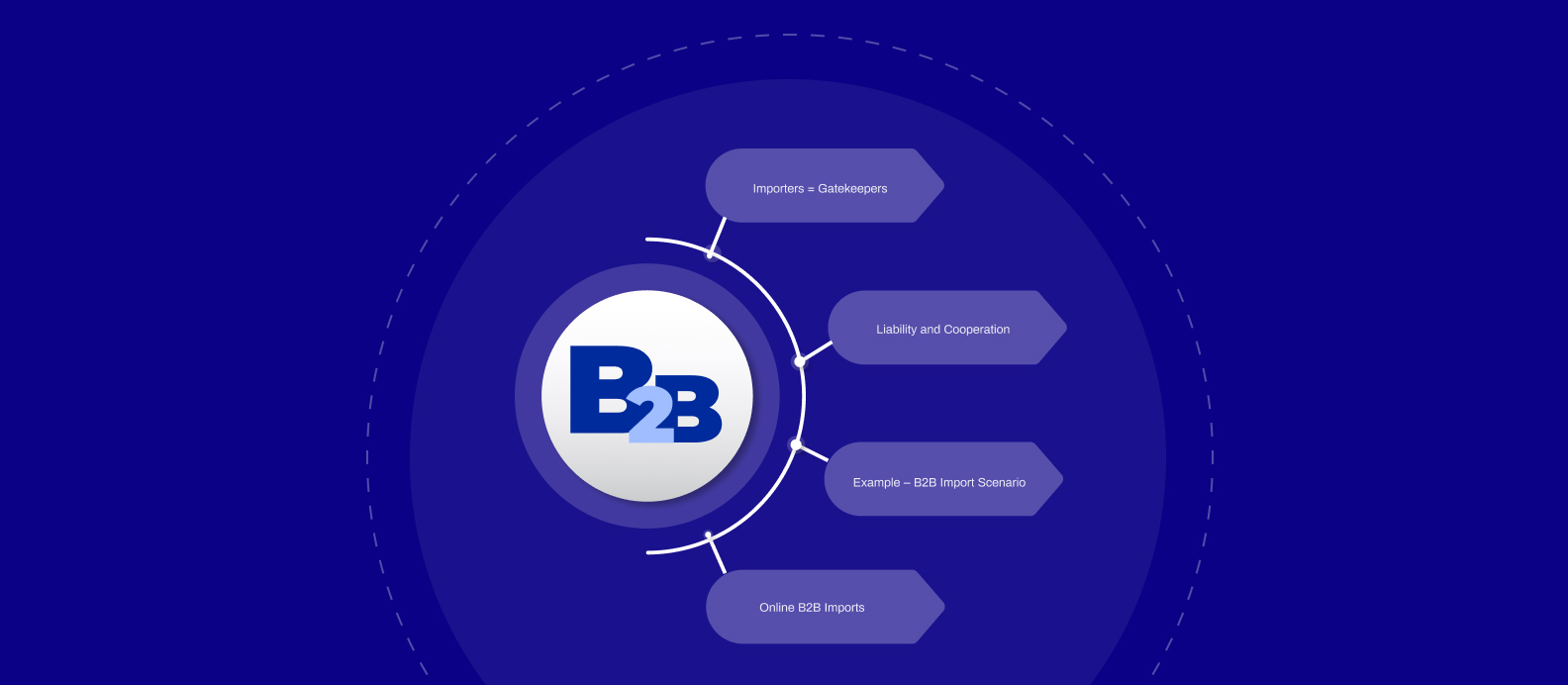
- Importers = Gatekeepers: Under the GPSR, importers act as gatekeepers for product safety. You must not place a product on the EU market unless it complies with the general safety requirement. This means verifying that the foreign manufacturer has met key obligations – such as proper labeling and having safety documentation (e.g., a Declaration of Conformity or test reports). If you import machinery or components to use in your own products, you also take on responsibility for ensuring the final product is safe for consumers.
- Liability and Cooperation: Importers are expected to work with market surveillance authorities just as manufacturers do. If a safety issue arises, you may need to help coordinate recalls or provide information. Importers must keep documentation for a defined period (often 10 years under EU law) and be able to trace both their suppliers and customers. In effect, you serve as the manufacturer’s proxy in the EU, which makes due diligence essential.
- Example – B2B Import Scenario: Suppose you import electronic components from a third country and sell them to EU gadget makers. If those components (such as lithium batteries) present safety risks for end-users, you must ensure they meet safety standards even if you’re not selling directly to the public. Similarly, if you import finished goods like power tools and wholesale them to EU retailers, you must verify compliance with GPSR (and any sector-specific rules such as EMC or Low Voltage) before sale. If the foreign manufacturer has not completed a risk assessment or provided EU-compliant warnings, the responsibility falls on you to resolve this before placing the goods on the market. The GPSR makes clear that import safety checks are not optional.
- Online B2B Imports: Many imports today flow through online marketplaces or platforms. The GPSR includes provisions for online sales to ensure consumers receive the same safety information online as they would in a physical store. If you sell via a platform or website to EU businesses, you must display key product information (manufacturer/importer name, product identifiers, and safety warnings) before purchase. This applies even to bulk or B2B e-commerce, as the regulation prioritises transparency and traceability in case products later reach consumers.
In summary, imports from third countries fall fully under the GPSR whenever the products are consumer-relevant. B2B importers must approach compliance with the same rigor as B2C importers. The regulation ensures that products cannot bypass safety rules simply because they are sold business-to-business; if EU consumers could ultimately be affected, GPSR obligations still apply.
B2B GPSR Examples Across Product Categories
To illustrate how GPSR might affect different sectors without diving too deep into technicalities, here are a few examples:
- Electronics: A company designs advanced networking equipment for professional installers (B2B). While not marketed to home users, tech-savvy consumers or small businesses might still buy it online. Under GPSR, the device must be safe not only for trained installers but also pose no undue risk if a consumer sets it up. This means providing clear instructions and warnings (e.g., grounding, ventilation). If it operates at low voltages outside the Low Voltage Directive, GPSR applies directly. If high voltage (covered by LVD), GPSR may still apply to risks like moving parts or overheating.
- Industrial Machinery: A manufacturer sells a food-processing machine for restaurants and factories (B2B). It falls under the Machinery Directive for operator safety, so GPSR’s role is minimal while it stays in commercial kitchens. But if the machine is later auctioned and bought by a consumer, new risks arise (e.g., no child-safety features, emissions in a home environment). GPSR anticipates such “migration to consumer use.” The manufacturer should document intended professional use and include warnings like “Not for household use.” Ideally, some safeguards should be built in, since authorities could apply GPSR to require recalls or modifications if consumers are exposed.
- Consumer Goods via B2B Supply Chains: A company imports wholesale toys or apparel from outside the EU to supply local boutiques (B2B). Since toys and clothing are clearly consumer products, the GPSR fully applies. The B2B step (importer to store) does not change this. The importer must ensure safety compliance (e.g., toys meeting toy safety standards, no choking hazards or toxic substances, clothing free from flammable or hazardous parts). Both importers and retailers count as economic operators under GPSR and must act if safety issues arise (such as pulling unsafe toys from shelves). This is a core example of GPSR serving as a safety net to catch issues not covered by other laws.
- Chemicals and Substances: Many chemicals sold B2B for industrial use fall under regulations like REACH or CLP and are not typically subject to GPSR if consumers never handle them. However, risks arise when bulk products like solvents or cleaning agents, intended for professional use, are diverted or repackaged into consumer-grade products. If that’s a realistic scenario, manufacturers should ensure proper safety information is provided and that the chemical isn’t inherently unsafe for general handling. GPSR can apply in cases where professional-use substances end up in consumer hands.
Final Takeaway
The GPSR is not only relevant to retailers. It applies to any product that could realistically end up in consumers’ hands, even if first sold through B2B channels. Manufacturers, importers, and distributors must look beyond their immediate customers and assess how their products might reach end-users. Aligning product design, documentation, and distribution processes with GPSR requirements ensures compliance while contributing to a safer marketplace.
At the same time, if your operations involve handling consumer data across the EU or UK, GDPR compliance is just as critical. Together, GPSR and GDPR form the backbone of responsible business in Europe.
At Euverify, we help both B2B and B2C companies stay compliant by offering practical GPSR solutions such as safety assessments, documentation support, and appointing an EU Responsible Person when needed. We also serve as your GDPR Representative in the EU or UK, making sure your data protection practices meet requirements. Our team takes the complexity out of compliance, keeping it affordable, efficient, and tailored to the way your business works.