
RoHS Compliance for Online Sellers: What You’re Responsible for (and What Your Supplier Isn’t)
Selling electronics on Amazon, eBay, or Etsy all sounds smooth until you dig into what the EU and UK actually expect from you. Most sellers importing products from outside Europe are carrying a compliance gap they don’t know about. And it’s not a small one.
The usual story goes like this. Supplier sends over a CE certificate. Seller assumes that it covers everything. It doesn’t.
Why Your Supplier’s RoHS Certificate Doesn’t Make You Compliant
When you source electronics from a factory in China or elsewhere outside the EU, they’ll often hand you something labelled a “RoHS certificate” or a CE test report. It looks official. It feels like job is done. But the moment you import that product and list it for sale in the EU or UK, the legal responsibility for compliance transfers to you. Not your supplier. You.
RoHS compliance isn’t something the manufacturer takes care of on your behalf. It’s your obligation as the person placing the product on the market. The factory in Shenzhen has no legal standing in Europe. You do, and so does all the liability that comes with it.
A supplier’s RoHS statement is useful as a starting point for your own documentation, but it is not a substitute for your own Declaration of Conformity, your own technical file, or your own Authorised Representative. Regulators and marketplaces are not interested in what your supplier claims. They want to see what you can prove.
What RoHS Actually Requires From Importers and Online Sellers
RoHS (the Restriction of Hazardous Substances Directive, updated as RoHS 3 under 2011/65/EU) restricts ten substances in electrical and electronic equipment. Lead, mercury, cadmium, hexavalent chromium, four phthalates. Each one has a maximum concentration limit, usually 0.1% by weight.
It covers a wide range of products. Consumer electronics, IT equipment, power tools, lighting, household appliances, toys with electronic components. If it plugs in or runs on a battery, there’s a good chance RoHS applies.
But compliance is more than just the substances themselves. To be legally compliant you need four things:
- A Declaration of Conformity (DoC) that explicitly lists RoHS alongside any other applicable directives
- A technical file with actual evidence that the product meets substance restrictions, whether that’s lab test reports or solid supplier documentation with traceability
- An EU Authorised Representative if you’re based outside the EU
- A CE mark on the product and packaging
Missing any one of these and you’re not compliant, regardless of what your supplier’s paperwork says.
The Most Common RoHS Mistakes Marketplace Sellers Make
Most compliance failures aren’t deliberate. They come from sellers not knowing what they didn’t know. These are the mistakes that come up most often.
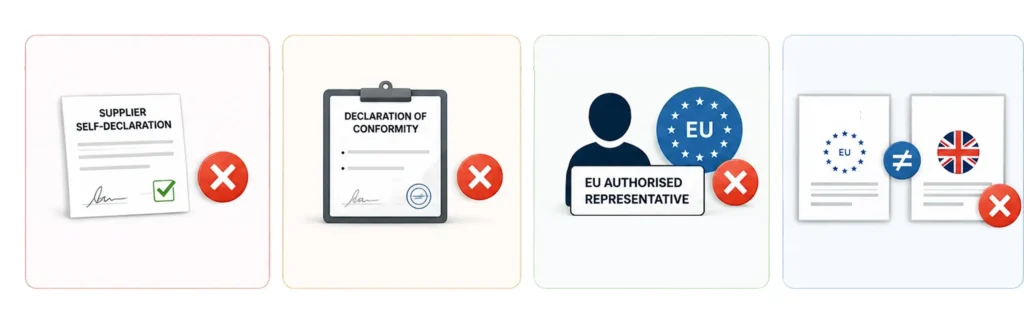
Relying on a supplier self-declaration with no test evidence behind it. A supplier ticking a box to say a product is RoHS compliant is not the same as having substance test reports from an accredited laboratory. If a market surveillance authority asks for your technical file, a self-declaration on its own won’t hold up.
Having a Declaration of Conformity that doesn’t mention RoHS. Some sellers do have a DoC, but it only references LVD or EMC directives and leaves RoHS off entirely. Every applicable directive needs to be listed. If RoHS isn’t on there, the document is incomplete.
No EU Authorised Representative at all. This is the most common gap for sellers based outside the EU, particularly those based in the US, UK, or Asia selling into the EU market. Without a registered AR with an EU address, you are not meeting your legal obligations — and every major marketplace platform will eventually ask for those details.
Assuming one DoC works for both the EU and UK. EU and UK regulations are separate. They require separate documentation. A DoC referencing EU regulation numbers does not satisfy UK requirements, and vice versa.
What Online Marketplaces Check Before Approving Your Electronics Listings
Marketplace compliance checks have got a lot stricter since the EU General Product Safety Regulation came into force in December 2024. Under GPSR, marketplaces are now directly on the hook for products listed on their platforms, which has changed how seriously they treat compliance requests across the board — Amazon, eBay, Etsy, and others.
Sellers are receiving requests for Declarations of Conformity, CE documentation, and AR details. Fail to provide them and your listing comes down. Keep failing and your account follows. Amazon EU, for example, is increasingly specific about wanting the name and registered address of your EU Authorised Representative, not just a vague assurance that one exists — and other platforms are following the same pattern.
When a marketplace flags a listing, the process tends to move quickly. You’ll typically receive a notice giving you a short window to provide documentation. If you don’t have the paperwork ready, that window closes fast. Having your DoC, technical file, and AR details ready before you need them is not overcautious. It’s just sensible.
And it doesn’t end with the platforms. Market surveillance authorities across EU member states actively monitor what’s being sold online. If a product gets flagged, they can demand your full technical file. No file means potential product withdrawal, fines, or in the worst cases, a recall. That’s a very different conversation from a listing removal.
UK RoHS Compliance: Why It’s a Separate Requirement From the EU
A lot of sellers sort out EU compliance and then treat the UK as covered by default. It isn’t.
The UK has its own RoHS regulations (SI 2012/3032) that run parallel to the EU directive but operate entirely independently. For Amazon UK, for example, you need a UK-specific Declaration of Conformity and a UK Responsible Person with a registered UK address.
On marking, CE marks are still accepted in Great Britain under current transitional arrangements, so you don’t necessarily need a UKCA mark right now. But the transitional rules have been extended more than once and the situation can change, so keeping an eye on MHRA and OPSS guidance is worthwhile.
If you’re selling on both Amazon EU and Amazon UK, you need both sets of obligations covered. One representative and one DoC will not serve both markets.
RoHS Compliance Checklist for EU and UK Marketplace Sellers
Here’s what a fully compliant setup looks like broken down by market.
For the EU:
- Declaration of Conformity covering RoHS 3 (2011/65/EU) and all other applicable directives
- Technical file with substance evidence, either lab test reports or traceable supplier declarations
- CE mark on the product and packaging
- EU Authorised Representative with a registered EU address
For the UK:
- UK-specific Declaration of Conformity
- UKCA mark or CE mark under current transitional rules
- UK Responsible Person with a registered UK address
Getting this in place doesn’t have to take weeks or cost a lot. Euverify sets up EU and UK Authorised Representatives within 24 hours, generates Declarations of Conformity through the platform, and stores your technical documents for the required 10 years.
What Happens If Your Electronics Listings Fail a RoHS Compliance Check

Ignoring RoHS compliance used to feel like a low-risk bet for smaller sellers. That calculation has shifted.
For instance, Amazon is pulling listings more readily. Market surveillance authorities are more active on online platforms than they were a few years ago. And under GPSR, the platforms themselves have more incentive to clean up what they’re hosting. The sellers who get caught out are not just the large brands. Smaller importers are being flagged too.
Getting compliant is not as complicated as it sounds once you know what’s needed. The documentation gap is usually fixable in a matter of days. The question is whether you sort it out now or deal with it after your listings are down and your account is under review.
Euverify provides EU and UK Authorised Representative services for electronics and general consumer products. Get compliant in 24 hours with a 14-day free trial.
Frequently Asked Questions
Not automatically. CE marking means the product is declared compliant with all applicable EU directives, and RoHS should be one of them. But the CE mark itself doesn’t tell you which directives have actually been assessed. If your Declaration of Conformity doesn’t explicitly list RoHS 3 (2011/65/EU), or if there’s no substance evidence in the technical file to back it up, the CE mark on the product means very little from a RoHS standpoint. Always check what’s actually listed on the DoC rather than assuming the mark covers everything.
Your Declaration of Conformity and technical file must be kept for a minimum of 10 years after the product is last placed on the market. This catches a lot of sellers out. If you discontinue a product and delete your records, you’re still legally expected to produce that documentation if a market surveillance authority requests it years later. Cloud-based document storage with a clear retention policy is worth setting up early rather than scrambling when a request comes in.
Yes, if the products are sufficiently similar in design, construction, and the directives that apply to them. Most sellers with a range of SKUs can group similar products under a single DoC rather than producing a separate document for every listing. If products differ meaningfully in components or construction though, separate documentation is the safer route.
This is a real and common problem, particularly when sourcing from manufacturers in Asia where component substitution can happen without notice. If a supplier swaps out a component, your existing technical file may no longer accurately reflect what’s in the product, which means your DoC could be invalid. It’s worth building a clause into your supplier agreements requiring notification of any design or component changes, and reviewing your documentation whenever a product is updated or revised.
Possibly yes, and it’s worth checking. REACH has a specific obligation that’s relevant to marketplace sellers: if a product contains a substance of very high concern (SVHC) above 0.1% by weight, EU consumers have the right to request information about it within 45 days. Sellers need to be able to respond to those requests. RoHS and REACH overlap in some areas but are not interchangeable, and being RoHS compliant does not automatically mean your REACH obligations are covered.