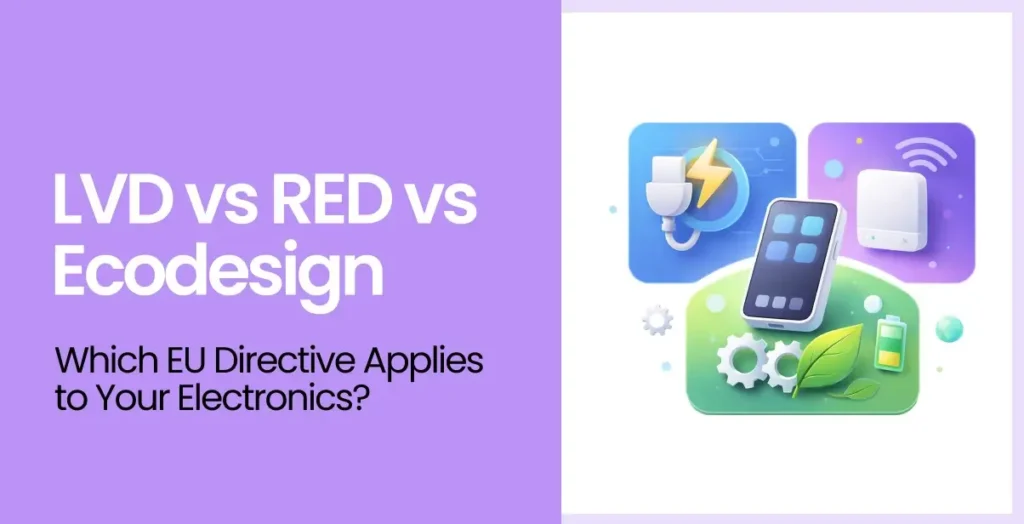

Which EU Directive Applies to Your Electronic Product? LVD vs RED vs Ecodesign Explained
A guide for manufacturers and importers selling into the EU market
If you are bringing an electronic product to market in the European Union, one of the first questions you need to answer is: which EU directives apply to my product? It sounds straightforward, but in practice it trips up manufacturers, importers, and compliance teams all the time.
The three frameworks you will encounter most often for electronic and electrical products are the Low Voltage Directive (LVD), the Radio Equipment Directive (RED), and the Ecodesign Regulation. They are all different, they all matter, and for many products, more than one of them will apply at the same time.
This guide talks you through each one clearly, explains how they interact, and gives you a practical step-by-step method to work out exactly which EU directive applies to your electronic product.
What Is CE Marking and Why Does It Matter for EU Directives?
Before we get into the specific directives, it helps to understand the CE marking system. CE marking is the EU’s product conformity symbol. When you affix it to your product, you are legally declaring that the product meets all applicable EU legislation. Without it, you cannot legally sell your product in the EU.
Your responsibility as a manufacturer or authorised representative is to identify every directive and regulation that applies to your product, demonstrate compliance with each one, and produce a Declaration of Conformity (DoC) listing them all. A single CE mark covers all of them.
The three most relevant frameworks for electronic products are:
- The Low Voltage Directive 2014/35/EU (LVD)
- The Radio Equipment Directive 2014/53/EU (RED)
- The Ecodesign Regulation, a family of product-specific regulations now operating under the Ecodesign for Sustainable Products Regulation (ESPR) framework, Regulation (EU) 2024/1781, which replaces the original Ecodesign Directive 2009/125/EC
Each one has its own scope, its own essential requirements, and its own conformity assessment process. Let us go through them one by one.
What Is the Low Voltage Directive (LVD) and Does It Apply to Your Product?
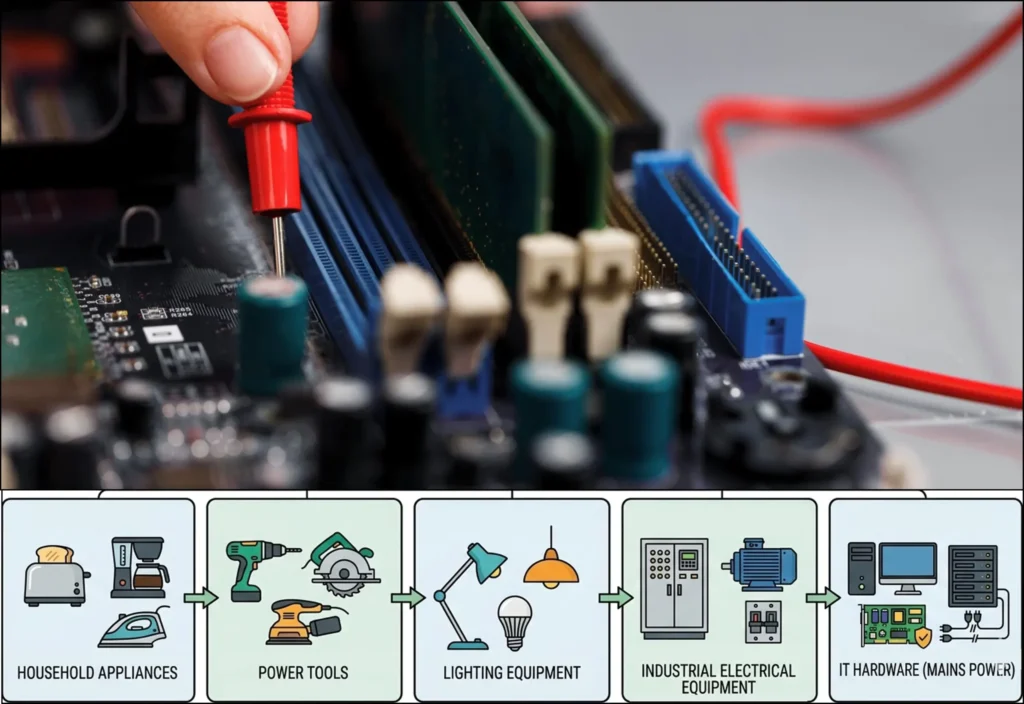
Products Covered by the LVD
The Low Voltage Directive 2014/35/EU applies to electrical equipment designed for use with a voltage rating of between 50 and 1,000 volts for alternating current (AC) or between 75 and 1,500 volts for direct current (DC). Its job is to make sure that electrical equipment is safe for users and anyone else who might come into contact with it.
Quick check: If your product plugs into a standard EU mains socket (230V AC), the LVD almost certainly applies to it.
Products in scope include:- household appliances- power tools- lighting equipment- industrial electrical equipment- IT hardware that runs on mains power
The directive covers both the finished product and any safety-relevant components within it.
Products That Are Excluded From the LVD
Some products are explicitly excluded from the LVD even if they fall within the voltage thresholds. These include electrical equipment for use in explosive atmospheres (which falls under the ATEX Directive), radio-electrical equipment (which is covered by the RED instead), medical devices (covered by the MDR), and certain specialist industrial or naval equipment.
Here is an important point that catches a lot of manufacturers out: if your product includes radio functionality such as Bluetooth, Wi-Fi, or a cellular modem, it will fall under the RED rather than the LVD for its radio-related safety and EMC requirements. But if it also operates at mains voltage, you may still need to show LVD compliance on top of that. The two directives can and do apply simultaneously.
What You Need to Do to Comply With the LVD
To comply with the LVD, you need to carry out a conformity assessment. Most manufacturers do this through internal production control (Annex III) or the full quality assurance procedure (Annex IV). You will also need to compile a technical file, draft a Declaration of Conformity, and affix the CE mark.
The LVD requires you to meet the essential safety requirements in Annex I. These cover protection against electrical hazards, protection against external influences such as moisture and vibration, and providing adequate information for users to operate the product safely.
The most practical route to demonstrating compliance is through harmonised standards published in the EU Official Journal. The key standard for most IT and audio/video equipment is now IEC 62368-1, which has largely replaced the older IEC 60950-1.
What Is the Radio Equipment Directive (RED) and Does It Apply to Your Product?
Products Covered by the RED
The Radio Equipment Directive 2014/53/EU applies to any product that intentionally emits or receives radio waves. Radio waves are defined as electromagnetic waves with frequencies in the range 3 kHz to 300 GHz. In practical terms, this covers an enormous range of modern electronics: smartphones, tablets, laptops with Wi-Fi, smartwatches with Bluetooth, GPS devices, smart home products, drones, wireless sensors, and connected industrial equipment.
Quick check: If your product transmits or receives any radio signal, including Wi-Fi, Bluetooth, Zigbee, LoRa, 4G, 5G, RFID, or NFC, the RED applies.
One thing that makes the RED particularly broad is that it has no voltage threshold. A small battery-powered IoT sensor running on 3.3V that emits Bluetooth Low Energy signals is fully within scope. Size and power level do not matter. What matters is whether the product intentionally uses radio frequencies.
The Three Essential Requirements Every RED Product Must Meet
The RED sets out three categories of essential requirements that all radio equipment must satisfy.
- Protection of health and safety under Article 3(1)(a). Equipment must not put users or other people at risk. For products that also fall within the LVD voltage range, this requirement refers to the same harmonised electrical safety standards used under the LVD.
- Electromagnetic compatibility under Article 3(1)(b). Equipment must not cause harmful interference to other devices and must have adequate immunity from interference. This covers the same ground as the Electromagnetic Compatibility Directive 2014/30/EU, which is why the EMCD does not apply separately to products already in scope of the RED.
- Effective use of the radio spectrum under Article 3(2). Equipment must be built to use the radio spectrum effectively and avoid causing interference. This covers things like transmit power limits, frequency accuracy, and modulation. It is the requirement unique to the RED.
For certain product categories, additional requirements apply under Article 3(3). Delegated regulations are introducing requirements for products like smartphones, laptops, and tablets to support common charging standards (USB-C under EU 2022/2380), include safeguards to protect user data, and support interoperability features.
What You Need to Do to Comply With the RED
RED compliance involves a conformity assessment, which uses internal production control (Annex II) in most cases. If your product uses radio frequencies that are not harmonised across the EU, you will need to involve a Notified Body using Annex III or IV. You must compile a technical file, issue a Declaration of Conformity, and affix the CE mark.
One requirement that catches manufacturers off guard: your DoC must reference the specific radio frequency bands your product uses. This is not optional and must be accurate.
Manufacturers selling into the EU from outside the European Economic Area must appoint an EU Authorised Representative. This is a legal requirement, not a recommendation.
What Is the Ecodesign Regulation and When Does It Apply to Electronic Products?
How Ecodesign Has Changed: From Directive to ESPR
The original Ecodesign Directive 2009/125/EC created the framework for setting minimum energy and environmental requirements for energy-related products. It did not set requirements directly. Instead, it gave the European Commission the power to adopt implementing regulations for specific product categories. Those regulations, such as (EU) 2019/2021 for electronic displays or (EU) 2019/2019 for refrigerators, contained the actual technical requirements.
In 2024, the EU adopted the Ecodesign for Sustainable Products Regulation (ESPR), Regulation (EU) 2024/1781, which replaces the Ecodesign Directive and significantly broadens its scope. The old Directive focused mainly on energy efficiency. The ESPR extends requirements to durability, repairability, recyclability, carbon footprint, and restrictions on hazardous substances. It also introduces the Digital Product Passport (DPP) for in-scope product categories.
Important: Implementing regulations adopted under the old 2009/125/EC Directive remain fully valid and enforceable. New implementing regulations will be issued under the ESPR framework going forward.
Which Electronic Products Need to Meet Ecodesign Requirements?
The Ecodesign framework applies to energy-related products: broadly, any product that uses energy directly or whose use affects energy consumption. Since virtually all consumer electronics draw power, most electronic products are within scope in principle.
However, you only face specific, mandatory requirements if an implementing regulation has been adopted for your product category. There are currently implementing regulations covering electronic displays including televisions and monitors, computers and servers, household washing machines, dishwashers, refrigerators and freezers, lighting products, external power supplies, and several other categories.
If your product category does not yet have an implementing regulation, you are not subject to specific Ecodesign requirements right now. That said, the Commission is actively expanding coverage under the ESPR work plan, so it is worth monitoring developments for your category.
What Ecodesign Compliance Involves
For products where an implementing regulation applies, you must meet the minimum requirements defined in that regulation. These typically include minimum energy efficiency thresholds, standby and off-mode power limits, information and labelling requirements, and increasingly, repairability requirements such as the availability of spare parts.
Ecodesign compliance is demonstrated through a conformity assessment, a technical file, a Declaration of Conformity, and CE marking. Importantly, Ecodesign requirements sit alongside LVD and RED requirements. They do not replace them.
LVD vs RED vs Ecodesign: A Side-by-Side Comparison
LVD | RED | Ecodesign | |
Full Name | Low Voltage Directive | Radio Equipment Directive | Ecodesign Regulation |
EU Legal Ref | 2014/35/EU | 2014/53/EU | (EU) 2019/2021 etc. |
Voltage Scope | 50-1000V AC / 75-1500V DC | Any (radio function key) | Energy-using products |
CE Mark | Required | Required | Required |
Key Focus | Electrical safety | Radio, safety, EMC | Energy efficiency |
DoC Required | Yes | Yes | Yes |
How to Work Out Which EU Directives Apply to Your Electronic Product
Many electronic products fall under more than one framework at the same time. The right approach is to assess your product independently against each one. Here is a simple four-step process.
Step 1: Does your product operate at mains voltage? If yes, apply the LVD (2014/35/EU) unless it is specifically excluded, for example because it is a medical device or ATEX-rated equipment.
Step 2: Does your product intentionally transmit or receive radio waves, such as Wi-Fi, Bluetooth, cellular, or GPS? If yes, the RED (2014/53/EU) applies. When the RED applies, the EMCD does not apply separately because the RED already covers both radio and EMC requirements. For safety at mains voltage, the RED references the same requirements as the LVD.
Step 3: Is your product energy-related, and does an implementing regulation exist for your product category under the Ecodesign framework? If yes, you must comply with that regulation in addition to any LVD or RED obligations.
Step 4: Check for other applicable legislation. This may include the Electromagnetic Compatibility Directive 2014/30/EU (if the RED does not apply but your product emits or is susceptible to electromagnetic disturbances), the RoHS Directive 2011/65/EU on restriction of hazardous substances, the WEEE Directive 2012/19/EU on waste electrical and electronic equipment, and the EU Battery Regulation (EU) 2023/1542 if your product contains batteries.
Real-World Example: Which EU Directives Apply to a Wi-Fi Smart Plug?
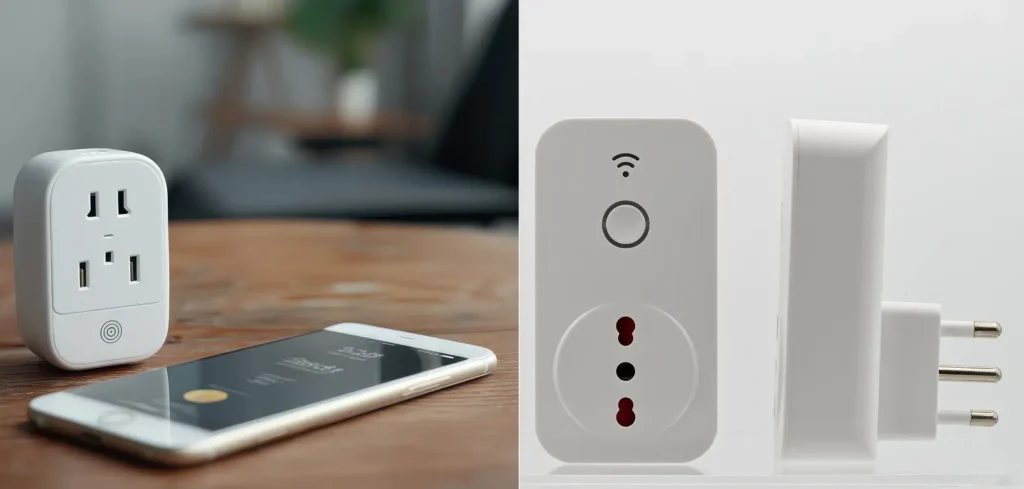
To make this concrete, let us work through a real product. Imagine a smart plug designed for EU consumers. It plugs into a standard 230V mains socket, draws and switches mains power, and connects to a home Wi-Fi network for remote control via a smartphone app.
This product is subject to all three frameworks. It operates at 230V AC, which puts it within the LVD voltage scope. It transmits and receives Wi-Fi on 2.4 GHz and/or 5 GHz, which puts it squarely within the RED. And because it is an energy-related product that controls mains loads, it is likely subject to Ecodesign requirements such as standby power limits, depending on whether an implementing regulation covers its specific category.
The manufacturer produces a single Declaration of Conformity that lists all three frameworks, compiles one consolidated technical file covering all requirements, and affixes a single CE mark. There is no need for separate marks per directive.
Get Expert Help With EU Directive Compliance
Working out which EU directives apply to your electronic product is just the first step. After that comes testing, technical documentation, conformity assessment, and market access. Getting any part of this wrong can mean delays at customs, product recalls, or fines from market surveillance authorities.
Euverify specialises in EU and UK product compliance for electronic and electrical manufacturers. Whether you need help identifying applicable directives, appointing an EU Authorised Representative, reviewing your technical file, or preparing your Declaration of Conformity, our compliance team is here to help.
Frequently Asked Questions
No. You only ever affix one CE mark to a product, regardless of how many directives apply. What changes is your Declaration of Conformity, which must list every directive and regulation your product complies with. One mark, one DoC, all applicable directives covered within it.
Yes. The directives apply based on where the product is placed on the EU market, not how it is sold. Selling direct-to-consumer online does not reduce your obligations. If anything, it increases your exposure because you are both the importer and the seller, so all compliance responsibility sits with you.
The brand or company that places the product on the market under its own name is the manufacturer in the legal sense, even if a third party physically makes it. If the product carries your brand name or trademark, CE marking compliance is your responsibility. Your contract manufacturer’s obligations are to produce to your specification, but the legal accountability for market compliance is yours.
Under most directives including the LVD and RED, technical documentation and the Declaration of Conformity must be kept for a minimum of 10 years after the last unit of the product has been placed on the market. This is not 10 years from launch. If you sell units over a five year period, the clock starts from the last sale.
Yes, provided the laboratory is accredited to ISO/IEC 17025 for the relevant test methods. EU market surveillance authorities accept test reports from accredited laboratories worldwide. What matters is the accreditation status of the lab and whether the correct harmonised standards were applied, not the country the lab is based in.