
REACH Compliance for Jewellery: Limits, Testing, and Common Failures
What jewellery importers and brands need to know before a market surveillance authority finds it first
Jewellery is one of the most commonly flagged product categories in EU market surveillance. RAPEX notifications appear year after year, and they do not only involve low cost items. Mid market brands, major retailers, and products with existing test reports are regularly affected.
The reason is simple. REACH compliance for jewellery is more complex than most brands expect, and the responsibility sits with whoever places the product on the EU or UK market. If you are importing from outside the EU, that responsibility is yours, not your supplier’s.
This guide explains the key restrictions, the limits you need to meet, how testing works, and where products most often fail. If you have questions about your own range, the Euverify team works with jewellery brands and importers across the EU and UK and can help you understand where you stand.
Who Is Responsible for REACH Compliance on Jewellery?
REACH, Regulation (EC) No 1907/2006, is the EU’s chemicals regulation. The UK operates a separate but similar system under UK REACH, administered by the Health and Safety Executive.
In both cases, the legal responsibility sits with the manufacturer if they are based in the EU, or with the importer if the product is sourced from outside the EU.
This means that if you are a brand or importer sourcing jewellery from Asia, Turkey, or any non EU country, you are the responsible party under REACH. A supplier’s test report does not transfer liability. You must be confident that the product complies and that your documentation can demonstrate it.
A supplier test report is only as reliable as the methods used and the components covered. Many compliance failures occur not because testing was skipped, but because the wrong test method was used or only part of the product was assessed.
Which REACH Restrictions Apply to Jewellery?

Jewellery is an article under REACH, meaning its function comes from its shape and design. But articles can still be subject to restrictions when the substances they contain pose a risk through skin contact. The relevant restrictions for jewellery sit primarily in REACH Annex XVII, which lists substances that are prohibited or limited in specific products.
Nickel
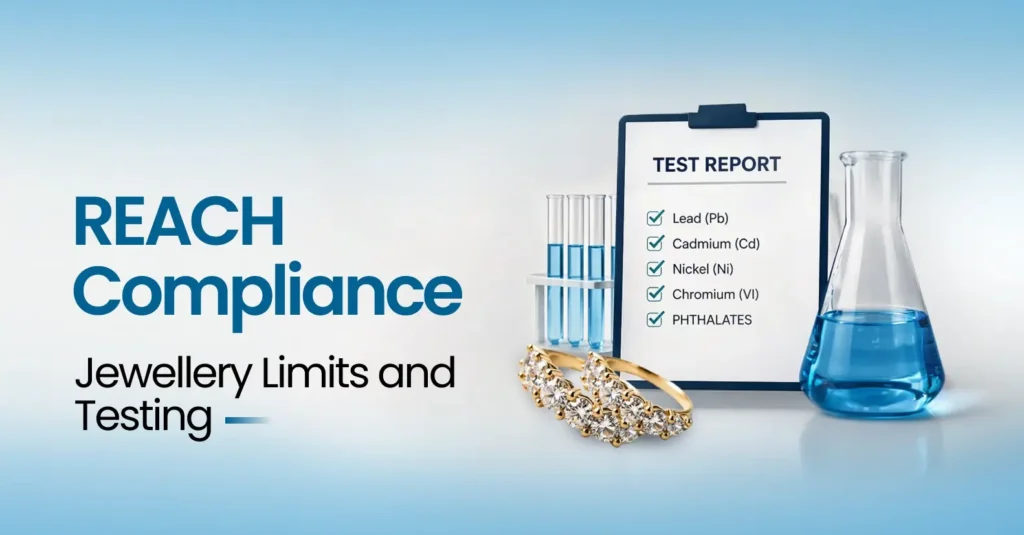
Nickel restrictions under Annex XVII Entry 27 are the most common cause of jewellery compliance failures. Any item intended for prolonged skin contact, such as earrings, necklaces, bracelets, rings, and watch components, must meet strict nickel release limits.
Maximum release limits:
- 0.5 µg/cm² per week for general skin contact
- 0.2 µg/cm² per week for items inserted into pierced skin
The restriction applies to release rate, not total nickel content, which is a critical distinction. A stainless steel item may contain around 10% nickel but release almost none, while a nickel plated item with much lower content may still fail.
Compliance must be demonstrated using the correct test standards. EN 1811:2011+A1:2015 is used for release measurement and EN 12472:2005+A1:2009 applies to coated items. A test report showing only total nickel content, such as XRF results, does not demonstrate compliance.
Lead and Cadmium
Lead is restricted under Annex XVII Entry 63 to a maximum of 500 mg/kg in metal parts of jewellery articles. Cadmium is restricted under Entry 23 to 100 mg/kg.
Both substances are commonly found in lower grade fashion jewellery alloys, especially in clasps, findings, and cast components.
A frequent issue arises when only decorative parts are tested. Functional components such as clasps and jump rings are often sourced separately and may not be included in testing, which can lead to compliance failures.
Chromium VI, Azo Dyes, and PAHs
If your jewellery includes leather, textile, rubber, or plastic elements, additional restrictions apply.
Key substance limits:
- Chromium VI: 3 mg/kg in leather components
- Azo dyes: 30 mg/kg in dyed textile or leather parts
- PAHs: 1 mg/kg per substance in rubber and plastic components
These requirements are often overlooked when the focus is only on metal parts. Cords, straps, and fabric elements are sometimes treated as secondary components, which can lead to unexpected compliance failures.
SVHCs and the Disclosure Obligation
Substances of Very High Concern are identified by ECHA as carcinogenic, mutagenic, toxic to reproduction, or of equivalent concern. There are more than 240 substances on the Candidate List as of 2024, and it is updated twice a year
Under REACH Article 33, if an article contains an SVHC above 0.1% by weight, you must:
- Inform business customers
- Provide the information to consumers within 45 days of a request
For jewellery, the most common SVHCs are phthalates used as plasticisers in flexible PVC cords and coatings.
The compliance issue is often not the presence of the substance, but the lack of a process to communicate it. EU market surveillance authorities are increasingly enforcing Article 33 disclosure failures as a standalone violation.
Substance Limits at a Glance

How Testing for Jewellery Actually Works
A jewellery item is a composite product. A single necklace might include a metal chain, cast pendant, fabric tassel, leather accent, and metal clasp. Each material type must be assessed against the relevant restrictions.
Testing only the main decorative metal component and treating the product as compliant is one of the most common mistakes seen in compliance reviews.
XRF screening is a useful first step. It is fast, non destructive, and can quickly flag elevated levels of lead, cadmium, chromium, and other metals across components. However, XRF is a screening tool only.
For compliance:
- Nickel must be tested using EN 1811 or EN 12472 release methods
- Lead and cadmium require ICP-OES analysis after acid digestion for accurate measurement
Test reports should clearly include:
- The specific component tested
- The standard used
- Results in the correct units
- The applicable regulatory limit
If a report does not reference a specific EN or ISO standard, it does not demonstrate REACH compliance in a way that will withstand scrutiny.
The Most Common Failure Points
Based on RAPEX data and Euverify’s work with jewellery clients, the failures that come up most often are:
1. Nickel release in plated items, where the plating is too thin or inconsistently applied and the underlying nickel-containing substrate is exposed in normal use.
2. Lead in clasps and findings, where the main decorative components were tested but the functional hardware was sourced separately and never checked.
3. Wrong test method for nickel, where the supplier provides an XRF report showing nickel content rather than a release test, and the brand accepts it as sufficient.
4. Phthalates in PVC cords and coatings, where the brand specified a material type without specifying phthalate-free formulations, and the supplier used the cheapest available option.
5. SVHC non-disclosure, where the product does not exceed a restriction limit but contains an SVHC above 0.1% and the brand has no process for responding to consumer requests.
Learn more about Jewellery Compliance in the EU: How to Avoid Bans
What About UK REACH?
UK REACH mirrors EU REACH in structure but operates as a separate regime, updated independently by the Health and Safety Executive.
For jewellery, the restrictions on nickel, lead, and cadmium are currently aligned with EU limits. However, the two regimes do not automatically stay in sync, so brands selling into both markets need to monitor each one separately.
Euverify supports both EU and UK REACH compliance, giving clients a single point of contact instead of managing two independent regulatory frameworks.
How Euverify Can Help
At Euverify, we work with jewellery importers, brands, and manufacturers to make REACH compliance straightforward. We review your existing test documentation to identify gaps, define the correct testing scope for your products, and ensure the right methods are being used.
We also monitor the SVHC Candidate List against your product range, so you stay ahead of regulatory updates, and help you prepare the documentation needed to demonstrate compliance to market surveillance authorities.
If you are based outside the EU, we can act as your EU Authorised Representative to support your REACH obligations.
If you want to know whether your jewellery range is genuinely REACH compliant, get in touch with our team. We will show you exactly where you stand and what needs to be done.
Frequently Asked Questions
Yes. The obligation is triggered by placing a product on the EU or UK market, regardless of the sales channel. Selling through your own website, Amazon, Etsy, or any other online platform carries exactly the same compliance requirements as selling through a physical retailer. Market surveillance authorities actively monitor online listings and can request documentation or pull products from sale just as they would in a physical retail context.
There is no fixed retesting interval set in law, but testing should not be treated as a one-time exercise. You should retest when a supplier changes materials or components, when you switch manufacturers, when a new SVHC is added to the Candidate List that could be relevant to your products, or when your existing test reports are more than two to three years old. Regulators expect your documentation to reflect the product currently on the market, not a version from several years ago.
REACH applies regardless of business size. There is no turnover threshold or minimum volume below which the restrictions stop applying. An independent designer importing jewellery from a manufacturer abroad and selling it to EU or UK consumers is subject to exactly the same obligations as a large retail chain. Market surveillance authorities do not only target large brands, and RAPEX notifications regularly include smaller operators.
Under REACH Article 33 you have 45 days to respond with information about any SVHC present above 0.1% by weight in the article. This means you need to know the answer before the request arrives, not after. If you do not have sufficient information from your supply chain to respond accurately, that is itself a compliance gap. Setting up a basic process for handling these requests and maintaining up to date substance information from your suppliers is a practical step that is often overlooked until a request lands.
Not without additional steps. US standards such as CPSC regulations or ASTM F2999 are not equivalent to EU REACH requirements and do not demonstrate compliance with Annex XVII restrictions. Test reports referencing US standards will not satisfy EU market surveillance authorities. If your products have only been tested to US standards, you will need to commission testing to the relevant EN and ISO methods before placing them on the EU or UK market.