
The 5 Data Categories Your Garments Will Need to Disclose Under the EU Digital Product Passport
The EU Digital Product Passport data requirements for textiles are getting a lot of attention. What is getting far less attention is what it will actually require brands to collect, verify and maintain. And that is where the real work lies.
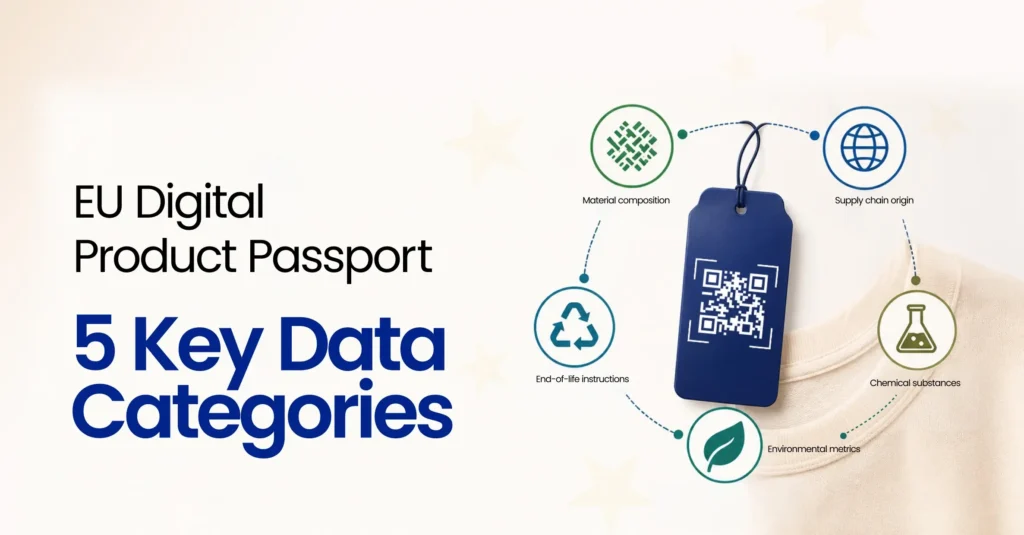
An EPRS study on DPP implementation for textiles (PE 757.808, European Parliament Research Service, June 2024) identifies up to 125 individual data attributes across five core categories. That number sounds intimidating. But broken down by category, the picture becomes much clearer, and so does the question of where your brand is likely to have gaps.
Here is what each category involves, what makes it difficult, and where most brands currently stand.
1. Material composition
This is the category most brands assume they already have covered. Many do not, at least not to the standard the DPP will require.
Material composition includes:
- Fibre types and percentages
- Recycled content
- Fabric weight
- Blend breakdowns
- Certifications such as GOTS or Oeko-Tex
The data needs to be verified and traceable to the source. A care label saying 80% cotton, 20% polyester is not enough. You need documentation from your fabric supplier confirming the exact composition, backed by testing or certification where required.
The challenge here is rarely awareness. Most brands know what their garments are made of. The challenge is documentation. If your mill changes a blend slightly between production runs and does not tell you, your DPP data becomes inaccurate. Building processes to catch those changes is a new operational requirement for most brands.
Where brands typically stand: Reasonable awareness, weak documentation. The data exists somewhere in the supply chain but is not always systematically captured or verified.
2. Supply chain origin
This is where things get more complex. Supply chain origin goes well beyond “made in Bangladesh.”
The DPP will require country of origin data at multiple stages of production:
- Where raw materials came from
- Where fibres were processed
- Where fabric was made
- Where the garment was assembled
This means tracing your supply chain back through Tier 1 (garment manufacturer), Tier 2 (fabric mills and dye houses), Tier 3 (yarn and fibre producers) and in some cases Tier 4 (raw material sources). For brands with long or complex supply chains, some of this information may simply not exist in any accessible form right now.
The EPRS study is clear that full traceability is the direction of travel, even if a phased approach is likely in the early years. Brands that start mapping their supply chain origins now will be far better positioned than those waiting for the delegated act to be finalised.
Where brands typically stand: Good visibility at Tier 1, partial at Tier 2, very limited below that. This is the most common and most significant gap across the industry.
3. Chemical substances

This is the category that surprises brand managers most. Many assume chemical substance disclosure is something for the cosmetics or chemicals industry. It is not.
The DPP will require disclosure of substances of concern present in the product. The ESPR defines this more broadly than REACH’s list of SVHCs. It covers substances classified as carcinogenic, mutagenic, toxic to reproduction, endocrine disrupting, persistent, bioaccumulative or toxic, among others. The exact concentration thresholds for textile products will be set in the delegated act. Until that is finalised, brands should not assume the REACH 0.1% SVHC threshold will be the only applicable standard.
Substances of concern in textiles typically include:
- Certain dyes and pigments
- Finishing chemicals
- Flame retardants
- Other substances used in textile processing
Collecting this data requires active engagement with your Tier 2 suppliers, the mills and dye houses, who may not be accustomed to providing this level of chemical transparency. Some may not have the internal systems to track it accurately.
This is also the category where inaccurate data carries the highest regulatory risk. Understating or omitting substance disclosures is likely to attract the most serious enforcement attention from market surveillance authorities.
Where brands typically stand: This is the weakest category for most fashion brands. Chemical substance data is rarely collected systematically and often requires building entirely new supplier reporting processes from scratch.
4. Environmental metrics
Environmental metrics cover a range of performance indicators. The exact requirements will be confirmed in the textiles delegated act, but based on the EPRS study, brands should expect to disclose:
- Carbon footprint across the production lifecycle
- Water consumption at key manufacturing stages
- Microplastic release potential
- Durability ratings
- Repairability data
This is the category where the data infrastructure required is most significant. Carbon footprint calculations need input from every stage of production, from raw material extraction through manufacturing, transport and packaging. Water consumption data needs to come from your mills. Microplastic release data requires standardised testing.
Some of this may already be available through sustainability frameworks your suppliers participate in, such as the Higg Index or Textile Exchange standards. Where it is not, brands will need to commission testing or work with suppliers to develop reporting capability.
Where brands typically stand: Variable. Brands with existing ESG reporting frameworks are ahead. Those without are starting from scratch on most metrics.
5. End-of-life instructions
This is the category easiest to underestimate. It sounds simple. It is not quite.
End-of-life instructions cover:
- Recycling routes
- Disassembly guidance
- Reuse options
- Repair guidance
- Extended Producer Responsibility (EPR) scheme information
The information needs to be accurate and specific, not generic. Saying “recyclable” is not sufficient if your garment contains mixed fibres that make recycling difficult in practice. The DPP is designed to give recyclers the information they actually need to process a garment correctly. That means instructions must reflect the real composition and construction of the product.
EPR scheme information adds another layer. Brands placing products on the EU market are subject to EPR obligations that vary by member state. The DPP will need to reflect the relevant scheme for each market where the product is sold.
Where brands typically stand: Most brands have basic care and recycling labelling in place. The gap is in the specificity and accuracy of the information, and in EPR scheme mapping across multiple EU markets.
What the EU Digital Product Passport Data Requirements Mean in Practice
The 125 figure refers to the total number of individual data fields across all five categories and three levels of granularity: model level (design specifications applying to all products of the same type), batch level (production run specifics) and item level (individual product history).
Not every brand will need to populate every field from day one. The EPRS study proposes a phased approach, starting with the most critical data categories and building out over time. But the direction is clear. The DPP is designed to make supply chain data comprehensive, verifiable and publicly accessible.
Brands building their data infrastructure now, before the textiles delegated act is finalised, will be in a much stronger position when the final requirements are confirmed. The specific application date for the textiles DPP has not yet been fixed in law. The commonly cited 2028 figure comes from early estimates, not from the ESPR itself. The actual deadline will be set in the delegated act. Those starting from scratch at that point will have very little time to close their gaps.
Where to start
If you are unsure where your brand currently stands across these five categories, a compliance gap analysis is the most practical first step. It maps your existing data against the anticipated DPP requirements and gives you a clear picture of what needs to be addressed, in which order, and with which suppliers.
Our guide on how to prepare your supply chain for the EU Digital Product Passport covers the practical steps in detail. And if you are a non-EU manufacturer, our piece on the Authorised Representative requirement explains the compliance structure you will need in place to manage your DPP obligations in the EU.
Euverify works with non-EU fashion brands on exactly this. If you would like to talk through your specific data gaps and what a realistic preparation plan looks like, get in touch at euverify.com.