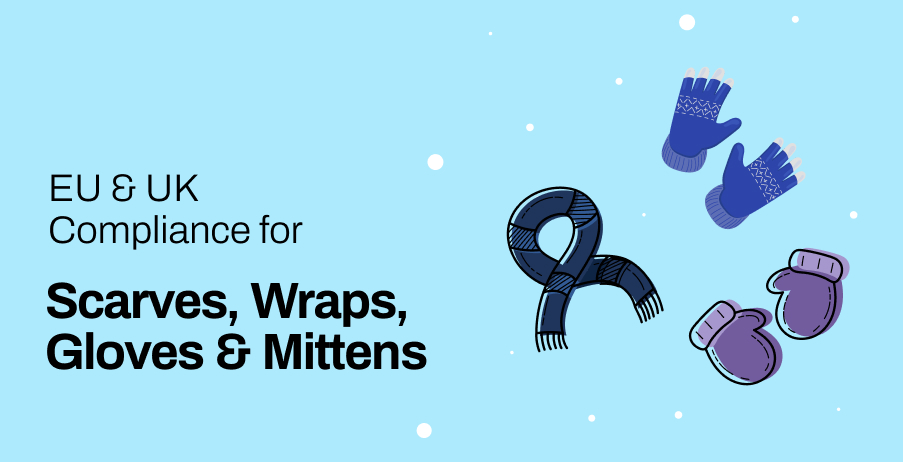

EU & UK Compliance and Regulations for Winter Accessories: Scarves, Wraps, Gloves & Mittens
When the temperatures drop, compliance shouldn’t. Behind every cosy scarf or soft mitten is a web of textile labelling rules, chemical safety requirements under REACH and UK REACH, and general product safety standards. Clear labels and safe materials protect consumers, while consistent compliance keeps brands on the right side of EU and UK law.
This compliance guide makes it simple to get a handle on all the rules. You’ll see exactly what needs to appear on labels, which chemicals are restricted, when gloves count as PPE and require CE or UKCA-style conformity, how child-safety rules shape designs with cords or fringes, and the latest updates on EU sustainability policies.
EU & UK Labelling and Safety Rules
EU Textile Labelling: Regulation (EU) 1007/2011 sets the standards for fibre names and mandatory fibre-content labelling on textile products like scarves, wraps, and gloves.
UK Textile Labelling: The UK mirrors these rules through the Textile Products (Labelling and Fibre Composition) Regulations 2012. Guidance confirms that fibre-content labelling is required across Great Britain.
General Product Safety: The EU’s General Product Safety Regulation (2023/988), fully in effect since December 2024, and the UK’s General Product Safety Regulations 2005 make sure consumer products are safe and give authorities the power to monitor the market.
Chemical Restrictions: Both REACH Annex XVII (EU) and UK REACH limit certain substances in textiles and leather. This includes some azo dyes, nickel release from metal parts, and chromium VI in leather gloves.
PPE vs Fashion: Gloves marketed for occupational cold protection (EN 511) are considered PPE under EU 2016/425 and UK PPE regulations, requiring full conformity assessment and marking. Fashion gloves without protection claims are not PPE.
Child-Safety Design: For children’s accessories, cords and drawstring rules in EN 14682 are widely used to ensure safety under the GPSR and GPSR(UK).
Textile Labelling: What Winter Accessories Must Say

EU (all Member States)
Regulation (EU) 1007/2011 says textile products must clearly state their fibre composition. For example, labels should read “100% wool” or “80% acrylic, 20% wool,” using the approved fibre names from the Regulation’s annexes. If your product has non-textile parts of animal origin, like leather patches on gloves, that also needs to be clearly indicated. While country-of-origin and size aren’t required by this Regulation, you still can’t mislead consumers.
Care instructions:
The law doesn’t require care instructions, but most brands follow ISO 3758 (2023 edition) care symbols. This makes it easier for consumers and retailers to know how to look after the product. Including them is considered best practice and is often expected by market surveillance.
UK (Great Britain)
In Great Britain (England, Scotland, and Wales), the same fibre-content labelling rules apply. According to UK government guidance and the 2012 enforcement regulations, you should clearly list the fibre content using accepted names, and make sure labels are clear and durable.
Quick tip for brands:
For small items like mittens, where sewing a label might be tricky, you can use alternative methods such as swing tags or packaging. The key is that the information must be clearly visible at the point of sale and remain available to the consumer. Always check your local market surveillance authority for specific preferences.
Chemical Safety: REACH & UK REACH for Textiles and Leather
Azo dyes in textiles and leather
Certain azo dyes that can release carcinogenic aromatic amines are banned above 30 mg/kg in dyed parts under REACH Annex XVII (Entry 43). This affects dyed scarves, wraps, and textile or leather gloves. UK REACH has the same restrictions.
Chromium VI in leather gloves
Leather gloves are a staple winter accessory, but chromium VI in leather is limited to ≤ 3 mg/kg for items that touch the skin (Annex XVII Entry 47). Regularly test leather batches and manage storage carefully, as heat and humidity can increase Cr(VI) levels. UK REACH sets equivalent limits.
Nickel release from metal components
Zippers, studs, or snaps on gloves or scarf pins must meet the nickel release limit of ≤ 0.5 μg/cm²/week for items in direct and prolonged skin contact (Annex XVII Entry 27). Use nickel-safe hardware and request supplier test reports to stay compliant.
A good practice would be to create a restricted substances list (RSL) aligned with Annex XVII and ask suppliers for seasonal test reports covering azo dyes, Cr(VI), and nickel release. Following this is standard due diligence under both GPSR and GPSR-UK.
Product Safety: Flammability, Cords, and Using Standards to Prove “Safe”
EU: GPSR
The EU’s General Product Safety Regulation (EU) 2023/988 ensures that products are safe for consumers and gives authorities strong powers for enforcement, both online and offline, including recalls. To stay compliant, you’ll need risk assessments, traceability, and a responsible person where applicable. For winter accessories, common risks include flammability, entanglement or choking hazards for children, and skin contact with restricted substances.
UK: GPSR 2005
Great Britain applies the General Product Safety Regulations 2005. The principle is the same: products must be safe, and you should consider relevant standards when demonstrating safety.
Flammability (outerwear vs nightwear) There isn’t a single mandatory flammability standard for all everyday outerwear in the EU or UK. However, flammability is still an important safety risk to assess, especially for loose, fluffy, or brushed fabrics like some acrylic scarves. Labs often use EN 1103 methods (or updated equivalents) to test how textiles behave around heat or flames. Even if it’s not legally required, including this testing in your risk file is a good way to show due diligence.
Children’s accessories: cords & drawstrings For scarves and wraps made for children, EN 14682 is the standard to follow to prevent strangulation or entanglement hazards. It sets limits such as no drawstrings in head and neck areas for younger kids and maximum cord lengths for older children. Following this standard is widely recognised as demonstrating compliance with general safety laws.
Design tips for kids’ scarves: Avoid long, dangling ties, oversized fringes that act like multiple cords, or toggles that could catch. Using EN 14682 as part of your design checklist is a strong safeguard under both EU and UK safety rules.
When Do Winter Gloves Become PPE?
Most fashion gloves don’t count as PPE, unless you claim they offer protection. For example, “cold-resistant work gloves” for warehouse or construction use are likely fall under the PPE Regulation (EU) 2016/425 and the GB PPE enforcement regime. That means you’ll need a full risk assessment, a technical file, conformity assessment, CE/UKCA (or UKNI in Northern Ireland) marking, and user instructions.
A quick way to tell is by checking EN 511 (Protective gloves against cold).If your gloves are tested or marketed to EN 511 performance levels, such as resistance to convective cold, contact cold, or water penetration, they’re classified as PPE. They must meet all relevant PPE requirements. If you’re selling “cosy fashion gloves” with no protection claims, avoid PPE wording and keep them under general consumer product safety rules instead.
Sector-by-Sector: The Winter Accessories Reality

Scarves & Wraps
Scarves and wraps must include clear fibre content labels using the approved fibre names listed in Regulation (EU) 1007/2011. If the product includes any parts of animal origin, such as leather or wool trims, that must also be clearly stated. While care instructions aren’t legally required, using ISO 3758:2023 care symbols is considered best practice and helps customers understand how to look after the item.
When it comes to safety, pay close attention to common risks. Flammability is a key one, especially for lofty synthetic fabrics. For children’s scarves, follow EN 14682 design principles to avoid entanglement or choking hazards. And don’t forget chemical compliance. Make sure any dyes you use meet the azo dye restrictions under REACH.
Gloves & Mittens (textile and leather)
For textile gloves, make sure fibre labels are included and use the correct names under EU rules. If the gloves have metal trims like zippers or studs, they must meet the nickel-release limits under REACH. Remember, PPE requirements only apply if you make protection claims, such as referencing EN 511 for cold resistance.
For leather gloves, keep a close eye on Chromium VI levels. The limit is ≤ 3 mg/kg, so it’s best to work with tanneries that maintain tight process control and carry out regular testing. [European Chemicals Agency]
If you’re an importer, you’re considered the “producer” under both EU and UK regulations once you place the product on the market under your brand name. That means you need to keep technical documentation for gloves and mittens and testing evidence ready for authorities—or marketplaces that request proof of compliance.
EU vs UK: What Actually Differs?
Textile labelling:
The rules are nearly identical. The UK enforces EU-style fibre labelling (based on Regulation 1007/2011) through its 2012 Regulations and provides detailed GB guidance on textile labelling.
General safety:
In the EU, the General Product Safety Regulation (2023/988) applies, while Great Britain follows the General Product Safety Regulations 2005. Both require products to be safe and allow authorities to take action or issue recalls. (Northern Ireland generally follows the EU approach for market surveillance.)
Chemicals:
EU REACH and UK REACH currently mirror each other for Annex XVII restrictions on textiles and leather, covering azo dyes, chromium VI, and nickel. However, it’s best to check regularly for new updates or any divergence between the two.
PPE:
The EU applies Regulation 2016/425, while Great Britain has adopted similar PPE rules under its own enforcement system. Always confirm which edition of the designated standards applies for GB marking and technical documentation.
The EU’s Next Step: Circular Economy and Textile EPR
The EU is moving quickly on its Circular Economy goals for textiles. Lawmakers have endorsed Extended Producer Responsibility (EPR) for textiles, which means brands and importers will soon need to help fund the collection, sorting, and recycling of textile waste.
Implementation will happen gradually. Several reports confirm that the EU has agreed to introduce mandatory textile EPR schemes, with rollout expected after a transition period once the law is formally adopted and transposed. Now’s the time to start preparing for registration, reporting, and eco-modulated fees linked to claims about durability and recyclability. (Source: Financial Times)
Takeaway for winter accessories:
EPR won’t change your fibre labels right away, but it will influence how you design and plan costs in the future. Building products that are durable, repairable, and genuinely recyclable will become more important each season. Making honest and transparent environmental claims will matter just as much.
A Practical Compliance Checklist for Scarves, Wraps, Gloves & Mittens
- Map your products: List all scarves, wraps, gloves, mittens by material (textile types, leather), age group (adult/children), and claims (fashion vs protection).
- Labels:
- Add fibre content using 1007/2011 names.
- Declare non-textile animal parts (e.g., leather).
- Include care symbols to ISO 3758:2023 (best practice; consumers expect it).
- Chemicals:
- Test dyed parts for azo amines (Annex XVII Entry 43).
- Nickel release on metal trims (Entry 27).
- Cr(VI) in leather gloves (Entry 47). Keep records (COAs/test reports).
- Product safety (GPSR / GPSR-UK):
- Do a risk assessment (flammability, entanglement, small parts for kids).
- For kids’ items, follow EN 14682 design rules on cords/drawstrings/fringes.
- PPE check for gloves:
- If you claim cold protection or occupational use, treat as PPE (EU 2016/425/GB PPE), test to EN 511, do conformity assessment, and mark accordingly. If it’s fashion-only, avoid protection claims.
- Documentation & traceability:
- Keep supplier declarations and lab reports.
- Document label artwork, test methods, and versioning.
- Be ready for market surveillance (EU Safety Gate/GPSR; UK OPSS).
- Watch policy updates:
Track EU/UK REACH changes (new Annex XVII entries); keep an eye on textile EPR rollout.
Final Takeaway
Whether you’re a shopper or a brand, the essentials come down to clarity and safety. For consumers, that means checking for accurate fibre labels, clear care symbols, and responsible design choices, especially in children’s scarves and leather gloves.
For brands and importers, winter accessories deserve the same compliance care as any other regulated category. That means getting the basics right: proper fibre labelling, targeted REACH or UK REACH testing, GPSR risk assessments, and full PPE conformity if your gloves make protection claims. These steps protect customers and reduce the risk of enforcement or recalls.
In the end, compliance for scarves, wraps, gloves, and mittens is straightforward once you know which rules apply: textile labelling, chemical safety, general product safety, and PPE when relevant. The direction of travel in Europe is clear, with a stronger focus on better information, safer materials, and more circular textiles as EPR implementation approaches.
If you would like expert help reviewing your labels, setting up a simple REACH testing plan, or confirming whether your gloves count as PPE, Euverify can help you stay compliant and winter-ready.