
EU and UK Safety Regulations for Enamel Pins: A Complete Compliance Checklist
Enamel pins are a fun and popular accessory, but if you’re making or selling them in the EU or UK, you need to be aware of important safety regulations for enamel pins to ensure your products are compliant. The safety of your customers is a top priority, and failure to meet regulations could lead to serious consequences, including fines or product recalls. But don’t worry, because we’ve created a detailed checklist to help you make sure your enamel pins meet all necessary compliance for enamel pins and product safety standards.
1. General Product Safety Requirements (EU & UK)

If you’re selling enamel pins in the EU or UK, your products must be safe to use and not pose health or safety risks under normal conditions.
In the EU, the General Product Safety Regulation (EU) 2023/988 sets updated rules for traceability, digital labelling, and market checks, making manufacturers, importers, and distributors more accountable.
In the UK, the General Product Safety Regulations 2005 (carried over from EU law post-Brexit) still apply. These laws form the core of safety regulations for enamel pins and other consumer goods.
To ensure compliance for enamel pins, you’ll need to assess product risks, follow relevant safety standards, and include clear warnings and instructions. Here’s how to get started:
Assess Product Design for Safety:
- Is the pin sharp? (Check for sharp edges or points that could injure users)
- Does the pin back stay securely attached? (Loose parts can be dangerous)
- Are there any potential choking hazards (e.g., small detachable parts)?
Ensure Proper Warnings:
- Include a warning label if the pin has sharp points (e.g., “Sharp points – handle with care”)
- Add a choking hazard warning if your pin contains small, detachable parts
- Ensure metal parts are non-toxic and safe for skin contact
Label Manufacturer/Importer Information:
- Add your business name, address, and contact details on the product or packaging
- If you are an importer, ensure your contact info is included for EU/UK traceability
Create a Risk Assessment:
- Document any potential safety risks associated with your pin (e.g., sharp edges, choking risks) and how you’ve mitigated them (e.g., safer design, warnings on packaging).
2. Children’s Product Safety (Toys Regulations)
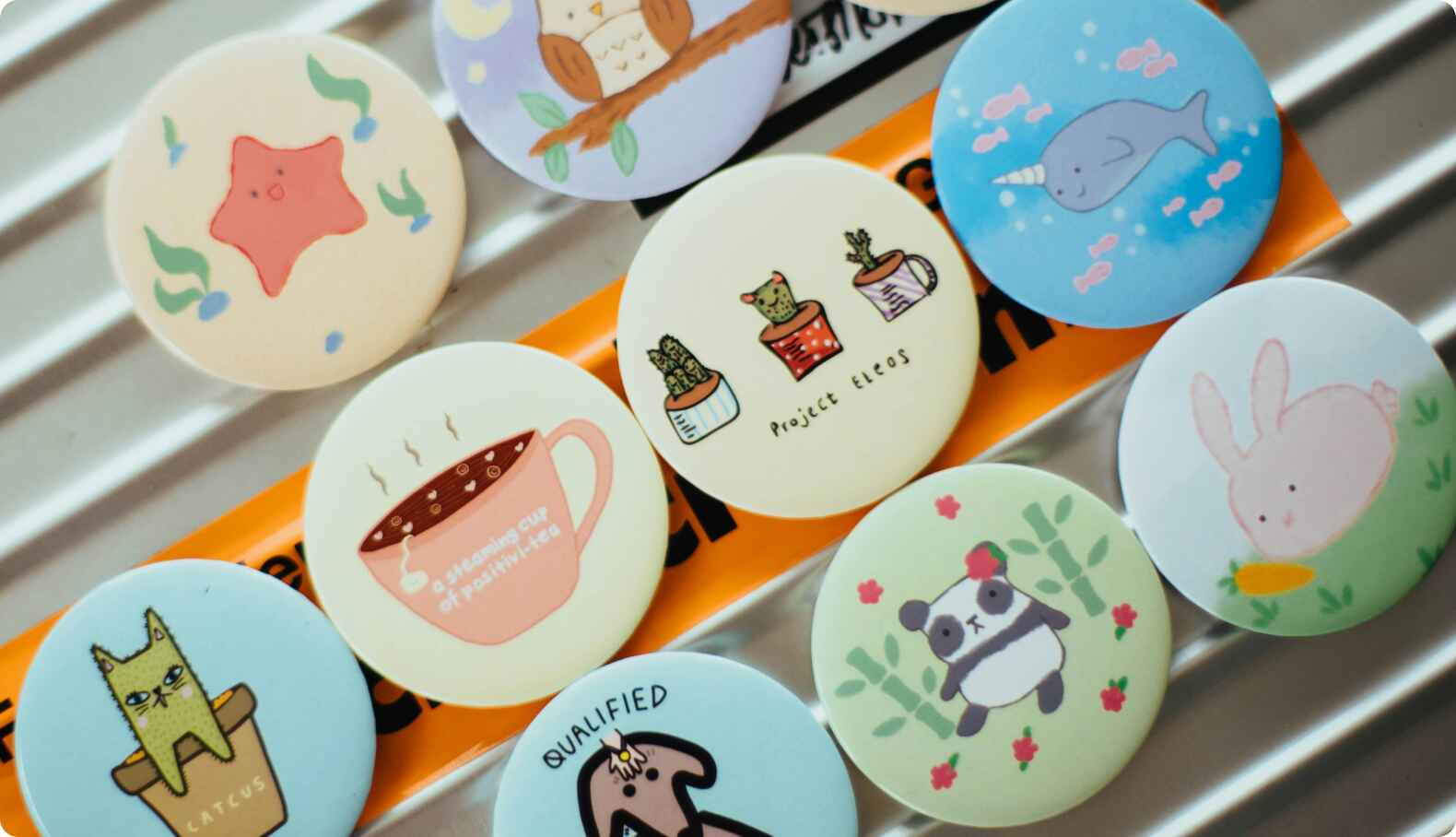
If your enamel pins are targeted at children or marketed as part of a toy or play set, they must meet toy safety regulations in both the EU and the UK.
Identify If Your Pin is a Toy:
- Does your pin feature characters, animals, or objects likely to appeal to children?
- If you intend the pin to be used in play by children under 14, it may qualify as a toy.
Add Age-Appropriate Warnings:
- If the pin is intended for children, include a clear age warning on the packaging (e.g., “Not suitable for children under 3 years”).
- If the pin is a toy, include CE marking (EU) or UKCA marking (UK) for safety.
Follow Toy Safety Standards (CE/UKCA Marking):
- CE Marking (EU): Pins considered toys must comply with the Toy Safety Directive (2009/48/EC).
This includes testing for:- Mechanical and physical safety (e.g., sharp edges, small parts),
- Chemical safety (e.g., lead, cadmium),
- Flammability.
- Compliance is demonstrated through EN 71 testing standards.
- UKCA Marking (UK): Follows the same testing requirements as CE in Great Britain.
- Northern Ireland: Still requires CE marking under the NI Protocol.
Test for Safety:
- Test for mechanical hazards (e.g., sharp points) and chemical hazards (e.g., lead, cadmium).
- Ensure no small parts pose a choking hazard.
Keep Documentation (Toy Safety):
- Maintain a Technical File containing:
- Product design and description
- Testing reports
- Manufacturing and safety details
- Declaration of Conformity (DoC)
3. Chemical Safety (REACH & RoHS Compliance)

Since enamel pins are made from metal and enamel, compliance for enamel pins must include chemical safety.
Use Non-Toxic Materials:
- Metals should be lead-free and cadmium-free.
- Enamel paints must not contain hazardous chemicals such as phthalates, lead, or cadmium.
Check for Nickel Release:
- Nickel plating is common in enamel pins, but it can trigger allergies.
- If your pins contain nickel, test for nickel release, ensuring they do not exceed 0.5 µg/cm²/week, per EN 1811 standard.
Clarification:
- RoHS (Restriction of Hazardous Substances) applies primarily to electronic and electrical equipment. If your pins do not contain electronics (e.g., LED lights), RoHS likely does not apply.
- REACH compliance remains essential for all materials used.
Obtain Supplier Certifications:
- Request REACH compliance certificates from suppliers for all materials used.
Conduct Laboratory Testing:
- Send your pins for third-party lab testing (e.g., for lead, cadmium, nickel).
Maintain Chemical Safety Documentation:
- Keep certificates, material data sheets, and lab reports for auditing and customs clearance.
4. Nickel Release and Allergy Concerns
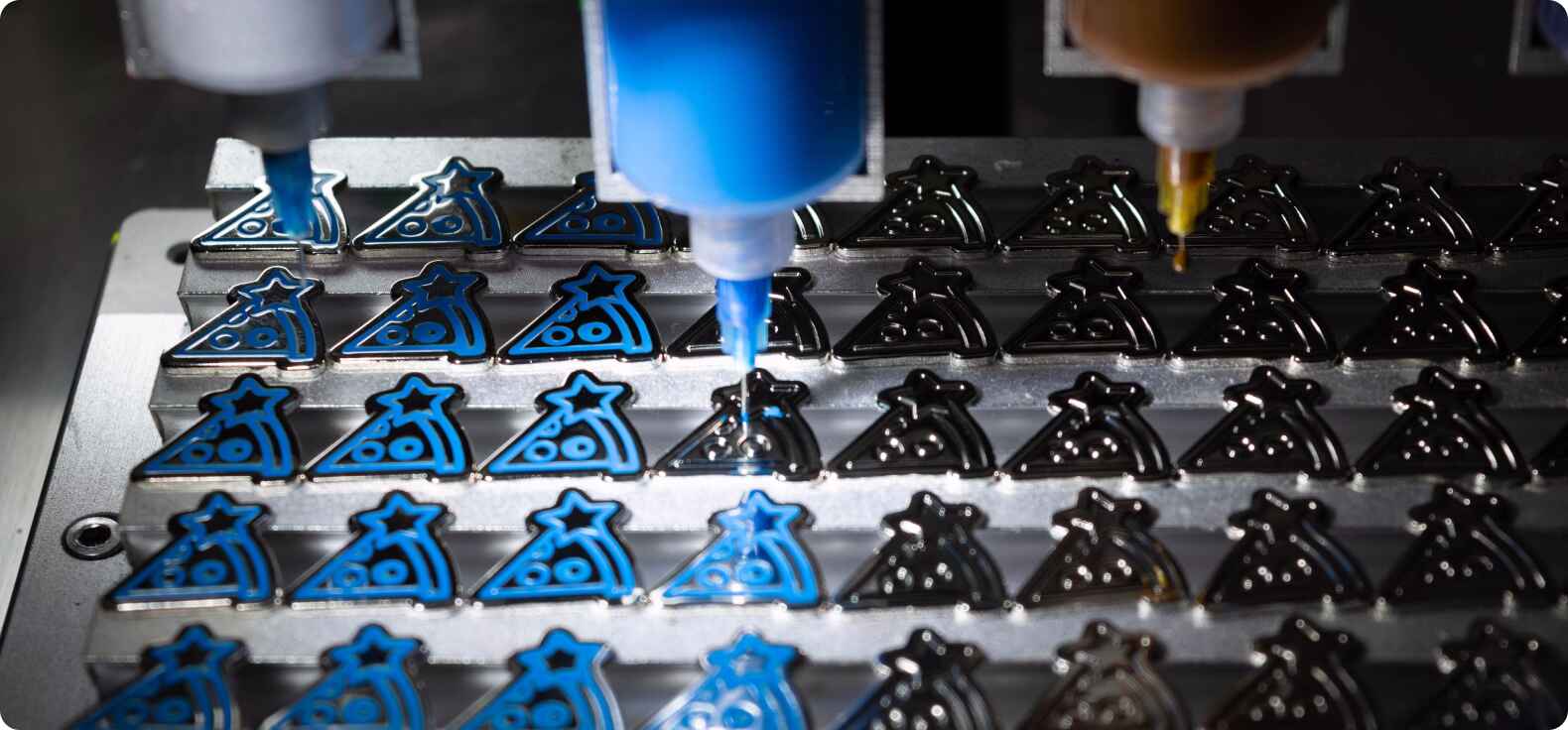
Nickel allergies are common, and safety regulations for enamel pins require proper precautions. Pins that come into direct contact with skin must comply with EU REACH Annex XVII rules.
Choose Nickel-Free Materials (or Limited Nickel Use):
- Use hypoallergenic plating or consider nickel-free materials such as stainless steel.
Test for Nickel Release:
- Confirm compliance with nickel release limits using EN 1811 lab testing.
Offer Allergy-Friendly Alternatives:
- Label hypoallergenic products clearly (e.g., “Nickel-free”).
Include Allergy Warnings (If Applicable):
- “Contains nickel – may cause allergic reactions for sensitive individuals.”
5. Labelling and Documentation Requirements
Proper labelling is critical for compliance for enamel pins in both markets.
Product Labelling:
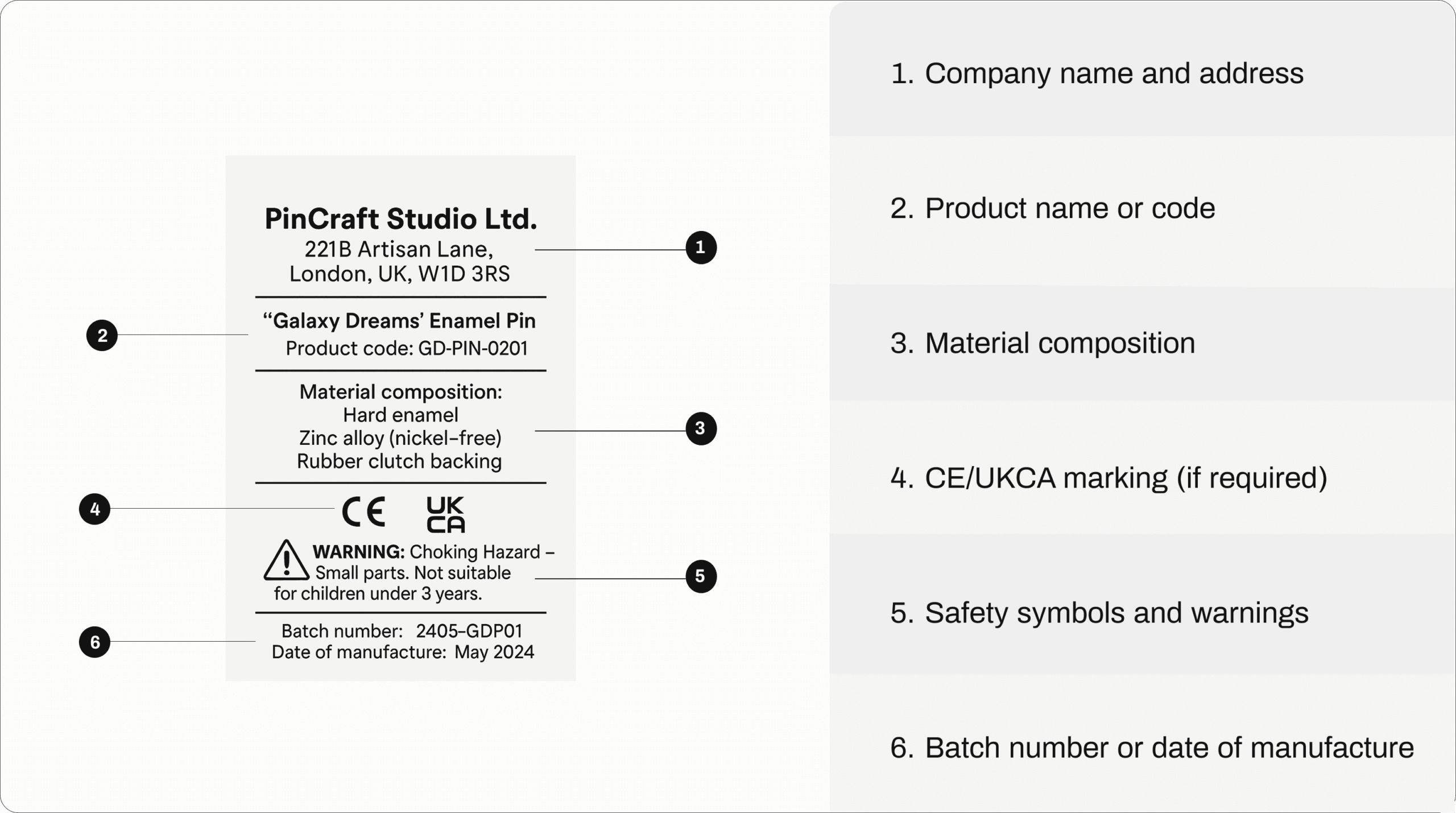
- Include business name, address, and contact information.
- Add product identifier (e.g., model name, SKU, or batch number).
Safety Warnings and Instructions:
- Add age warnings and caution messages for small parts or sharp points.
- Include care instructions if relevant.
Language Requirements:
- Labels and safety instructions must be in the official language of each country where the product is sold (e.g., French in France, German in Germany).
Regulatory Markings (If Applicable):
- CE or UKCA mark for toys or electronic pins.
- Nickel warning or test certification if relevant.
Maintain Documentation:
- Compliance file should include:
- Testing reports (e.g., for REACH, EN 71)
- Supplier certificates
- Technical file (for toys)
- Sales and distribution records for traceability
Example of Correct Labelling for Enamel Pins
6. CE or UKCA Marking: When is it Required?
CE or UKCA marking is only needed in certain cases.
Is the Pin a Toy?
- Yes. CE/UKCA marking required.
Is the Pin a Novelty with Electronics?
- If the pin includes LEDs or circuitry, it may fall under the Low Voltage Directive (LVD) or EMC Directive, and need CE/UKCA marking.
Is the Pin a General Fashion Accessory?
- No CE or UKCA marking needed for purely decorative pins for older teens or adults.
7. Do You Need an Authorised Representative to Sell Enamel Pins?

Depending on where your business is based and how your enamel pins are classified, you might need to appoint an Authorised Representative (AR) to sell in the EU or UK.
You’ll need an AR if:
- Your business isn’t based in the EU or UK.
- Your enamel pins fall under specific rules that require CE or UKCA marking. For example:
- If your pins are considered toys or marketed to children
- If they include electronics like LED lights
In these cases, an Authorised Representative acts as your official contact in the region. They hold your technical files, help with compliance checks, and communicate with local authorities if needed.
You probably don’t need an AR if:
- Your pins are fashion accessories or collectibles for adults
- They’re not toys and don’t contain electronics
- You’re not using CE or UKCA marking
- You only need to meet general product safety laws (like the EU GPSR or UK General Product Safety Regulations)
Even without an AR, full compliance for enamel pins still includes meeting safety standards, correct labelling, and maintaining traceability.
Final Tips for Compliance for Enamel Pins
If you’re selling enamel pins in the EU or UK, staying up to date with product safety laws like the new EU GPSR regulation is essential. If you’re unsure about the process of compliance for enamel pins, Euverify is here to help. With expert advice, tailored consultations, and trusted testing services, we’ll make sure your pins meet all the safety regulations for enamel pins, giving you the confidence to grow your business across new markets.