
EU Toy Safety: How to Classify Products for Under and Over 36 Months
Age grading a toy sounds like the easy part of EU compliance. It isn’t.
The 36-month (3-year) threshold is one of the most frequently misapplied distinctions in EU toy regulation. It determines not just how a product is labelled, but how it is designed, tested, and certified. Get it wrong and you are not looking at a minor correction. You are looking at a product that should never have reached the shelf.
Why EU Toy Safety Law Treats 36 Months as a Hard Legal Boundary
EU toy safety legislation, starting with Directive 88/378/EEC and now the current Toy Safety Directive 2009/48/EC, treats children under 36 months as a separate category altogether. The reasoning is practical: this age group has limited physical and mental development, and they put things in their mouths. A lot.
The 2009 Directive is currently being replaced by a new Toy Safety Regulation. The core rules around the 36-month threshold are expected to stay largely the same, but it’s worth keeping across the final text as it comes through.
Either way, the requirements that apply to toys for this age group are among the tightest in the regulation. Component parts and detachable elements can’t be small enough to swallow or inhale. The mechanical, physical, chemical, and flammability standards are all more demanding. This isn’t just about putting a warning on the box.
The problem is that the Directive tells you what the classification means but doesn’t always tell you how to make the call. For straightforward products that’s fine. For anything near the boundary, it leaves a lot of room for inconsistency, and that’s where the mistakes happen.
EU Commission Guidance on Toy Age Classification: What It Says and Why It Matters
To fill that gap, the European Commission published Guidance Document No. 11 through the Expert Group on Toys Safety. It focuses specifically on three product categories where classification disputes came up most often: puzzles, dolls, and soft and stuffed toys.
Four factors shape that assessment:
- The under-three’s psychological need to cuddle and nurture
- Their attraction to objects that resemble themselves, babies, or small animals
- Their stage of mental development, including limited patience and concrete thinking
- Their physical capabilities, such as developing grip, coordination, and dexterity
How EU Toy Safety Rules Classify Puzzles, Dolls and Soft Toys by Age
Puzzles
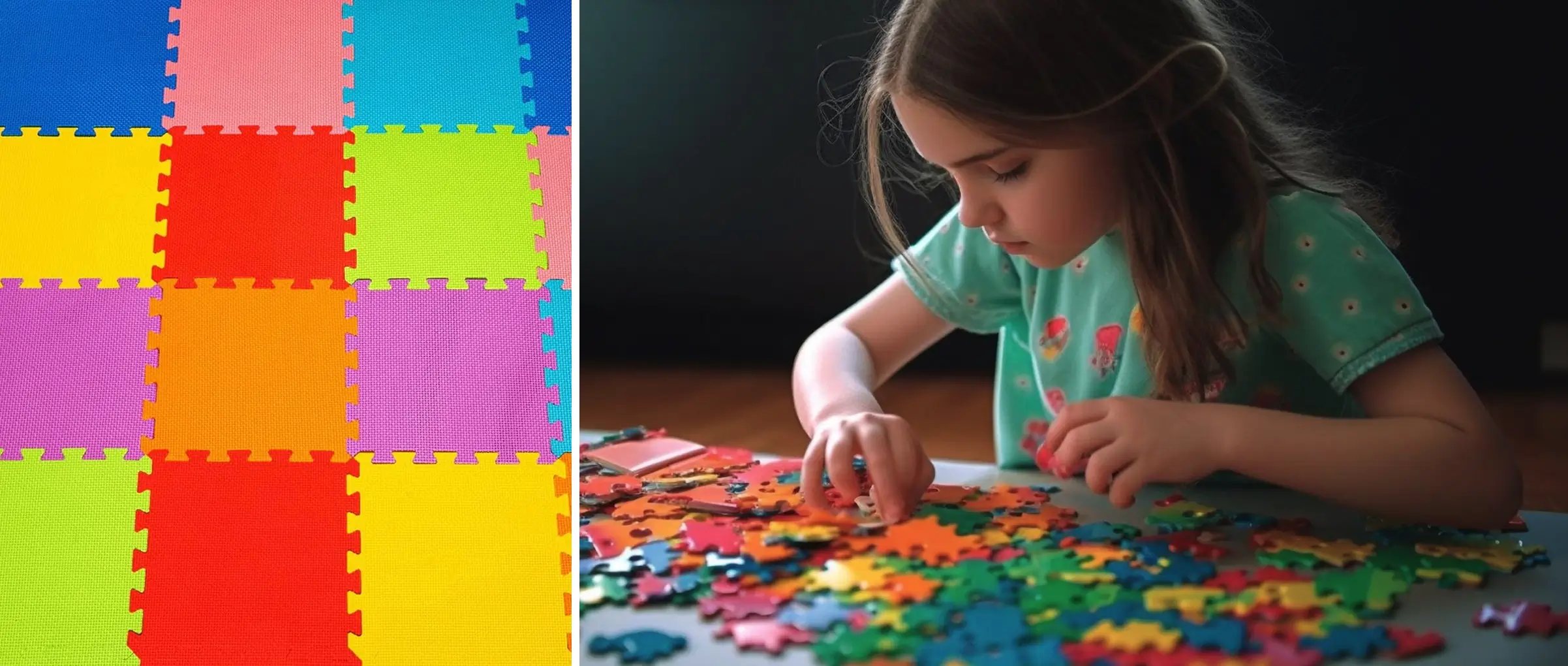
Foam floor puzzles are probably the easiest category to work with. If the pieces are interchangeable, meaning they’re the same shape with identical indents and can be connected in any order, the product is for under-threes. It doesn’t matter how big or small the individual pieces are. The child doesn’t need to figure anything out. They just click pieces together.
As soon as a puzzle requires pieces to fit together in one specific way to make a particular shape, it moves into the over-36 category. Hopscotch games work the same way. The tiles only go in a fixed sequence, and the game requires hopping on one leg, which is physically beyond what most children under three can do.
For wooden and plastic tray puzzles, under-36 classification works when the puzzle has large, easy-to-grab pieces, one piece per hole, and a simple visual match to complete. You’d be surprised how many clock and number puzzles qualify here. Successfully completing one doesn’t actually require knowing how to tell the time or count. The child is just matching shapes.
Where puzzles tip into over-36 territory is when they involve a complex subject, many small pieces, and combinations that are genuinely hard to reconstruct once the pieces get mixed up. No guiding image, non-interchangeable pieces, and real difficulty are the markers.
Dolls
Dolls work on a different logic entirely. The key question is whether the child will identify with the doll as something to nurture, like a baby or younger sibling, or whether it’s an aspirational figure for a different kind of play. That distinction does a lot of work in this category.
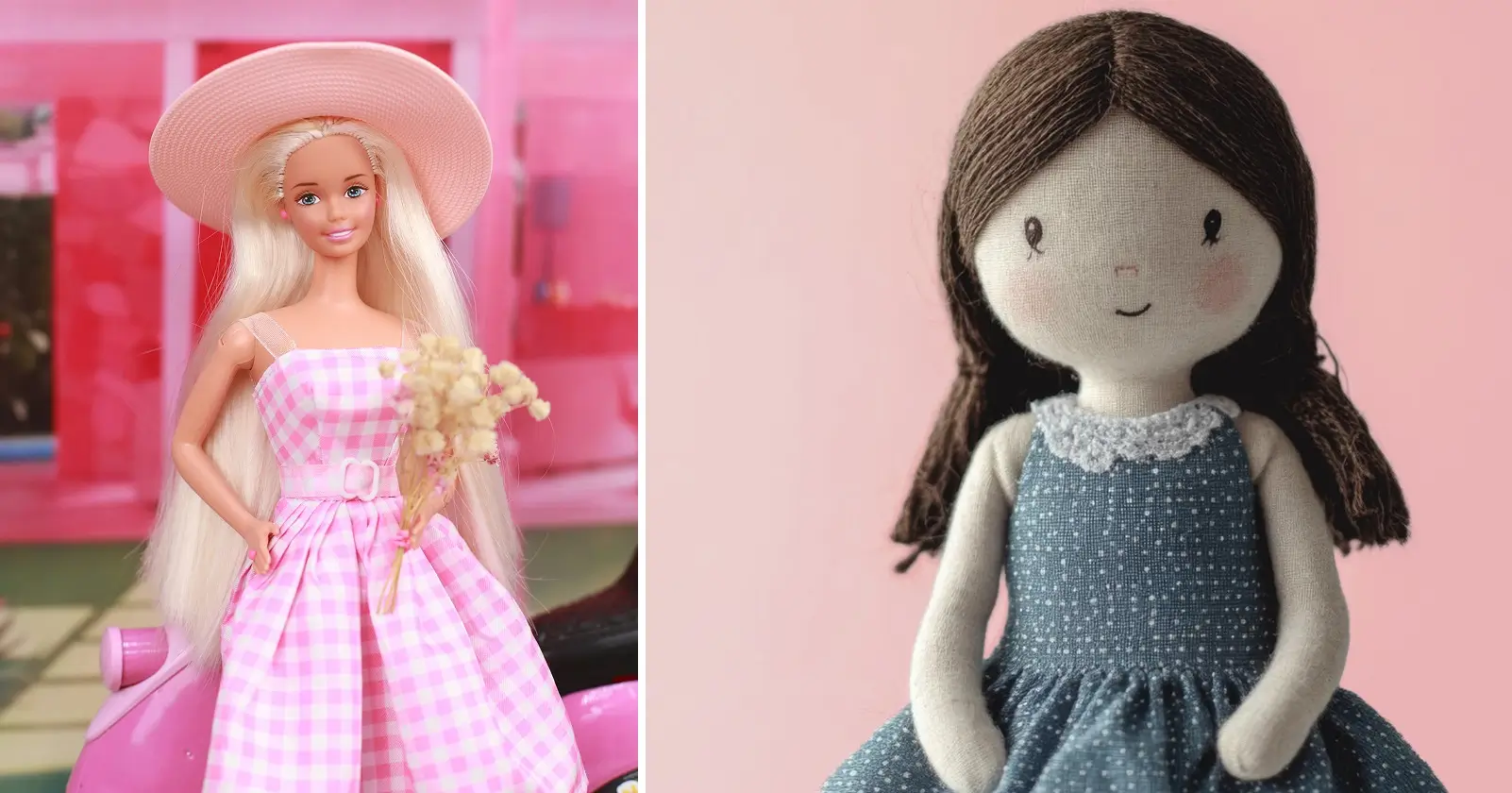
Rag dolls made entirely from padded fabric are under-36. Dolls with padded fabric bodies and rubber or PVC heads and limbs are also under-36, as long as the design is simple and any actions are basic. Pulling a cord to make it cry, pressing a button, that sort of thing. Nothing that requires coordination or sustained attention.
Where it gets more nuanced is with accessories. The doll itself might be perfectly suitable for a two-year-old, but if the box includes shoes with laces, a small scooter, or clothes that need buttoning, the whole product shifts to over-36. It’s the package that gets classified, not just the doll inside it.
Note: Fashion dolls, including anything designed to look like a teenager or adult and intended for play around appearance and aspiration, are over-36. That’s true regardless of how soft the doll feels.

Soft and Stuffed Toys
This is the most straightforward category. The guidance is pretty clear that almost all soft toys should be treated as suitable for children under 36 months. The exceptions exist but they’re genuinely rare.
Stuffed animals, musical soft toys, door decorations, animal-shaped cushions, pyjama cases, sleeping bags in animal shapes, hot-water bottle covers and even wheeled suitcases with a removable soft toy attached all qualify as under-36. The list is broader than most people expect.
Even things that aren’t obviously toys, like animal-shaped backpacks and purses, fall into the under-36 category. The guidance does flag the choking risk from cords and straps on these products, but that’s a reason to address the safety engineering, not a reason to reclassify the product as over-36.
The exception is when extra features are added that get in the way of the core cuddling function. Hard components, complex mechanisms, or accessories that change how the child fundamentally interacts with the toy can push it into the over-36 bracket.
Note: Soft toys sold purely for decoration, Christmas ornaments, table centrepieces, objects that incorporate a soft toy into a photo frame, sit outside the Directive entirely. They’re not toys, so they don’t need toy classification at all.
Quick Reference: Classification at a Glance
Here’s a quick summary of how the three categories break down across the guidance document.
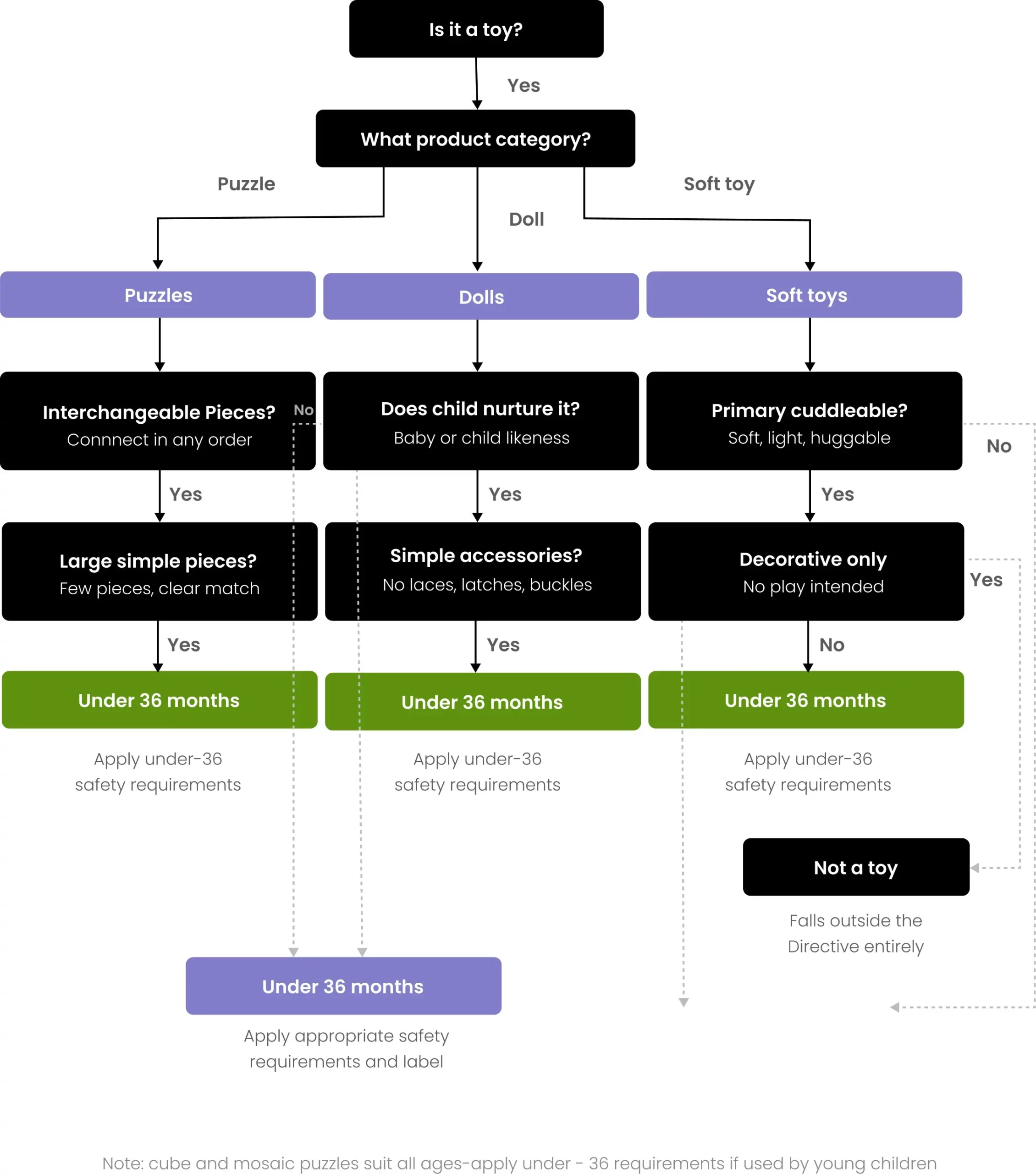
Note: This chart is a general guide. Borderline products should be assessed against the full criteria in EU Commission Guidance Document No. 11.
EU Toy Age Classification at a Glance
Toy Category | Likely Under 3 Years | Likely Over 3 Years |
Puzzles | Foam floor mats (interchangeable pieces), simple wooden peg puzzles, large-piece tray puzzles | Complex jigsaw puzzles, hopscotch tiles, 3D puzzles, multi-piece geometric sets |
Dolls | Padded fabric rag dolls, soft baby dolls with rubber/PVC heads, simple button/cord actions | Fashion dolls (e.g. Barbie), fully rigid dolls, dolls with complex accessories |
Soft & Stuffed Toys | Almost all stuffed animals, backpacks, purses, cushions, sleeping bags in animal shapes | Soft toys with complex additional features that prevent easy cuddling |
Note: some products such as cube and mosaic puzzles suit all ages. If a toy is used by under-threes as well as older children, apply the under-36 requirements.
Three Toy Age Classification Mistakes That Create Compliance Risk
1. Using safety risk as a proxy for age classification
This is probably the most common one. A product has small parts, so it gets classified as over-36. Job done. Except that’s not how it works. The guidance is explicit: the presence of parts that could be swallowed or inhaled doesn’t automatically put a toy in the over-36 category. Age classification and safety risk assessment are separate questions that need separate answers.
A toy can be genuinely intended for under-threes and still require careful engineering to make it safe for that age group. Conflating the two either restricts products that are right for young children, or lets manufacturers skip the more rigorous safety requirements by misclassifying something as over-36 to avoid the extra work. Neither outcome is good.
2. Using the warning label to solve a classification problem
Sticking a ‘Not suitable for children under 36 months’ warning on a product doesn’t settle the question of whether it should actually be classified that way. The guidance is specific on this: you can’t use the warning label to avoid the cost of additional testing or redesign. If a toy genuinely meets the criteria for the under-36 category but has safety issues for that age group, the answer is to fix the product. The label is there to inform, not to paper over a compliance gap.
3. Treating the classification as a binary fixed point
Some products genuinely work for a wide age range and get used in different ways at different ages. Cube and mosaic puzzles are a good example in the guidance. A two-year-old will stack them or push them around. A five-year-old will try to recreate patterns. The toy is the same; the play is different.
For these products, the right question isn’t ‘which age is this for’ but ‘is it safe for the youngest person who’ll use it.’ If the answer is yes, apply the under-36 safety requirements and let the product serve both age groups. Don’t artificially push it into the over-36 bracket just because older children will also enjoy it.
EU Toy Age Grading: What Manufacturers and Importers Need to Do
If you’re manufacturing or importing toys for the EU or UK market, here’s what this actually means day to day.
- Your classification needs to be documented and defensible. If a market surveillance authority asks why a product was classified as over-36, ‘we thought it looked too complex for young children’ isn’t going to cut it. You need to show your reasoning against the criteria.
- Guidance Document No. 11 is non-binding, but it’s the most detailed official framework available for age classification. It should be referenced in your technical file.
- Accessories and packaging affect the whole product’s classification. A doll that’s fine for a two-year-old doesn’t stay fine if you put it in a box with lace-up shoes and a miniature scooter.
- When you’re genuinely unsure, default to the under-36 requirements. Getting the safety engineering right costs less than a recall, a market withdrawal, or an enforcement action.
- Under the Toy Safety Directive, the burden sits with you as the economic operator. Your classification decision needs to be one you can explain and stand behind.
Expert Support for EU Toy Safety Classification and Compliance
Toy safety classification sits at the intersection of several compliance areas. The 36-month distinction affects your chemical safety obligations, your mechanical and physical testing requirements, your labelling, and what needs to go into your technical documentation. Getting one of those wrong tends to pull the others out of alignment.
At Euverify, we work with manufacturers, importers, and EU Responsible Persons to get classification decisions right from the start and build the technical documentation to back them up. If you’re bringing a toy product to the EU or UK market and want a second set of eyes on your age classification, we’re happy to help.
Frequently Asked Questions
Yes. If you’re selling toys to customers in the EU or UK, the Toy Safety Directive applies regardless of whether you sell through a marketplace, your own website, or a physical shop. Marketplace sellers are increasingly being held to the same standards as traditional importers.
If the manufacturer is based outside the EU, the responsibility falls on the importer bringing the product into the market. If you’re buying from a supplier in China and selling into the EU, the classification decision is yours to own and document.
Not always. Age classification is primarily a design and criteria-based assessment rather than a lab test. However, once you’ve classified a toy as under 36 months, it must then pass the relevant safety tests for that category, some of which do require laboratory testing.
Yes. If the product genuinely works for a wide age range and meets the under-36 safety requirements, it can be marketed to both age groups. You don’t have to restrict it to one category.
The new Regulation is still being finalised. The core principles around the 36-month threshold are expected to carry over, but the documentation and compliance obligations for economic operators are likely to become more detailed. It’s worth monitoring the final text as it comes through.