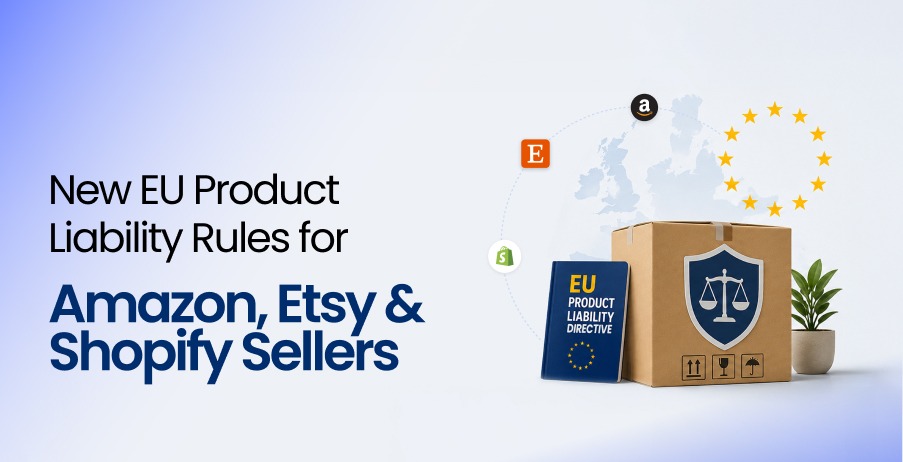

What Amazon, Etsy, and Shopify Sellers Need to Know About the New EU Product Liability
If you sell through Amazon, Etsy, or Shopify into the EU, you’ve probably assumed the platform carries the legal risk. It’s their storefront, their checkout, their name on the page. Surely liability sits with them too.
That assumption was never entirely true. For products placed on the EU market after 9 December 2026, relying on it gets expensive.
Directive (EU) 2024/2853 rewrites the EU’s product liability rules for the first time since 1985. Its main goal is to stop a situation where a defective product reaches an EU consumer and nobody established in the EU is left to answer for it. Marketplace sellers sit right in the middle of that redesign.
Here’s where different types of sellers land in the new structure, what protection your platform actually offers, and what to sort out before the December 2026 deadline.
How the New PLD Rules Reshape Product Liability for Marketplace Sellers
Under the old 1985 rules, liability sat with the manufacturer and, for products from outside the EU, with the importer. But when a non-EU brand shipped directly to EU consumers, there was often no importer at all, and injured consumers had nowhere to turn.
The new Directive closes that gap. It names six types of operator who can be held liable for a defective product: the manufacturer, the importer, the Authorised Representative, the fulfilment service provider, the distributor, and the online platform. But these six don’t all work the same way.
One important limit: only individuals can claim under the Directive. Business customers can’t use it to claim for their own losses.
The manufacturer, importer, and Authorised Representative aren’t a queue of backups waiting their turn. They can all be liable at once. If the manufacturer sits outside the EU, the importer and the AR become liable in parallel, not as substitutes who only step in if the manufacturer can’t be reached. Article 12 spells this out: when more than one operator is liable for the same harm, they can be pursued jointly and severally. The point isn’t to find whoever’s left standing. It’s to make sure someone in the EU is always reachable, and that can mean several parties at once.
The bottom three categories work differently. The fulfilment service provider is a genuine fallback: it only becomes liable if there’s no EU importer or AR at all. The distributor and the platform become liable only in one narrow circumstance, when they’re asked to name the responsible upstream party and fail to do so within a month.
So the platform sits at the end of this chain rather than outside it. Two conditions decide whether it ever actually becomes liable, and sellers have real influence over both.
Where Amazon, Etsy, and Shopify Sellers Sit in the EU Product Liability Chain
Marketplace sellers aren’t one single category here. Where you land depends on whether you’re based outside the EU, whether you’ve appointed an Authorised Representative or work with an EU importer, and how clearly your listing identifies you.
Selling Under Your Own Brand on Amazon or Etsy? EU Law Treats You as the Manufacturer
This one catches a lot of sellers off guard. Put your own name or logo on a product, and EU law treats you as its manufacturer. It doesn’t matter who actually made it.
Source from a factory outside the EU, brand it yourself, and list it on Amazon, Etsy, or Shopify: you’re the manufacturer for liability purposes, first in line if something goes wrong. This covers private label sellers, own-brand retailers, and anyone commissioning production from a third-party factory.
In practical terms, if your product harms an EU consumer, you’re the first person they can go after.
Non-EU Brands With No EU Presence: The Product Liability Gap You Need to Close
A brand based outside the EU, selling into the EU with no Authorised Representative and no EU importer, has nobody EU-established standing above the platform.
This is exactly the scenario the Directive was built for. With no manufacturer, importer, or AR reachable in the EU, responsibility falls to whichever EU-established operator does exist. Usually that’s the fulfilment provider, if there is one. If not, it’s the distributor. Ultimately, it lands on the platform.
Platforms have already reacted. Amazon requires sellers to designate an EU Responsible Person under GPSR, which has applied since December 2024, and the new Directive raises the stakes further. Expect platforms to keep tightening what they ask from sellers who don’t have an EU-established party in their setup.
How an EU Authorised Representative Affects Your Product Liability Position
Appointing an AR gives you an EU-established party that a claimant can reach, whether or not you also have an EU importer. Under the new Directive, that AR can be sued directly over a defective product, alongside you and any importer. That had no basis under the old 1985 rules.
Two things follow from this. First, an AR arrangement set up purely to satisfy GPSR labelling requirements may not go far enough to cover this new exposure. Second, your AR needs to understand exactly what they’re now exposed to, and your mandate with them needs to reflect that.
Check whether your mandate includes indemnification. If a claim is brought against your AR because of a defect in your product, who pays? Without a clear indemnification clause, that’s left to interpretation. You should also confirm your AR holds complete, current technical documentation, not just enough to pass a market surveillance check, but enough to hold up in litigation. Courts can order disclosure of the technical file, and gaps in it work against you.
Does Amazon, Etsy, or Shopify Actually Protect You From EU Product Liability Claims?
This is where sellers tend to get it wrong in both directions. Some assume the platform absorbs all the risk. Others assume it offers none at all. Neither is right.
A platform is only treated like a distributor, and only exposed to liability, when two separate conditions are both met.
The first is about presentation. If an average shopper would reasonably think, based on how the listing looks, that the platform itself (or a trader acting under its authority) is the one supplying the product, this condition is met. A listing that clearly names the seller and gives their contact details doesn’t meet this bar.
The second is about traceability. Even if the presentation condition is met, the platform escapes liability if it can name an EU-established operator within a month of being asked.
What that means for you: if your brand and contact details are clearly visible on the listing, and the platform can point to you when asked, it’s unlikely both conditions line up against the platform. But that also means the platform isn’t shielding you from anything. The claim would come to you directly instead. If your identity is buried, and the listing reads as though the platform itself is the seller, the first condition becomes easier to meet, but the platform can still sidestep liability just by naming you within that one-month window.
The takeaway: keep your brand and contact details visible on every listing. Letting the platform’s fulfilment setup or branding obscure who you are doesn’t protect you. It just shifts risk onto the platform, which usually means tighter compliance demands land back on you.
EU Product Liability and Non-EU Marketplace Sellers: The Core Problem Explained
Strip away the complexity, and the question for non-EU sellers comes down to this: if a customer in Germany or France is harmed by a defective product, who can they actually go after?
If nobody EU-established fits the bill, the Directive has a built-in answer. Liability moves down to the next EU-established party in line. Sell through an EU fulfilment centre with no AR and no importer, and that party is likely the fulfilment provider, or failing that, the platform itself.
That’s the pressure pushing platforms to tighten seller requirements. It’s also why appointing an EU Authorised Representative has become one of the more consequential compliance decisions a non-EU brand can make.
GPSR, applicable since December 2024, already requires every product sold into the EU to have a named EU-established responsible operator. Most non-EU marketplace sellers have already appointed one just to keep their listings live. What changes under the new Directive is that this same appointment now doubles as your anchor point in the liability chain. If that party is your Authorised Representative, it is now also directly in the product liability chain.
Three Non-EU Seller Setups and Your EU Product Liability Exposure

Setup 1: Non-EU brand, no AR, no importer
You’re exposed, full stop. There’s no EU-established party above the fulfilment provider in your chain. Expect platforms to flag this as a compliance issue increasingly, and possibly restrict your ability to sell. Appointing an AR is the fastest way to close this gap.
Setup 2: Non-EU brand, AR in place, no importer
Your AR is your EU-established party in the liability chain. That role carried no product liability risk under the old rules. Under the new ones, your AR can be sued directly. Check that your mandate includes indemnification terms, and that your AR holds complete, up-to-date technical documentation.
Setup 3: Non-EU brand, EU importer in place
Your importer was already liable under the old rules and remains so. If you also have an AR, both can be pursued alongside you. The new Directive widens what can be claimed: data loss, psychological harm, no financial cap, and court-ordered disclosure of evidence. So your agreement with your importer should be reviewed if it predates this framework.
EU Product Liability and Private Label Sellers: You Are the Manufacturer
Sourcing a product, branding it yourself, and selling it as your own is one of the most common models on Amazon and Etsy. It’s also the one that puts you most squarely in the firing line under the new Directive.
You’re the manufacturer, full stop, regardless of where the item was actually made or how many hands it passed through first.
A few practical implications:
Technical documentation: as manufacturer, the technical file, test reports, risk assessments, declarations of conformity, is your responsibility. Courts can compel disclosure of it under the new Directive, so a generic test report from your supplier and nothing else leaves you exposed.
Supplier agreements: if a claim lands on you and the defect traces back to the factory, your ability to claw back costs depends entirely on your contract terms. Build in an indemnification clause that pushes financial responsibility for production defects back onto the supplier. Do this for every agreement before December 2026.
Post-sale changes: software updates or modifications made after a product reaches the market extend your liability under the new rules. If you sell anything connected or software-updatable, get specific advice on how this applies to your product line.
How to Prepare for the EU Product Liability Directive Before December 2026
Whichever setup applies to you, here’s what’s worth doing now.
Establish your EU footprint. Do you have an AR, an importer, neither? That answer determines your starting point. An AR can typically be appointed within one business day through a provider like Euverify, giving you an EU-established party immediately.
Revisit your existing AR mandate. If it was drafted purely for GPSR purposes, it likely doesn’t touch product liability at all. Confirm it covers indemnification, documentation standards, and a process for handling post-sale updates, and update it if it doesn’t, before December 2026.
Put your brand front and centre on listings. Your name and contact information should be visible on every listing, on every platform. This is already required under GPSR, and it matters even more now.
Stress-test your technical file. Since courts can order disclosure, check now whether what you’re holding would actually hold up, not after a claim has already landed.
Revisit supplier agreements. Indemnification clauses, liability caps, and warranty language all need updating to reflect the new framework if your contracts predate it.
Review your product liability cover. The new Directive expands what counts as recoverable damage to include loss or corruption of data not used for professional purposes, and medically recognised psychological harm. It also removes the old €500 threshold and any national financial caps. Check whether your existing policy, if it was written before December 2026, actually reflects that.
EU Authorised Representative Services for Marketplace Sellers: How Euverify Can Help
Euverify provides EU Authorised Representative and Responsible Person services for non-EU brands selling into Europe and the UK. Your representative is appointed within one business day of signing.
We’ve prepared for the new Directive. Our updated representation agreement reflects the new liability framework. From 9 December 2026, every product we represent must be covered by product liability insurance valid in the markets where it is sold. We also check that the documentation we need to represent your product is complete and up to date. Compliance remains the manufacturer’s responsibility.
If you’re assessing your EU setup for the first time, or reviewing an existing AR arrangement ahead of December 2026, we can help identify any gaps and get the right structure in place.
Find out more about Euverify’s EU Authorised Representative services →