CE or UKCA Marking for Enamel Pins: Do You Need It?
How to Classify Enamel Pins as Toys or Fashion Accessories in the EU and UK
Enamel pins have become a staple of modern fashion, self-expression, and pop culture. Whether it’s a small business creating original art pins, or a large brand launching collectibles, these tiny accessories come with big responsibilities, especially when selling in the European Union (EU) or the United Kingdom (UK).
One of the most common questions among enamel pin sellers is:
Do enamel pins need CE or UKCA marking?
The short answer? Sometimes, but not always. It all comes down to how your enamel pin is classified. Is it considered a fashion accessory for adults, or is it seen as a toy for children? Getting this classification right is crucial, because it affects your legal responsibilities when it comes to product safety regulations.
In this guide, we’ll explain what CE and UKCA markings are, when enamel pins require them, how to determine if your enamel pin is considered a toy, what can happen if you misclassify your product, and best practices to help you stay compliant with safety regulations.
CE/UKCA Compliance for Enamel Pins: An Essential Guide
What Are CE and UKCA Markings?
CE marking is a declaration that a product sold in the EU complies with relevant European legislation. It’s mandatory for products covered by specific EU directives, such as the Toy Safety Directive, the Low Voltage Directive, or the EMC Directive. UKCA marking (UK Conformity Assessed) is the UK’s equivalent, introduced after Brexit. It serves the same purpose as CE marking but applies to products sold in Great Britain, meaning England, Scotland, and Wales. Northern Ireland continues to follow CE marking under the Northern Ireland Protocol.
CE or UKCA marking is not a blanket requirement for all products; it only applies to specific product categories defined in legislation.
So the critical question becomes:
Does your enamel pin fall into one of those categories?
Enamel Pins as Fashion Accessories (No CE or UKCA Needed)
If your enamel pin is marketed and sold primarily as a fashion item, collectible, or decorative accessory, intended for adults and teens aged 14 and over, designed without features that appeal to young children, and doesn’t include any electrical or mechanical parts, it’s likely considered a general consumer product – or a “fashion accessory.” In that case, CE or UKCA marking isn’t required. Still, you must comply with general product safety laws under the EU General Product Safety Regulation (GPSR) and, in Great Britain, the General Product Safety Regulations 2005. Northern Ireland follows the EU GPSR.
Even without CE or UKCA marking, your product must be safe for consumers. This means meeting the chemical limits in REACH Annex XVII, including cadmium in metal jewellery and brooches (0.01% by weight), lead in articles that children could put in their mouths (0.05% by weight), and nickel release for parts in prolonged contact with the skin. Your product must also be labelled with a type, batch or serial number, the manufacturer’s name, postal and email address, and any necessary safety warnings. If you are based outside the EU, you must appoint an EU-based responsible person, whose details must also appear on the product or packaging. If you sell online, this information must be shown on your product listings. You should also carry out a risk assessment and keep technical documentation. In other words, CE or UKCA may not apply, but meeting safety requirements is still essential.
When Enamel Pins Are Considered Toys (CE/UKCA Required)
Enamel pins must carry CE marking in the EU or UKCA marking in the UK if they are considered toys under the relevant toy safety regulations. According to both EU and UK definitions, a toy is any product “designed or intended, whether or not exclusively, for use in play by children under 14 years of age.” This can include enamel pins that feature child-targeted characters (like cartoon animals or kids’ TV show themes), are packaged with children’s products (such as gift sets or party bags), are sold in toy stores or listed in the toy section of websites, or are marketed specifically for children.
If your enamel pin is considered a toy, then the following applies:
- CE or UKCA marking is mandatory. You must test the pin against the EN 71 safety standards, including:
- EN 71-1: Mechanical and physical properties (e.g., small parts, sharp points)
- EN 71-2: Flammability
- EN 71-3: Chemical migration (e.g., lead, cadmium, nickel)
If your enamel pin is classified as a toy, you have specific legal responsibilities. You must draw up and keep a Declaration of Conformity and create and maintain a Technical File for at least 10 years. The CE or UKCA mark must be clearly visible on the pin itself or its packaging, and you need to include appropriate warnings, such as “Not suitable for children under 36 months” together with the age-warning symbol, where relevant. You must also carry out a safety assessment covering chemical, physical, mechanical, flammability and hygiene hazards before the product is placed on the market.
New EU Toy Safety Regulation: The Toy Safety Regulation (EU) 2025/2509 was published on 12 December 2025 and will replace the Toy Safety Directive from 1 August 2030. It introduces a Digital Product Passport (accessed via a QR code or similar data carrier), bans intentionally added PFAS and certain bisphenols, and restricts endocrine disruptors in toys. If your pins could be classed as toys, start planning for these changes now.
How to Tell if Your Enamel Pin Is a Toy
It’s not always obvious whether a pin qualifies as a toy. The classification depends on several factors and not just your intention.
Ask yourself:
- Design appeal– Does the pin look like a child’s item? Bright colors, cute faces, familiar cartoon themes?
- Marketing language– Are you calling it “great for kids” or “ideal for school bags”?
- Sales channels– Is it sold in a toy shop or a children’s clothing store?
- Packaging– Is it colourful or play-themed in a way that would attract kids?
- Use case– Is it a gift targeted at children (e.g., for birthday parties or holidays)?
If the answer to any of these is “yes,” it might be a toy in the eyes of regulators, even if you label it otherwise.
Important: Simply labelling a pin “for ages 14+” or “not a toy” does not automatically exempt it if the overall presentation suggests otherwise.
To avoid CE marking requirements, design enamel pins with neutral or adult-oriented themes, avoid marketing that targets children, and use age disclaimers when appropriate, such as “Collectible item for ages 14+.
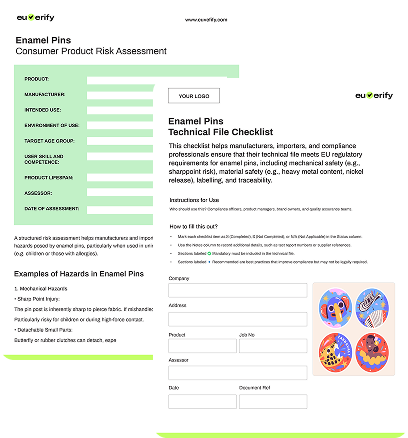
Technical Files Checklist & Risk Assessment Template
Enamel Pins
- Ensure Compliance
- Reduce Risk
- Streamline Documentation
- Supports market access
Get it now for just £40!
What About Enamel Pins with Electronics?
Some enamel pins light up, flash, or make sounds. These are electronic devices and may fall under:
- The EMC Directive (electromagnetic compatibility)
- The RoHS Directive (restriction of hazardous substances)
- The Radio Equipment Directive, if the pin uses Bluetooth, NFC or any other wireless function
- The Batteries Regulation (EU) 2023/1542, which covers battery labelling and, from February 2027, requires batteries to be removable and replaceable by the user
- The WEEE Directive, which requires producer registration and take-back arrangements (this is separate from CE marking)
Most battery-powered pins run below the voltage range of the Low Voltage Directive, so their electrical safety is covered by the GPSR instead. If the pin is also classed as a toy, the Toy Safety Directive and EN IEC 62115 (electric toys) apply.
Risks of Misclassifying Your Enamel Pin
Misclassifying your enamel pin can lead to serious consequences:
- Customs delays or product seizure if CE marking is missing when required
- Listing takedowns on platforms like Amazon or Etsy if safety documentation isn’t provided
- Fines or product recalls if regulators determine the product violates safety laws
- Loss of customer trust if safety issues occur (e.g., a child choking on a pin backing)
Example: Pins, badges and similar small metal accessories have been recalled in the EU for lead or cadmium content and choking hazards, particularly when marketed to children. You can search past recalls on the EU Safety Gate portal.
Avoid these outcomes by classifying your pin correctly and maintaining all necessary compliance documentation.
Don’t Forget Your Packaging
Since 12 August 2026, the EU Packaging and Packaging Waste Regulation (PPWR) has applied to all packaging placed on the EU market, including the backing cards, bags and boxes used for enamel pins. Check your packaging against the PPWR requirements before shipping to EU customers.
Final Thoughts
Most enamel pins are simple fashion accessories, but some can be classified as toys or even electronics. Knowing how your product fits into these categories is key to staying compliant with safety laws in the EU and UK. If your pin is designed for adults, you probably don’t need CE or UKCA marking. That said, you still have to follow chemical safety rules and general product safety regulations. If your pin is made for children or could reasonably be seen as a toy, then CE or UKCA marking is required.
It’s important to document your risk assessment, any testing you’ve done, and your labelling. If you’re not sure how your pin should be classified, it’s a good idea to talk to a enamel pins compliance expert like Euverify to help you through the process. Taking the time to get it right will protect both your business and your customers.
Want step-by-step help?
Download our full guide on EU and UK compliance for enamel pins to learn everything you need to know. It covers topics like chemical testing, toy safety, packaging, labelling, and importer responsibilities.
Appoint your EU representative and ensure compliance for your Enamel Pins
- Stay compliant with EU regulations
- Hassle-free EU representation for Enamel Pins.